Clear Sky Science · en
Uncovering the community structure and evolutionary dynamics of on-demand instant delivery networks
Why your dinner delivery reshapes the city
Every time you tap an app to get food or groceries delivered, you trigger a small flurry of movement on city streets. Multiply that by hundreds of thousands of orders a day, and on-demand delivery becomes a powerful force that can clog traffic, crowd sidewalks, and change how neighborhoods work. This study looks under the hood of one of the world’s largest instant delivery systems, in Beijing, to show how these rider flows self-organize into invisible “territories” that grow and shrink over the course of a day—and how understanding them could make cities both more efficient and more livable.
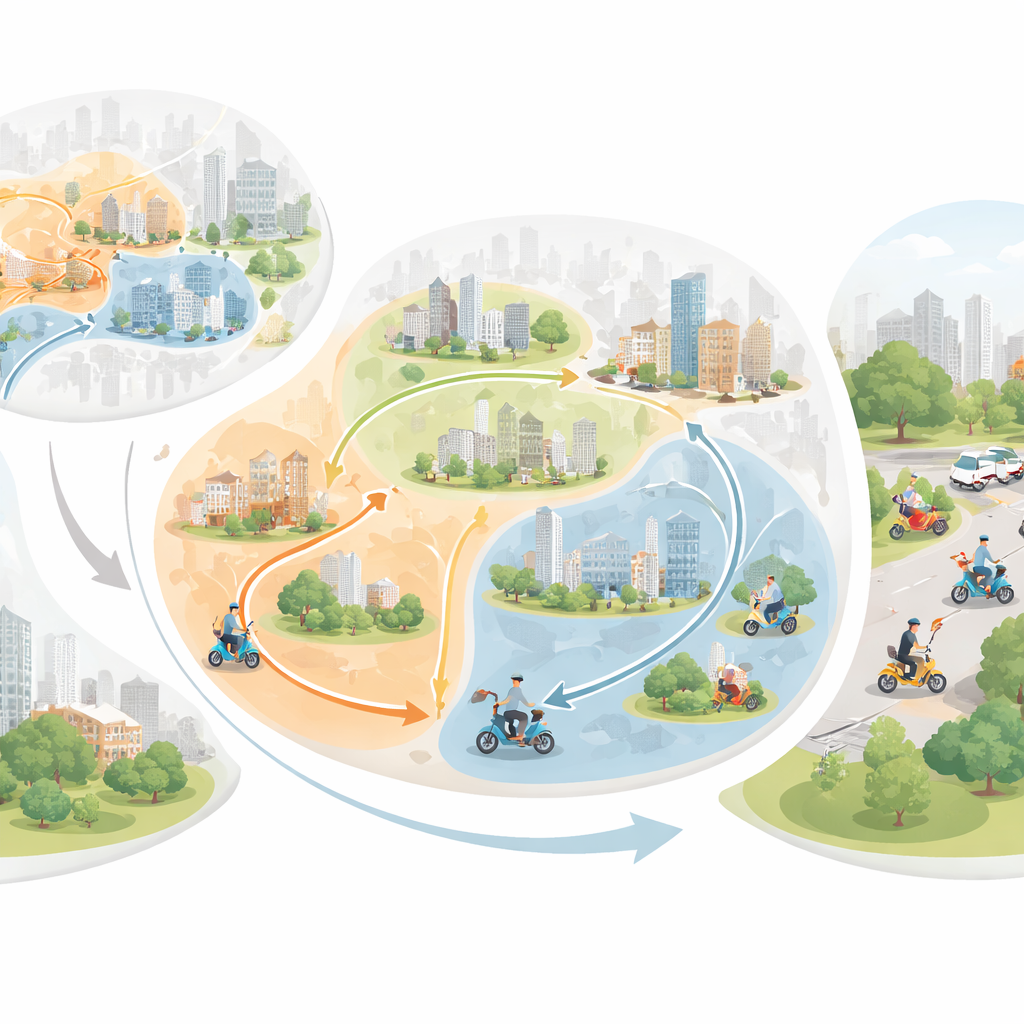
Invisible zones of app-powered movement
The researchers analyzed nearly 280,000 delivery orders from a major Chinese platform, tracking where each order started and ended, hour by hour, across a finely gridded map of Beijing. Instead of treating the city as fixed districts, they asked: which areas are tightly linked by frequent deliveries at a given moment? Using network methods, they found 160 distinct “communities” of delivery activity—compact zones only a few kilometers across, within which most riders move back and forth. These zones do not match official boundaries; rather, they emerge from the constant matching of restaurants, shops, and customers by platform algorithms.
Daily rhythms: from morning build-up to night-time fade
These delivery communities are not static. Between 7 a.m. and 11 p.m., they follow a regular daily life cycle. Only a few communities exist early in the morning, but their number and size quickly grow as breakfast and lunch orders ramp up. By late morning, most zones have appeared and expanded, then remain relatively stable through the afternoon and early evening. Around 8 p.m., as demand drops, communities begin to shrink and merge, and by late night roughly half of them have disappeared. Central business and shopping districts show dense clusters that light up strongly during peak hours, while outer suburbs host only isolated communities, often tied to a single high-demand site such as an airport area.
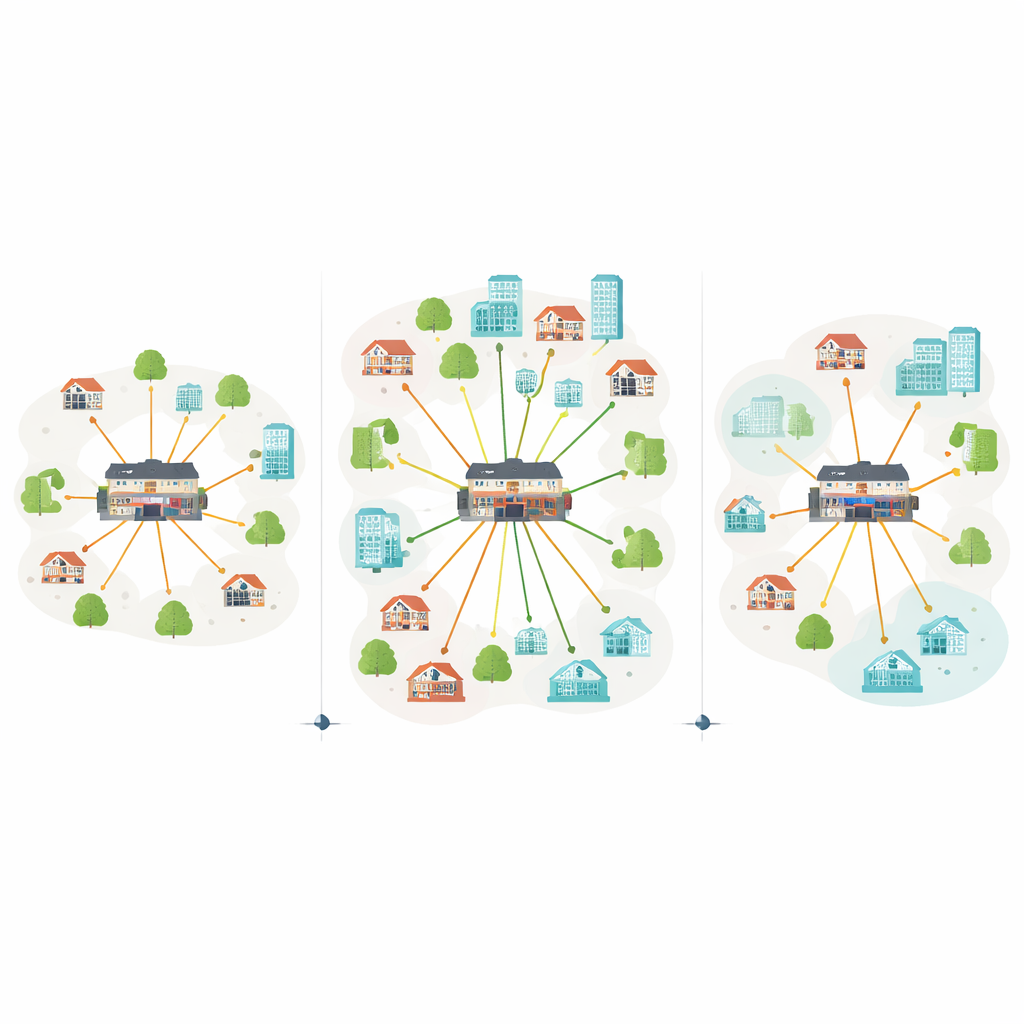
Stable cores and shifting edges
Looking closer, the team found that not all places behave the same within these communities. About three quarters of the city’s grid cells stay loyal to a single delivery community throughout the day. These stable spots tend to be anchored by strong, steady streams of orders, especially pickups from busy shops and malls. The remaining cells are far more restless: roughly 30% of locations switch between two or more communities over the course of a day, sometimes belonging to as many as ten. These “border zones” cluster in central urban areas, where human activity is dense and varied, and where delivery platforms must constantly rebalance riders across overlapping territories.
What makes a place stable—or fickle?
To explain why some locations are stable while others are fluid, the researchers combined delivery data with information on population, buildings, roads, and different types of facilities, and then trained a machine learning model. They found that strong supply—especially many pickups and large shopping malls—acts like an anchor, making a location more likely to remain in the same delivery community all day. In contrast, places with large working populations, big building footprints, or a wide mix of land uses tend to be more variable. Offices, in particular, generate bursts of daytime demand that rise and fall as workers arrive, eat, and leave, causing nearby zones to grow and then shed territory. Interestingly, this pattern differs from taxi networks, where mixed-use areas are often stabilizing rather than destabilizing.
From static rules to flexible street management
This new picture of delivery as a set of living, breathing territories has practical consequences. Today, most cities regulate curb space, loading zones, and traffic with fixed rules, even as app-based services operate minute-to-minute. By revealing when and where delivery communities emerge, stabilize, and dissolve, the study offers a data-driven way to time and place infrastructure and regulations. For example, rider parking, rest areas, and micro-hubs could be located at stable core nodes such as major malls, while curb space and fleet sizes could be adjusted in step with the predictable daily pulse of each community. In plain terms, if cities and platforms learn to “listen” to these invisible patterns, they can cut wasted trips, ease congestion, and support riders, all while preserving the convenience that on-demand delivery has woven into everyday urban life.
Citation: Zhang, C., Xiao, Z., Li, Y. et al. Uncovering the community structure and evolutionary dynamics of on-demand instant delivery networks. npj. Sustain. Mobil. Transp. 3, 26 (2026). https://doi.org/10.1038/s44333-026-00084-6
Keywords: instant delivery, urban logistics, mobility networks, dynamic communities, sustainable cities