Clear Sky Science · en
Multimodal sensing technologies for HPAI biosurveillance in poultry production systems
Why Bird Flu on Farms Matters to Everyone
Highly pathogenic avian influenza, often called HPAI or bird flu, is no longer just a problem for chickens on distant farms. Recent waves of the H5N1 strain have wiped out more than 168 million birds in the United States, pushed egg prices sharply higher, and even spilled over into dairy cattle and people. This review article explains how new “smart” sensing technologies—listening to animal sounds, sampling barn air, and running rapid genetic tests on site—could spot outbreaks earlier, protect food supplies, and reduce the risk that a dangerous flu virus adapts to spread easily among humans.
The Growing Threat on Farms and in People
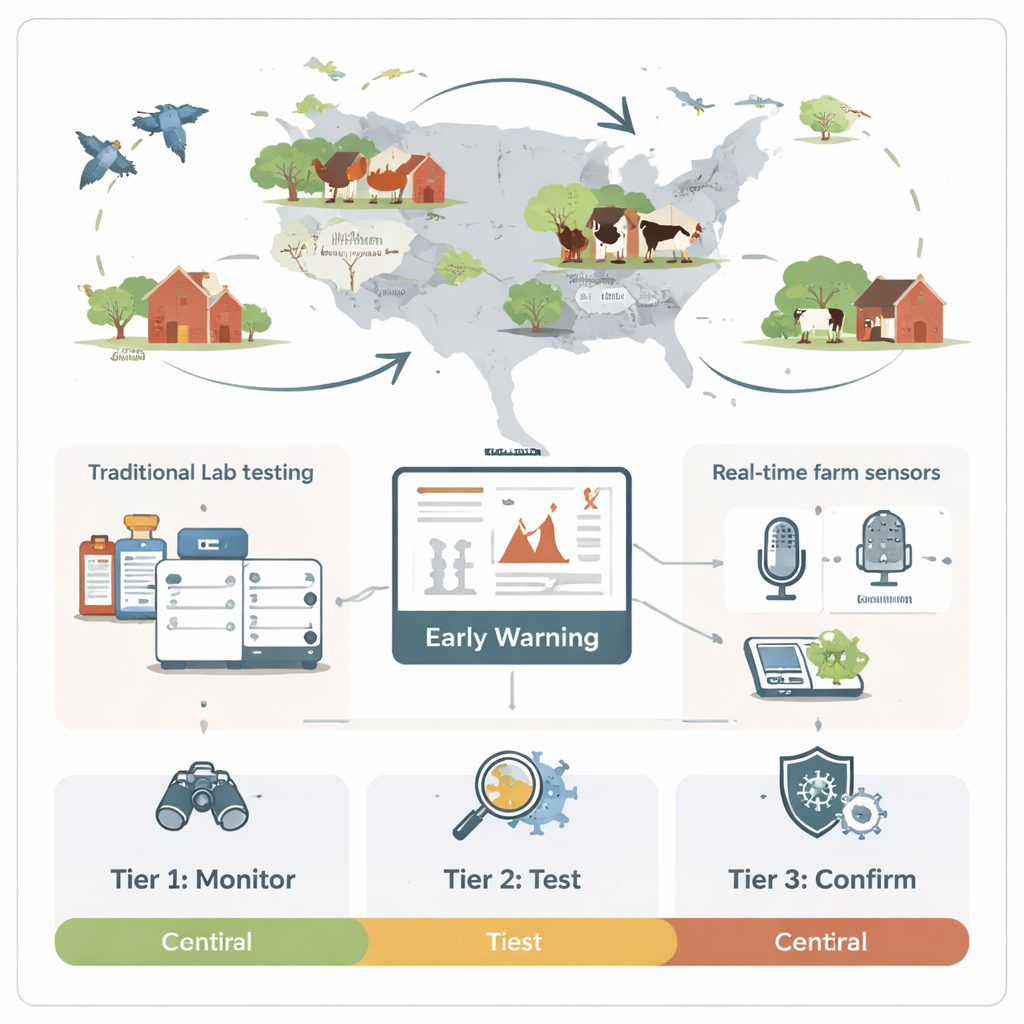
Over the past few years, a new branch of the H5N1 virus (clade 2.3.4.4b) has spread widely through U.S. poultry and, more recently, dairy herds. Each outbreak forces farmers to cull entire flocks, driving losses above 1.4 billion dollars and creating sudden drops in egg and meat supplies. At the same time, more than 70 human infections have been recorded in the United States, mostly among low-wage workers who handle infected animals and often have limited access to healthcare. Maps and surveillance data show that waves of H5N1 in birds often overlap with the usual winter spikes of seasonal flu in people, creating a shared risk landscape at the animal–human boundary. This overlap makes it especially important to track what is happening in barns and pastures as well as in clinics.
How This Virus Works and Why It Spreads So Easily
Avian influenza viruses are small, enveloped particles that carry their genetic material in eight separate RNA segments. Two surface proteins, hemagglutinin (H) and neuraminidase (N), give rise to familiar labels like H5N1 or H3N2 and determine which species the virus can infect and how severe the disease may be. Low-pathogenic strains mostly stay in a bird’s gut and airways and often cause few visible signs. In contrast, highly pathogenic strains such as today’s H5N1 have a special “cleavage site” on the H protein that lets the virus multiply throughout the body, leading to sudden death in up to 90–100% of affected birds. The segmented genome also makes it easy for influenza viruses from different hosts to swap pieces and evolve, which is why cross-species infections in cattle, cats, or wildlife are so worrisome: each new host is an opportunity for the virus to change.
Limits of Today’s Biosecurity and Testing
Poultry companies already follow strict biosecurity rules, including controlled access, disinfection, and visual health checks. Yet large HPAI outbreaks have occurred even on farms that meet these standards. One reason is speed: traditional surveillance relies on noticing sick birds, collecting swabs, and sending them to a distant laboratory for PCR testing, a process that can take two or three days. Because H5N1 can kill a flock in roughly 48 hours, this delay leaves a window for the virus to sweep through barns and spread between farms. Sampling enough birds from giant flocks is also difficult, and routine protocols rarely test dust, water, or surfaces where virus can linger unnoticed. As a result, early infections, mild cases, and low levels of contamination often slip past the defenses.
Listening, Sniffing, and Seeing: New Ways to Sense Outbreaks
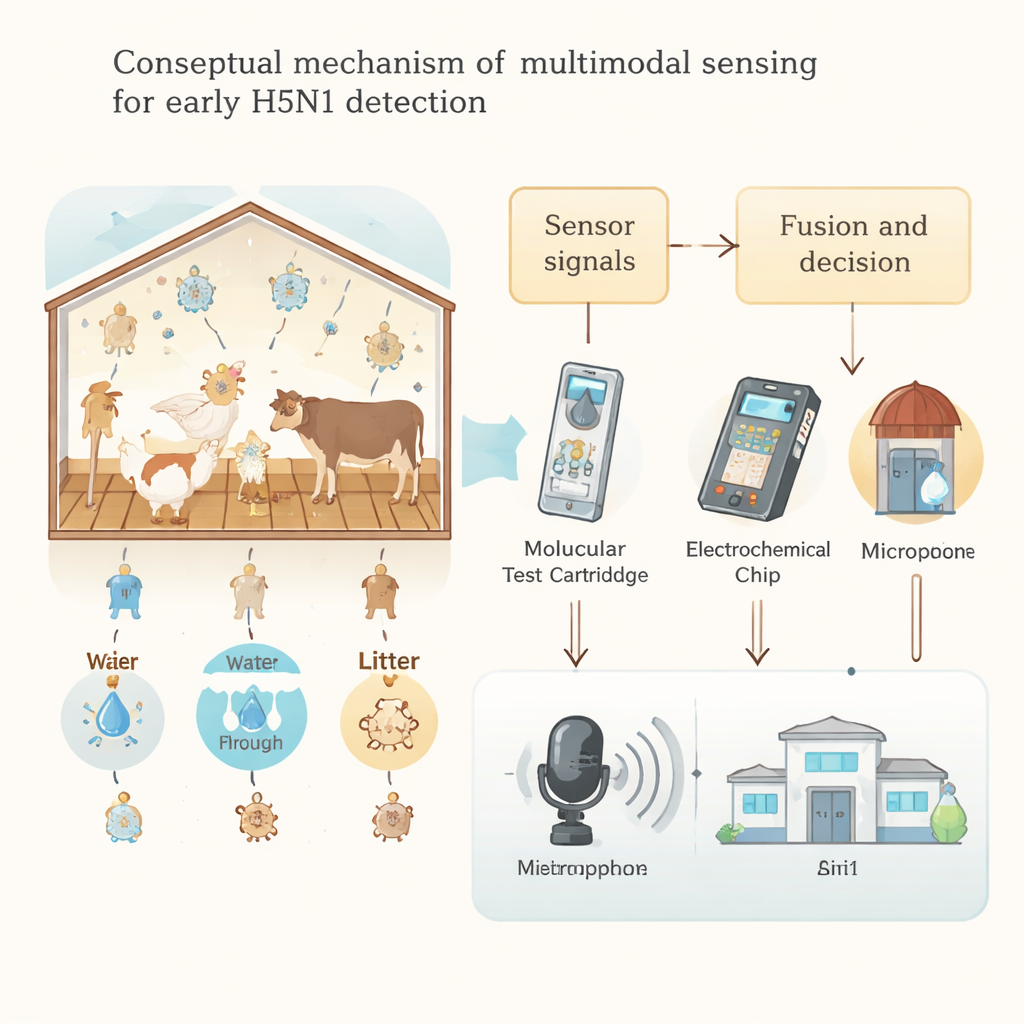
The authors argue that farms need multimodal sensing—multiple, complementary ways of watching for trouble. On the targeted side are tools that look directly for the virus or its components: portable methods that amplify viral RNA at a single temperature, programmable CRISPR-based tests that give results in under an hour, and compact electrochemical and optical biosensors that can pick up viral proteins in air, water, or swabs. On the nontargeted side are methods that look for general signs of illness without caring which microbe is responsible, such as thermal cameras that detect fever, lasers that read chemical fingerprints from barn dust, and microphone systems that learn the sound patterns of healthy and sick flocks. For example, deep-learning models can detect subtle changes in chicken vocalizations one to two days before obvious illness, while advanced light-scattering methods can distinguish virus-related molecules in aerosols mixed with ordinary barn dust.
Building a Tiered Early-Warning System
Rather than using every tool everywhere, the review proposes a three-tier system. In Tier 1, low-cost sensors run continuously in the background, listening for abnormal coughing, tracking airborne particles, or scanning dust for suspicious chemical signatures. If these broad alarms cross a threshold, Tier 2 kicks in: rapid on-farm molecular tests and biosensors check targeted samples such as air concentrates or swabs, typically within 30–60 minutes. Only when these faster screens suggest real danger does Tier 3 begin, with confirmatory lab tests like full PCR panels or virus isolation that take a day or more. This stepwise approach balances speed and reliability, reducing panic over false alarms while still gaining precious time compared with waiting for birds to die or workers to fall visibly ill.
What This Means for Food and Health Security
In plain terms, the article concludes that fighting modern bird flu requires farms to behave more like smart factories and less like isolated sheds. By combining ears (acoustic monitoring), noses (chemical and molecular sensors), and brains (data-fusion algorithms) across animal, environmental, and human health sectors, agriculture can move from reacting to disasters toward anticipating them. Earlier detection means fewer mass culls, more stable prices for eggs, meat, and milk, and lower chances that H5N1 will pick up the right mutations to start a human pandemic. There are still hurdles—technology costs, the need for worker training, and the challenge of combining noisy data from very different sensors—but multimodal sensing offers a realistic path to safer farms and stronger One Health surveillance for everyone.
Citation: Ali, M.A., Ataei Kachouei, M., Jacobs, L. et al. Multimodal sensing technologies for HPAI biosurveillance in poultry production systems. npj Biosensing 3, 11 (2026). https://doi.org/10.1038/s44328-025-00075-6
Keywords: avian influenza, biosensors, farm surveillance, CRISPR diagnostics, acoustic monitoring