Clear Sky Science · en
Impact of wear position on dosimeter performance: a hybrid measurement-simulation approach to quantify in-situ factors
Why light at your body matters to your brain
Many of us spend our days under artificial light, wearing fitness trackers or smartwatches that quietly log our activity. Increasingly, researchers also give people small light sensors to wear so they can study how everyday light affects sleep, mood, and health. But these sensors usually sit on the chest or wrist, while the organ that actually senses light for body clocks—the eye—is higher up and points in a specific direction. This study asks a deceptively simple question: how well do body‑worn light sensors stand in for the light that really reaches our eyes?
How light shapes sleep and daily rhythms
In the last two decades, scientists have discovered special light‑sensing cells in the eye that help set our internal clock, influence alertness, and even affect mood. To understand these effects in real life, they need good measurements of a person’s “personal light exposure” over days and weeks. Wearing a sensor near the eyes would be ideal, but bulky devices on glasses are uncomfortable and often rejected in daily life. So most field studies place sensors on the chest or wrist as a convenient substitute. Previous comparisons of these locations have given mixed and sometimes contradictory results, partly because they were done in different lighting conditions and with different devices. That makes it hard to say, once and for all, which wear position gives the most reliable picture of light at the eyes.
Three simple ways body position can fool a sensor
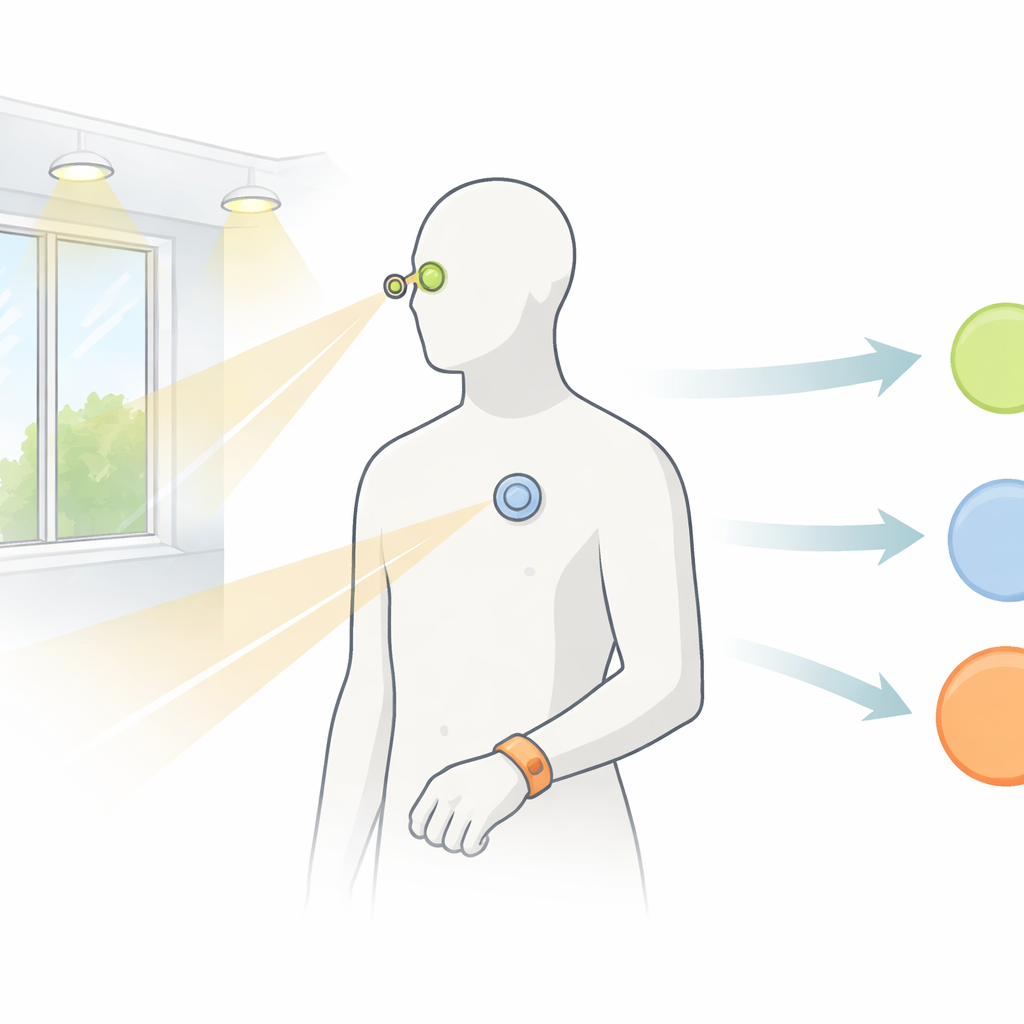
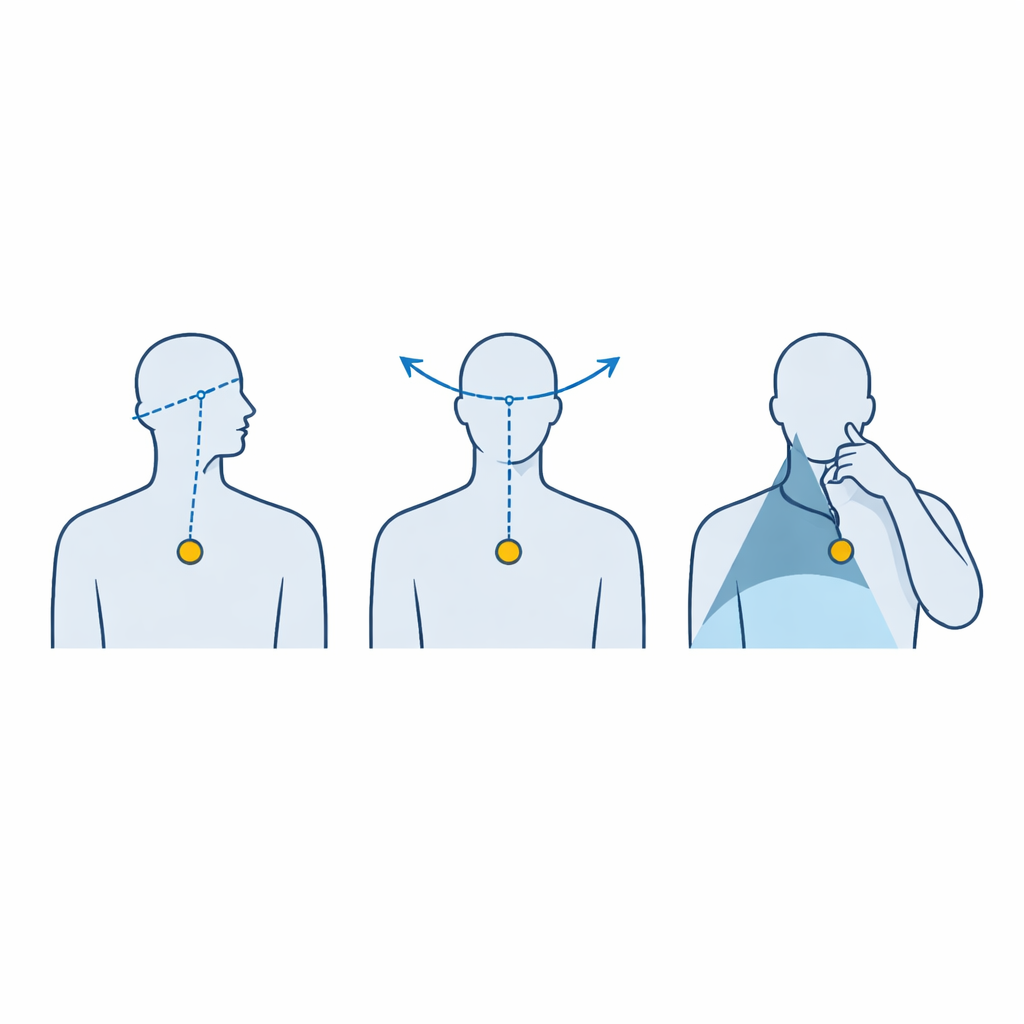
The authors break the problem down into three easy‑to‑grasp factors. First is how far the sensor is from the eyes in straight‑line distance, called translational displacement: if you move a sensor from near your eyes down to your wrist, it may end up in a very different light field, especially indoors where light can change sharply over small distances. Second is how the sensor is aimed compared with your gaze direction, called rotational displacement: your eyes usually look roughly forward, but your wrist or chest may tilt up, down, or sideways. Third is body self‑occlusion: parts of your own body—chin, arms, clothing folds—can block light from reaching the sensor. Any combination of these three effects can make readings at the body diverge from what your eyes actually see.
Scanning real bodies in 3D
To study these factors cleanly, the team built a hybrid approach that combines real measurements of body shape with detailed computer simulations of light. They used a handheld 3D scanner to capture high‑resolution models of twelve adults in three everyday postures: standing, sitting upright looking at a screen, and sitting while leaning forward to write. For each digital body, they used lighting simulation software to trace thousands of virtual rays from the eyes outwards across the upper body. This allowed them to calculate, for every point on the chest and shoulders, how far it was from the eyes, how its surface was angled relative to the viewing direction, and how much of the surrounding light it would lose because other body parts blocked its view.
Where on the chest is "good enough"?
With these maps, the researchers then asked: which parts of the chest behave most like the eyes? They defined two sets of illustrative limits on distance, angle, and blockage to mark regions that might be considered suitable for wearing a sensor. In upright postures—standing or seated while looking at a screen—a sizable portion of the chest met even fairly strict criteria, with between about one‑sixth and almost half of the chest area qualifying depending on posture. Sensors placed on the lower, central chest tended to point closest to the viewing direction, while those toward the sides or higher up were more skewed. In contrast, when people leaned forward to write, the chest turned away from the line of sight and the head and arms blocked more light; under these conditions, almost none of the chest surface satisfied even the more lenient limits.
What this means for future light‑tracking
For everyday activities where the torso and gaze are roughly aligned, such as standing or sitting upright, a carefully chosen spot on the chest can give readings that are reasonably representative of eye‑level light, and generally better than the wrist. Yet the study also shows that even small shifts in sensor position can matter, and that activities involving a downward gaze—like reading or writing at a desk—quickly reduce the reliability of chest‑worn sensors. In those situations, sensors closer to the head may be preferable. Overall, the work provides a new, visual way to judge how body shape and posture influence light measurements, helping researchers design more dependable studies of how our daily light “diet” supports healthy sleep and biological rhythms.
Citation: de Vries, S.W., Mardaljevic, J. & van Duijnhoven, J. Impact of wear position on dosimeter performance: a hybrid measurement-simulation approach to quantify in-situ factors. npj Biol Timing Sleep 3, 20 (2026). https://doi.org/10.1038/s44323-026-00079-z
Keywords: personal light exposure, wearable light sensors, circadian rhythms, sleep and light, dosimeter placement