Clear Sky Science · en
Impact of wear position on dosimeter performance: measurement validity under simulated indoor illumination
Why the Light on Your Chest Isn’t the Light in Your Eyes
Many of today’s health and sleep studies rely on tiny light sensors worn on the body to estimate how much light reaches our eyes over the day. That matters because light strongly influences our body clock, alertness, and mood. This paper asks a simple but crucial question: when we wear a light sensor on our chest, how well does it really reflect the light our eyes see in typical indoor spaces?
How Light Shapes Health and Why We Measure It
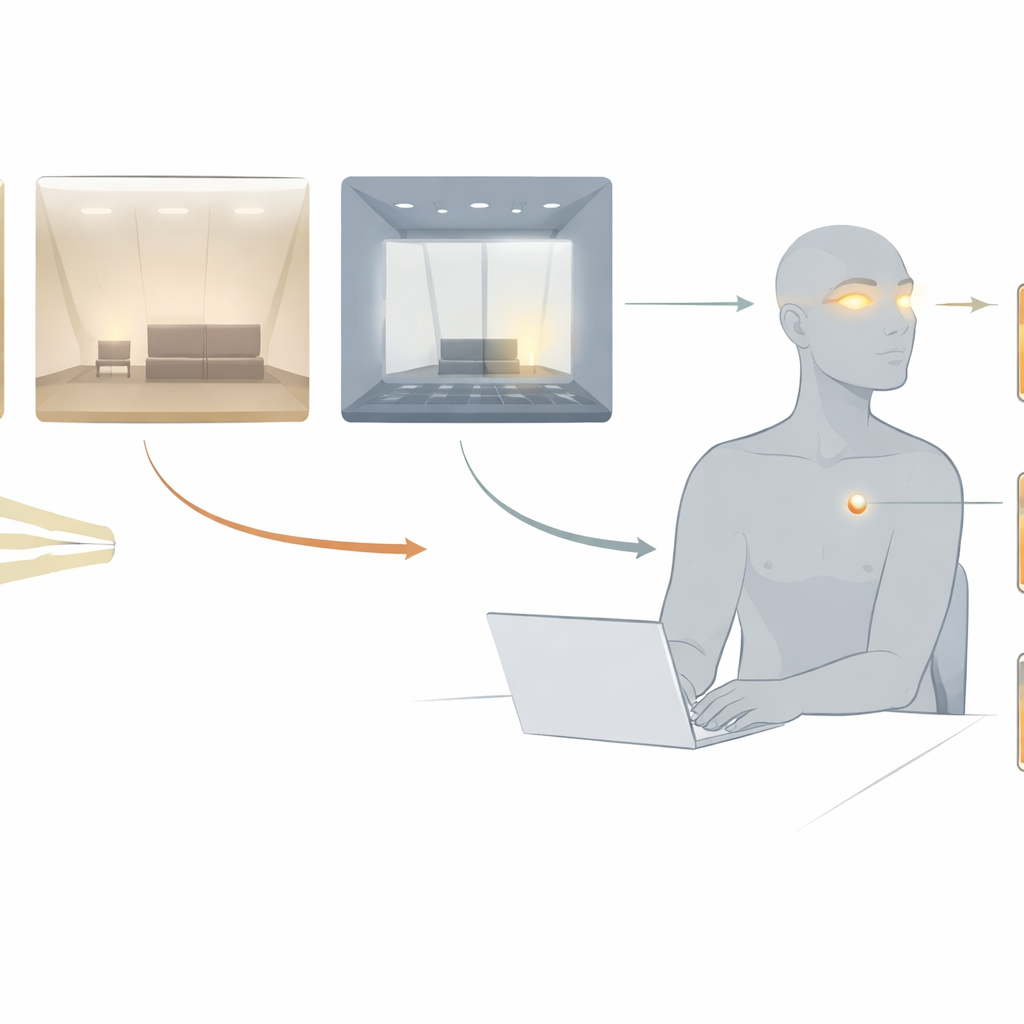
Light does far more than let us see. It helps set our internal 24-hour clock, affects how sleepy or alert we feel, and even links to mood and long-term health. To study these effects out in the real world, researchers often track “personal light exposure” using small wearable sensors, or dosimeters. In theory, the most meaningful place to measure is at the eye, because that is where light actually enters the body’s timing system. In practice, though, putting a device near the eyes can be awkward or uncomfortable, so many studies clip the sensor to the chest. Earlier field studies gave mixed answers on whether chest readings truly match eye-level light, partly because they were done in complex, changing real-world conditions.
A Virtual Laboratory of Bodies and Rooms
To untangle this problem, the researchers built a virtual testbed. They started with detailed 3D body scans of twelve people in three everyday postures: standing, sitting while looking at a screen, and sitting while writing at a desk. They placed these virtual people in a simple rectangular room and used a high‑fidelity lighting simulation tool to model three generic indoor lighting setups: soft light from the whole ceiling (diffuse top lighting), more focused downward beams from the ceiling (directional top lighting), and light from a bright vertical surface in front of the person, like a large window or screen (diffuse side lighting). For each posture and room position, they simulated light at the eyes and at four locations on the chest. This allowed them to explore how chest and eye measurements differ under controlled but realistic conditions.
Three Hidden Reasons Chest Sensors Disagree with Eyes
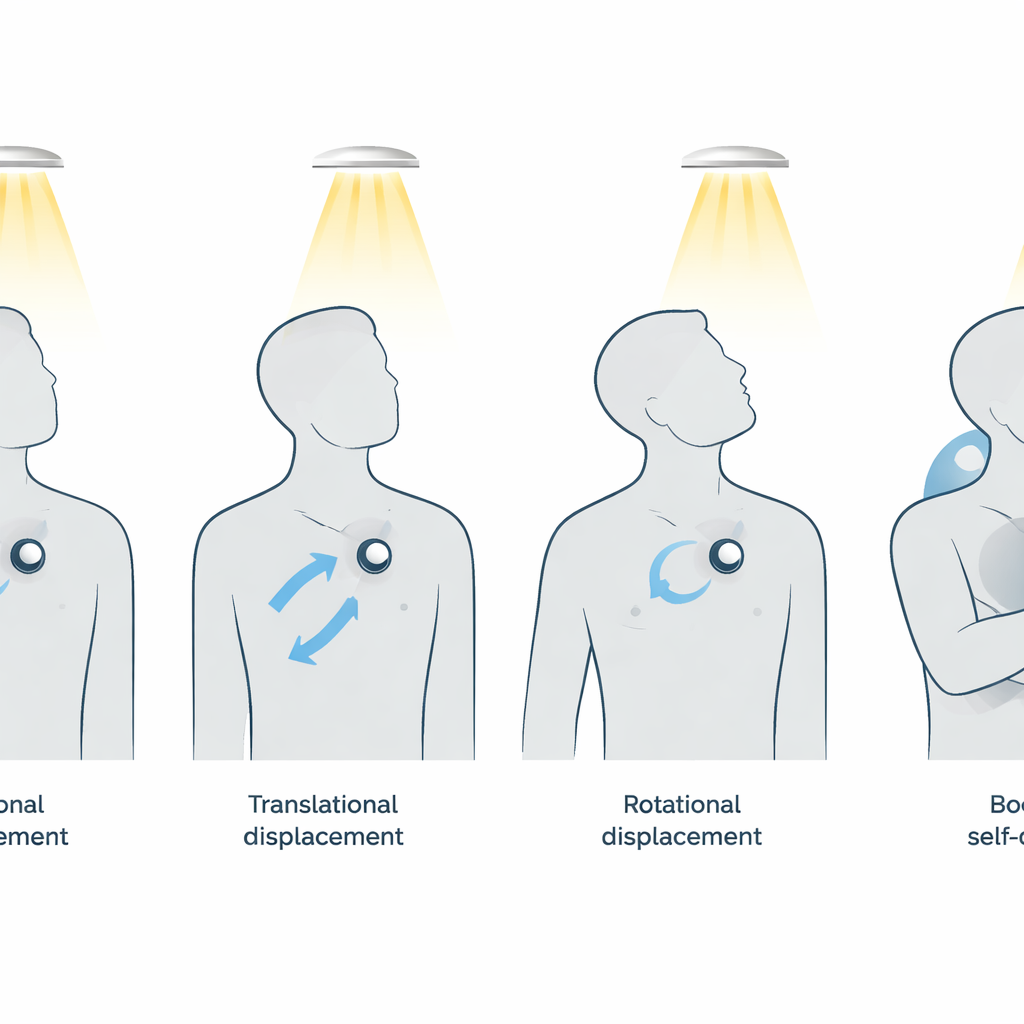
The team broke down the sources of disagreement into three simple geometric effects. First, “translational displacement” is the fact that the chest is physically farther from, or differently placed relative to, a light source than the eyes. Second, “rotational displacement” captures that a chest sensor often faces a slightly different direction than the person’s gaze—typically angled more upward toward overhead lights. Third, “body self‑occlusion” occurs when parts of the body, such as arms or the head, block light from reaching the chest sensor. By simulating each of these factors separately, the authors showed that rotational displacement is usually the largest driver of error, tending to make chest sensors read higher light levels than the eyes under overhead lighting, while translation and self‑occlusion often push readings lower.
How Big Are the Errors in Everyday Situations?
Across the three lighting types and postures, differences between chest‑worn and eye‑level measurements were often large. For sensors placed on the upper chest, average deviations ranged roughly from about 20 percent below to more than 80 percent above the true eye‑level light. Lower‑chest placements did somewhat better but still showed wide spreads. When the researchers added a realistic “field of view” mask to represent how the brow and eyelids naturally block some directions of light at the eye, differences became even bigger—especially when people were seated and looking down at a desk under side lighting, where overestimation could be several times the actual light reaching the eyes. On top of this, people differed greatly from one another: even with the same lighting and posture, some bodies and sitting styles led to much larger mismatches than others.
Practical Tips for Better Light Tracking
These findings have important consequences for studies that connect light exposure to sleep, alertness, and health. The authors conclude that there is no single fixed “correction factor” that can reliably turn chest measurements into eye‑level light, because the error depends heavily on room lighting, posture, and body shape. Instead, they argue that reducing rotational mismatch is key: wherever possible, sensors should be placed on a part of the chest whose orientation closely matches the person’s usual gaze direction during the activities of interest. If custom placement for each person is not feasible, placing the device on the lower chest appears to give the smallest overall range of error—though still with significant individual differences. For settings dominated by ceiling lights, chest sensors without any shading may systematically overestimate light at the eye, so results must be interpreted with caution or complemented with better‑placed, possibly head‑mounted, devices.
What This Means for Everyday Light and Health Research
In plain terms, this study shows that a clip‑on sensor at your chest does not necessarily see the same light your eyes do, and the gap can be sizable and highly personal. The errors grow when light comes mainly from above, when your posture bends your upper body away from your gaze direction, or when parts of your body block the sensor’s view. Carefully choosing where to wear these devices—and, in some cases, moving closer to the eyes—will make future research on light, sleep, and health more trustworthy, and help ensure that recommendations about “how much light you need” rest on solid measurements.
Citation: de Vries, S.W., Mardaljevic, J. & van Duijnhoven, J. Impact of wear position on dosimeter performance: measurement validity under simulated indoor illumination. npj Biol Timing Sleep 3, 19 (2026). https://doi.org/10.1038/s44323-026-00073-5
Keywords: personal light exposure, wearable light sensors, indoor lighting, circadian health, measurement accuracy