Clear Sky Science · en
Polarization-independent dielectric gradient near-perfect absorbers for aqueous mid-infrared molecular sensing
Seeing Molecules in Water
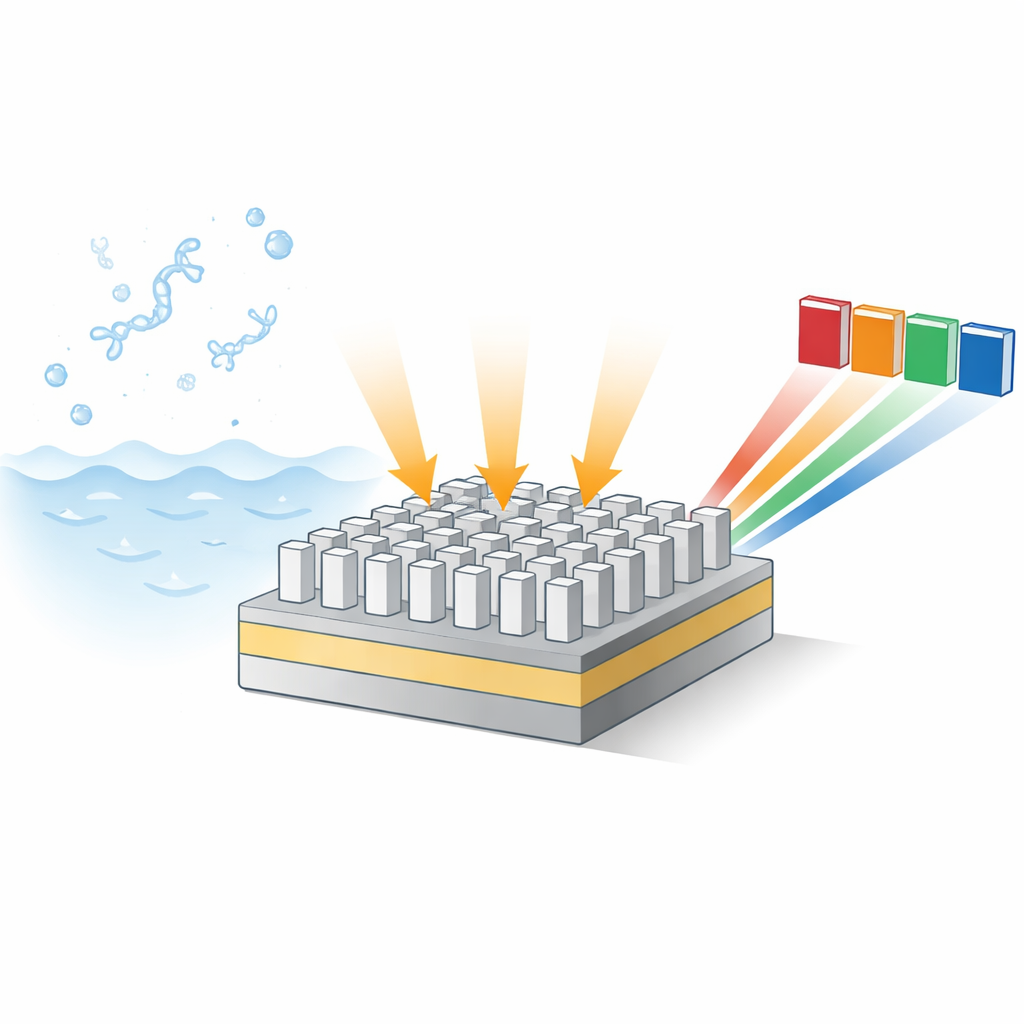
Many of life’s most important chemical reactions happen in water, but water itself is a strong absorber of mid‑infrared light—the very light scientists use to read the vibrational “fingerprints” of molecules. This paper presents a new kind of light‑trapping surface that can still pick out tiny molecular signals even when water should drown them out, opening paths toward compact, chip‑based chemical sensors for biology, medicine, and environmental analysis.
Why Mid‑Infrared Light Matters
Mid‑infrared light interacts with the natural vibrational motions of chemical bonds, giving each molecule a characteristic pattern—a bit like a barcode. In principle, shining mid‑infrared light on a sample and recording what gets absorbed can reveal which molecules are present without attaching any labels or dyes. The problem is that these wavelengths are much larger than the molecules themselves, so the interaction is weak. It becomes even harder in water, which has a broad, intense absorption band that masks the finer molecular signatures scientists want to see.
From Hot Metals to Cool Dielectrics
One strategy to overcome weak interactions is to use nano‑structured surfaces that strongly concentrate light. Metallic nanostructures can do this, but they suffer from electrical losses that broaden their optical response and convert light into unwanted heat. This makes it difficult to resolve narrow molecular fingerprints and can overheat delicate biological samples. The authors instead turn to dielectric materials—specifically silicon structures that guide and trap light without electrical loss. These structures can host very sharp optical resonances, which respond strongly to even slight changes in the molecules sitting on their surface.
A Smart Light‑Absorbing Surface
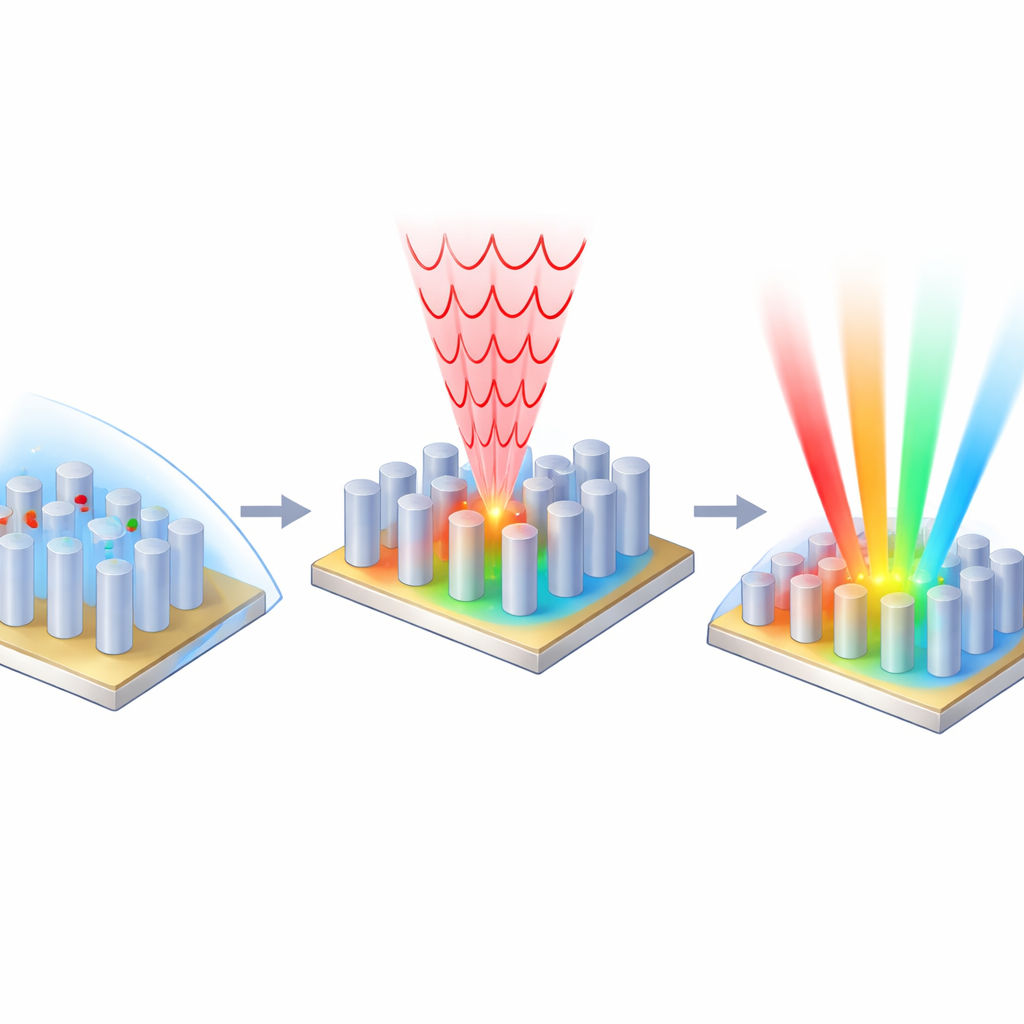
The team designed a multilayer chip consisting of a gold mirror at the bottom, a thin transparent spacer, and an array of tall silicon blocks on top. By arranging four blocks in a square pattern within each repeating cell and carefully tweaking their size and spacing, they create so‑called quasi‑bound modes that strongly trap mid‑infrared light while still allowing it to couple in and out. Two geometric “gradients” are built into the array: one controls how strongly each cell leaks light (and thus how sharp the resonance is), and the other shifts the resonance wavelength across the surface. As a result, a single compact device hosts many slightly different resonances that together cover an important band of molecular fingerprints, with each spot on the chip acting like a pixel tuned to a different color of mid‑infrared.
Working Under Any Polarization and in Air
Because the unit cell is arranged with four‑fold rotational symmetry, the resonances do not care about the direction in which the incoming light is polarized. Experiments with a mid‑infrared microscope show that, over a range of wavelengths around 1720–1800 cm⁻¹, the device absorbs up to about 80% of the incident light regardless of polarization. When the researchers coated the surface with a few‑nanometer film of a test polymer (PMMA), they observed clear changes in the overall absorption envelope centered around the polymer’s known vibrational line. By comparing this envelope to that of the bare device, they extracted a strong, roughly 20% modulation that cleanly reveals the polymer’s presence, demonstrating robust, polarization‑independent sensing in air.
Turning Water from Foe to Background
The most striking advance comes when the device is used in the presence of water. Instead of immersing the metasurface fully—which would let water’s strong absorption destroy the resonances—the authors briefly cover it with water and then allow the liquid to recede, leaving behind a thin, roughly 700‑nanometer film. In this configuration, the engineered resonances survive with about 50% absorption even near water’s own strong band. The thin film is uniform enough that the water signal itself is stable across the chip, while the polymer layer still produces a clear additional modulation of more than 30% at its vibrational frequency. This represents, to the authors’ knowledge, the first demonstration of mid‑infrared molecular sensing with a dielectric metasurface under a genuine water background.
What This Means Going Forward
In practical terms, the work shows that carefully designed dielectric metasurfaces can deliver strong, selective molecular signals even in watery environments that previously seemed off‑limits. The combination of near‑perfect absorption, polarization‑independent operation, and many distinct resonances on a single chip points toward compact, camera‑based systems that read out chemical fingerprints without bulky spectrometers. With future integration of microfluidics to stabilize the thin water layer and data‑driven analysis, such devices could evolve into versatile platforms for label‑free biochemical sensing in realistic, water‑rich settings.
Citation: Yang, X., Jiang, T., Rohrer, L. et al. Polarization-independent dielectric gradient near-perfect absorbers for aqueous mid-infrared molecular sensing. npj Nanophoton. 3, 25 (2026). https://doi.org/10.1038/s44310-026-00121-9
Keywords: mid-infrared sensing, dielectric metasurfaces, aqueous biosensing, perfect absorbers, molecular spectroscopy