Clear Sky Science · en
Emission Control of Perovskite Nanocrystals empowered by Bound States in the Continuum in Dielectric Gratings
Turning Tiny Light Sources into Smart Beams
Light from tiny crystals already powers bright screens and sensitive sensors, but it typically shines in all directions like a bare lightbulb. This study shows how to team those crystals with a carefully patterned glass chip so their glow becomes stronger, more focused, and easier to steer, opening doors for sharper displays, compact sensors, and new quantum technologies.
Why Tiny Crystals Matter
Colloidal nanocrystals are minuscule bits of semiconductor that behave like artificial atoms. They can be made in large batches, tuned to shine in different colors, and used in devices such as solar cells, cameras, and detectors. Perovskite nanocrystals are especially attractive because they glow very efficiently in bright, vivid hues. Yet in most setups, their light sprays out over many angles and is hard to control, which limits how well devices can direct or collect that light.
From Metal Tricks to Loss-Free Light Control
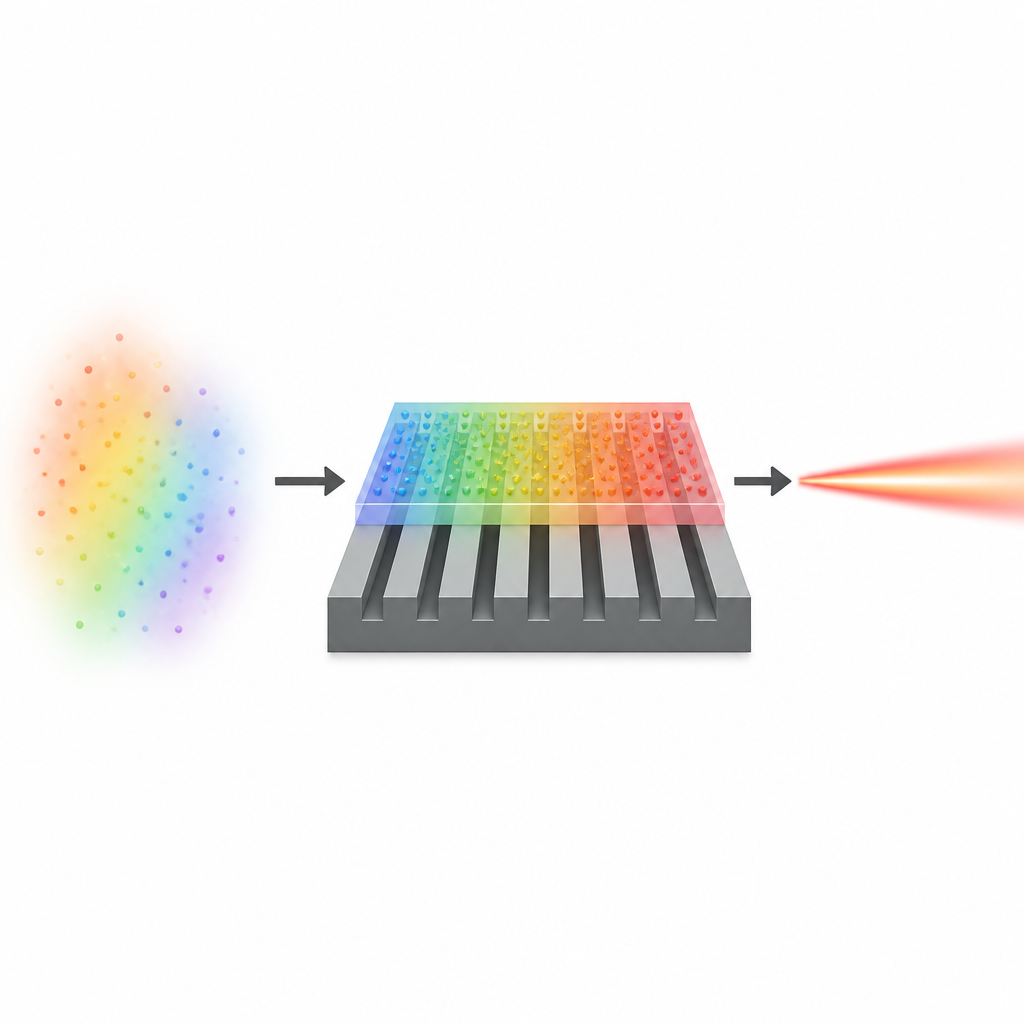
In the past, researchers often turned to tiny metal structures to boost and guide light from these emitters. While metals can concentrate light strongly, they also waste energy as heat and are not always compatible with standard chip-making methods. The team behind this paper instead uses a fully transparent, low-loss approach based on silicon bars arranged in a regular grating on glass. These bars are designed to host special optical states that trap and recycle light on the surface of the chip, allowing it to interact more strongly with the perovskite nanocrystals that coat the structure.
How the Patterned Chip Shapes the Glow
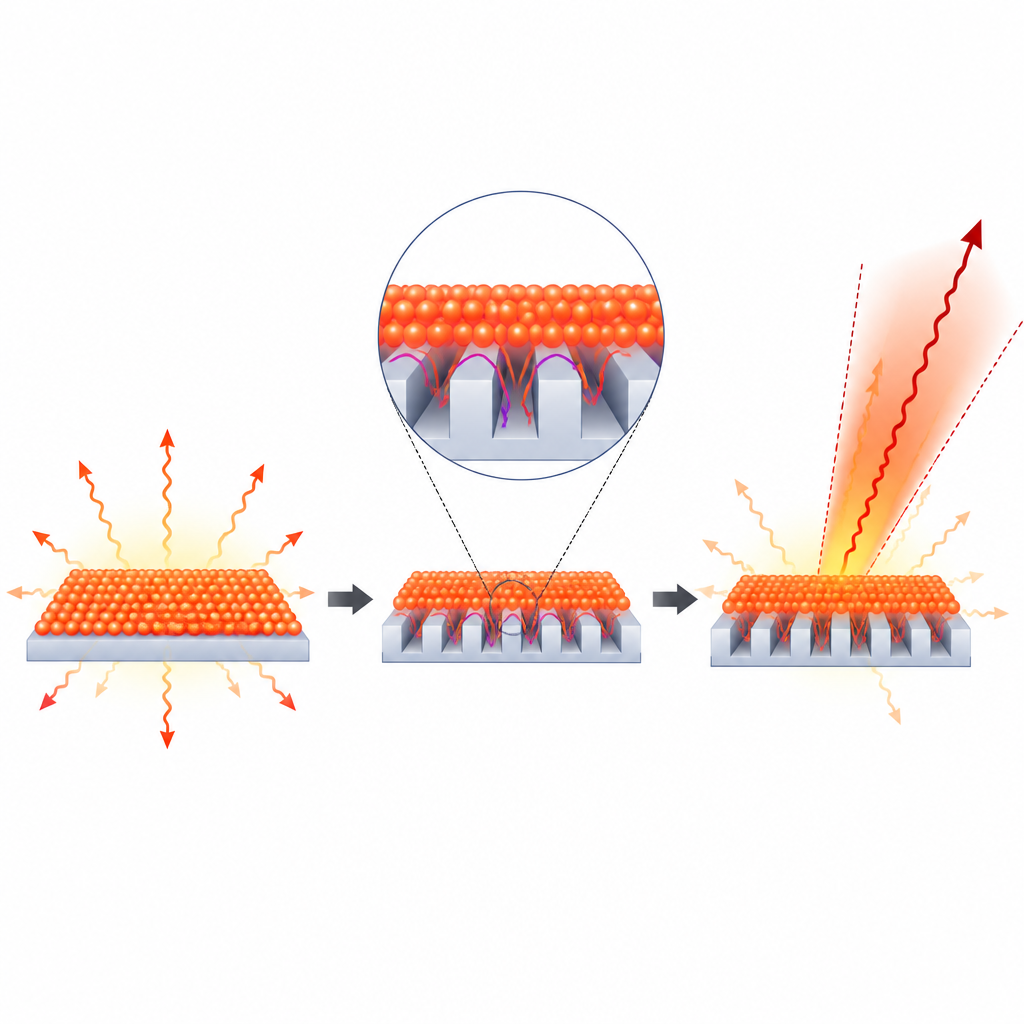
The researchers fabricated a carpet of parallel silicon bars only tens of nanometers tall, covering an area about the size of a grain of dust. They then coated this grating with a thin film of red-emitting perovskite nanocrystals. By tuning the bar width, spacing, and height, they matched one of the chip’s narrow optical resonances to the natural emission color of the nanocrystals. When this happens, the light from the nanocrystals couples into a so-called leaky guided mode that stores light near the surface before letting it escape. As a result, the overall brightness jumps by roughly a factor of six compared with an unpatterned film.
Steering Light with Angle and Position
The pattern does more than just brighten the glow. By changing the angle at which light hits the sample and by shifting the laser spot from the center to one side of the grating, the team can redirect most of the emitted light to the left or to the right. This works because changing the pump position effectively changes the sideways momentum of the light that enters the surface mode, which then controls the direction in which it leaks out. The device also makes the emission sensitive to polarization, meaning the brightness depends on the direction of the light’s oscillation, a useful feature for on-chip optical circuits that sort or encode information using polarization.
Watching Ultrafast Light-Matter Dance
To dig deeper into what happens inside this hybrid chip, the authors used ultrafast transient absorption microscopy, a technique that tracks how excited states evolve on trillionths-of-a-second timescales. Comparing plain nanocrystal films to nanocrystals on the grating, they observed new spectral features and broadened peaks when the crystals interacted with the chip’s resonant mode. These fingerprints indicate the formation of hybrid states in which the light trapped by the grating and the excitations inside the nanocrystals mix together, revealing that the device not only redirects light but also reshapes the underlying light-matter interaction.
What This Means for Future Light Devices
In simple terms, this work shows how to turn a thin, glowing coating into a bright, steerable beam by placing it on a smart, low-loss, silicon-based pattern. The approach uses chip-friendly materials and fabrication tools, and it can be tuned simply by changing the geometry of the bars. That makes it a promising route toward compact light sources whose color, brightness, direction, and polarization can be tailored on demand for imaging, communication, and quantum photonic technologies.
Citation: Chen, Z., Xu, L., Gao, B. et al. Emission Control of Perovskite Nanocrystals empowered by Bound States in the Continuum in Dielectric Gratings. npj Nanophoton. 3, 26 (2026). https://doi.org/10.1038/s44310-026-00120-w
Keywords: perovskite nanocrystals, silicon metasurface, directional emission, light matter interaction, nanophotonics