Clear Sky Science · en
Wavelength-tunable and 180 nm-bandwidth second-order nonlinear frequency conversions in all-fiber system
Why turning one color of light into many matters
Modern technologies from medical imaging to fiber‑optic internet rely on carefully tailored colors of light, yet convenient light sources do not exist for every useful color. This paper presents a new way to turn simple, steady laser beams inside ordinary optical fiber into a rich rainbow of new wavelengths, using only milliwatts of power. The result is a compact fiber device that can generate and tune broad bands of light, potentially shrinking and simplifying many optical systems that now need bulky, power‑hungry equipment.

A tiny coated fiber that reshapes light
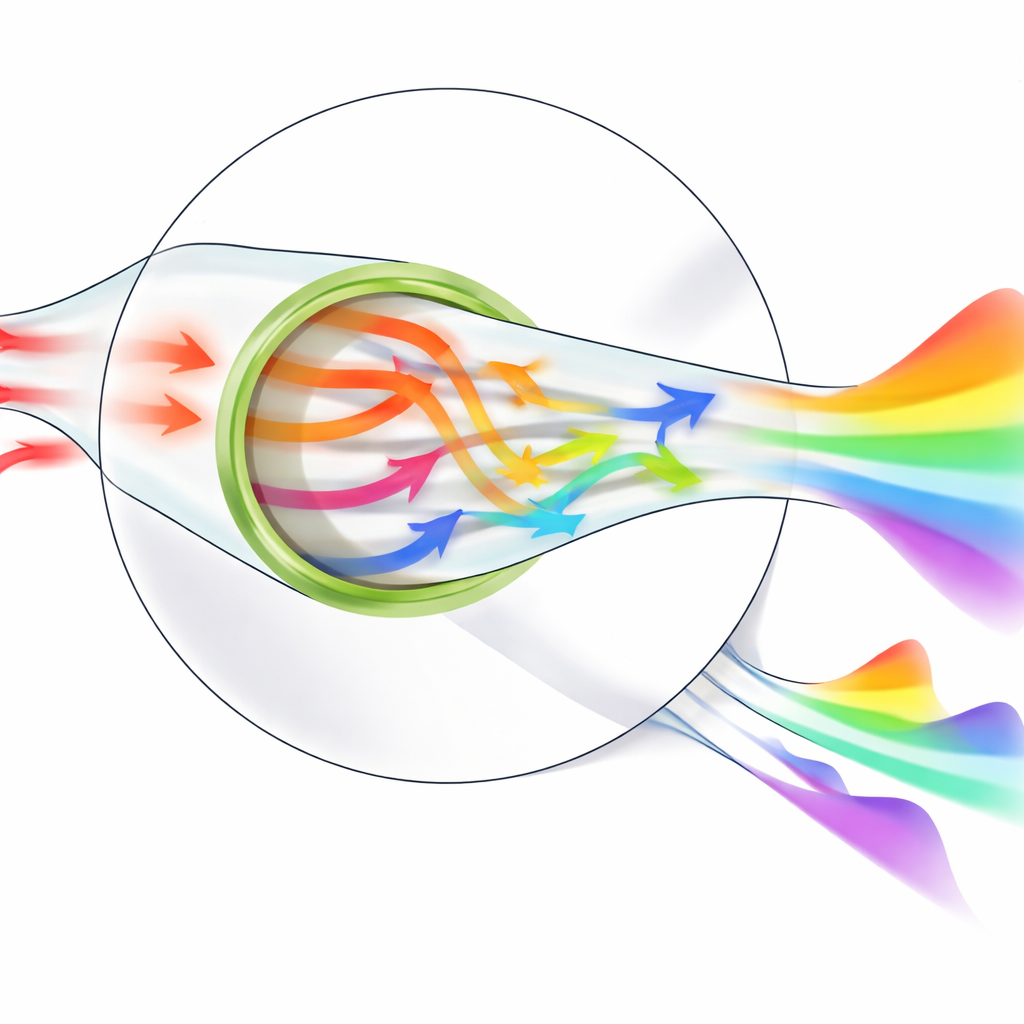
The core of the work is a very thin optical fiber, called a microfiber, whose central section is tapered down to about three thousandths of a millimeter in diameter. Around a short stretch of this waist, the researchers carefully wrap a few‑layer crystal of gallium selenide (GaSe), a material known for its strong ability to mix and double light frequencies. Light guided along the microfiber leaks slightly outside its glass core in an evanescent field, where it strongly overlaps with the GaSe. This extended contact length, combined with precisely chosen fiber diameter, lets incoming infrared light interact efficiently with the crystal and generate new colors without needing a resonant cavity or complex microchip.
Designing the fiber so many colors can form
For frequency conversion to work well, the different light waves must stay in step as they travel, a condition known as phase matching. In standard silica fibers this is hard to achieve for second‑order processes, which double a light frequency (second‑harmonic generation, SHG) or add two different frequencies together (sum‑frequency generation, SFG). Here the team uses simulations to tune the microfiber’s diameter so that the effective speeds of the pump light and its converted partners match over a large span of input wavelengths around the telecom C band. By treating the thin GaSe coating as a gentle perturbation, they show that key guided modes remain nearly phase matched from 1200 to 1600 nanometers, laying the groundwork for broadband conversion.
From a few lasers to ten new colors
To test narrowband operation, the authors launch four continuous‑wave telecom lasers at different infrared wavelengths into the GaSe‑coated microfiber. Out the other end, they observe four doubled‑frequency signals and six mixed‑frequency signals, for a total of ten distinct visible outputs. The brightness of each one can be smoothly controlled by adjusting the power of the corresponding pump laser. By modulating two of the pumps in time and sliding their pulses past each other, they show that the strength of an SFG signal follows how much the two waveforms overlap, directly visualizing how temporal synchronization between beams governs the conversion process.
Building broad rainbows with gentle light
The same device also works with light sources that are inherently broadband. When the team replaces the narrow lasers with two superluminescent diodes—steady but spectrally wide emitters—they obtain three smooth humps in the visible: two from SHG of each diode and a broad central band from SFG between them. They then push the concept further using a filtered supercontinuum source, which spans hundreds of nanometers in the infrared. Under only a few milliwatts of power, the microfiber produces an "ultra‑broadband" SHG continuum nearly 180 nanometers wide, far surpassing previous in‑fiber demonstrations. Finally, by pairing one broadband diode with a tunable narrow laser, they show that the center wavelength of the broadband SFG band can be shifted by more than 70 nanometers simply by dialing the laser’s color, while its width stays roughly constant.
What this means for future light sources
In everyday terms, the researchers have turned a short, crystal‑coated strand of glass into a flexible color‑conversion module that works like a quiet, low‑power prism in reverse: several simple beams go in, and a designer spectrum comes out. Because the approach is fully fiber‑based, it is naturally compatible with existing telecom hardware and can be extended to other wavelength ranges by choosing different crystals and pump colors. The work shows that strong, tunable, and broadband frequency conversion no longer requires bulky crystals or intense pulsed lasers, opening a path toward compact fiber devices that supply hard‑to‑reach colors of light for sensing, communications, metrology, and advanced imaging.
Citation: Hao, Z., Ma, Y., Jiang, B. et al. Wavelength-tunable and 180 nm-bandwidth second-order nonlinear frequency conversions in all-fiber system. npj Nanophoton. 3, 22 (2026). https://doi.org/10.1038/s44310-026-00119-3
Keywords: nonlinear fiber optics, broadband light sources, frequency conversion, gallium selenide, sum-frequency generation