Clear Sky Science · en
Common patterns of skyrmion magnetizations unveiled by defect implantation
Magnetic Whirls as Tiny Data Carriers
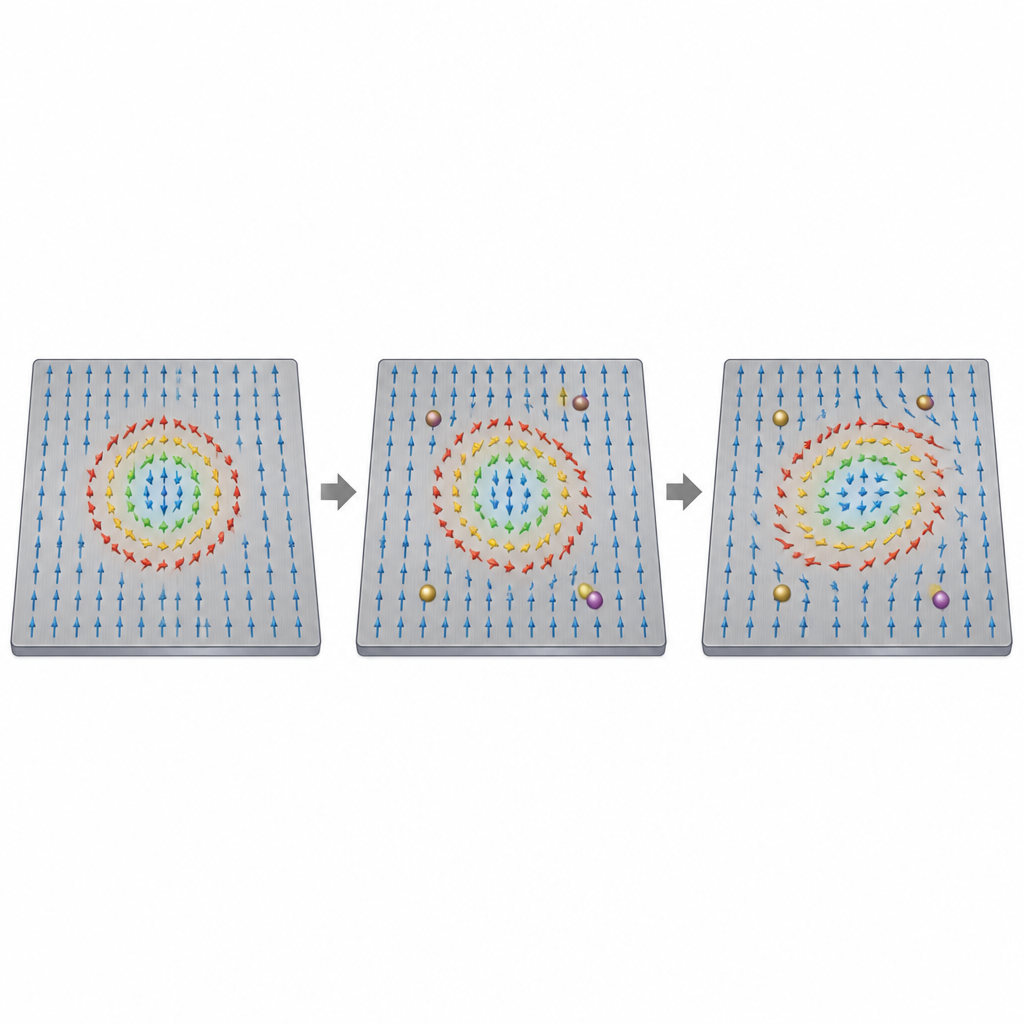
Imagine storing information not in tiny bar magnets, but in swirling patterns of magnetism only a few billionths of a meter across. These patterns, called skyrmions, can act as ultra-small, robust bits for future data storage devices. This study explores how adding individual foreign atoms into a material can quietly reshape these magnetic whirls and their strength, offering a knob to fine tune how each skyrmion behaves as a digital bit.
Why Magnetic Whirls Matter
Skyrmions are whirlpool-like twists in the direction of many atomic magnets on a flat surface. Unlike ordinary magnets, their twisted structure gives them unusual stability and special transport effects, making them attractive for low power, high density memory. A key question for turning them into useful bits is how much magnetization each skyrmion carries compared with its surroundings, because that difference sets how clearly a device can read a 0 from a 1. The authors focus on understanding and controlling this magnetization and related orbital effects that arise as electrons move in the twisted pattern.
Hidden Types of Magnetization
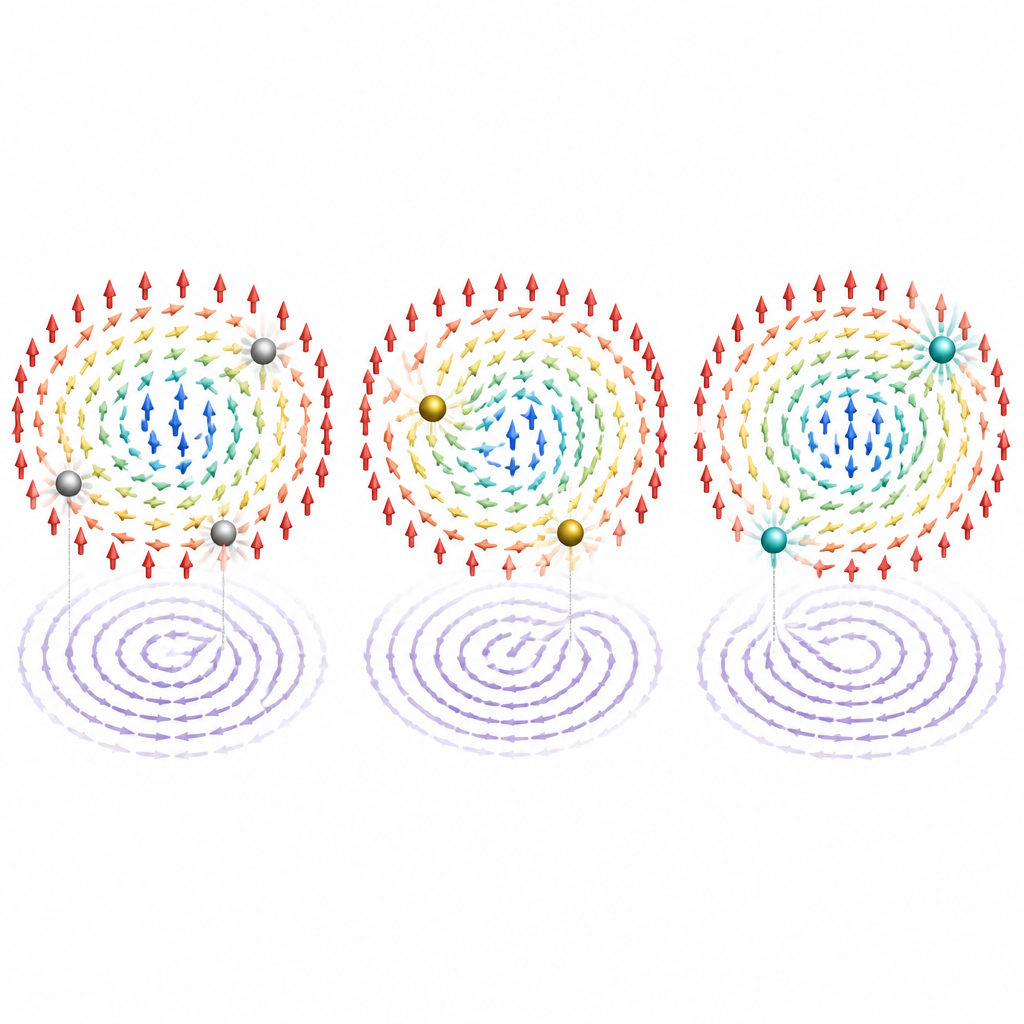
In a simple magnet, electrons contribute a spin magnetization and an orbital magnetization linked to their motion around atoms under the influence of spin orbit coupling. In skyrmions, things become richer. Because the local atomic magnets are not all aligned, the electrons experience an effective magnetic field tied to how three or more spins tilt with respect to one another. This generates chiral orbital magnetization, which depends on the handedness of the twist. The authors show that there are several distinct chiral orbital contributions, involving two, three, or four spins at a time, that can all add to the magnetic signature of a single skyrmion.
Using Defects as Design Tools
The team studied a well known material stack in which tiny skyrmions form in an iron layer sandwiched between palladium and iridium. They then virtually replaced one palladium atom near a skyrmion with different impurity atoms from the 3d and 4d transition metal series. Using first principles quantum calculations, they tracked how the total spin and orbital magnetizations of the skyrmion responded. They found that the overall magnetization follows clear patterns as the impurity’s atomic number increases. For 3d elements such as titanium through copper, the response shows a double dip pattern, while for 4d elements like zirconium through silver, it shows a single valley. Remarkably, these same shapes appear not only in the spin magnetization but also in the usual orbital and chiral orbital contributions.
How the Patterns Arise
The study links these trends to how each impurity couples magnetically to the iron atoms that host the skyrmion. 3d impurities typically carry strong magnetic moments and directly compete with the existing interactions in the iron layer, reshaping the skyrmion’s core and edge in a characteristic way. In contrast, 4d impurities have weaker moments and mainly modify how the surrounding atoms interact with each other, effectively stiffening or softening the skyrmion’s profile. The authors also uncover a cubic relation between the skyrmion’s spin magnetization and one of the chiral orbital terms, in contrast to the simple linear relation between spin and the usual orbital magnetization. This cubic link traces back to how three spin tilts combine geometrically in the twisted texture.
From Theory to Future Memory Devices
By revealing common patterns that connect spin, ordinary orbital, and chiral orbital magnetizations, this work offers practical design rules. In essence, once the spin magnetization of a skyrmion is measured, the hidden chiral orbital parts can be inferred. That opens a route to engineer skyrmion based bits simply by choosing which impurity atoms to implant and where. The results suggest that 3d impurities are especially effective in amplifying the magnetic signal of skyrmions, bringing the idea of defect tuned, skyrmion based storage devices a step closer to reality.
Citation: Lima Fernandes, I., Lounis, S. Common patterns of skyrmion magnetizations unveiled by defect implantation. npj Spintronics 4, 21 (2026). https://doi.org/10.1038/s44306-026-00140-4
Keywords: magnetic skyrmions, orbital magnetization, spintronics, atomic defects, data storage