Clear Sky Science · en
Radio-frequency assisted switching in perpendicular magnetic tunnel junctions
Why tiny magnets matter for tomorrow’s memory
Modern electronics increasingly rely on magnetic random-access memory (MRAM), a promising technology that could make our devices faster, more energy-efficient, and longer-lasting. At the heart of one leading MRAM design lies a stack of nanometer-thin magnetic layers that must flip their direction reliably billions or trillions of times without wearing out. This paper explores a clever way to coax those tiny magnets to switch more easily and gently by adding a carefully tuned radio-frequency (RF) “nudge” just before the main electrical pulse that performs the write operation.
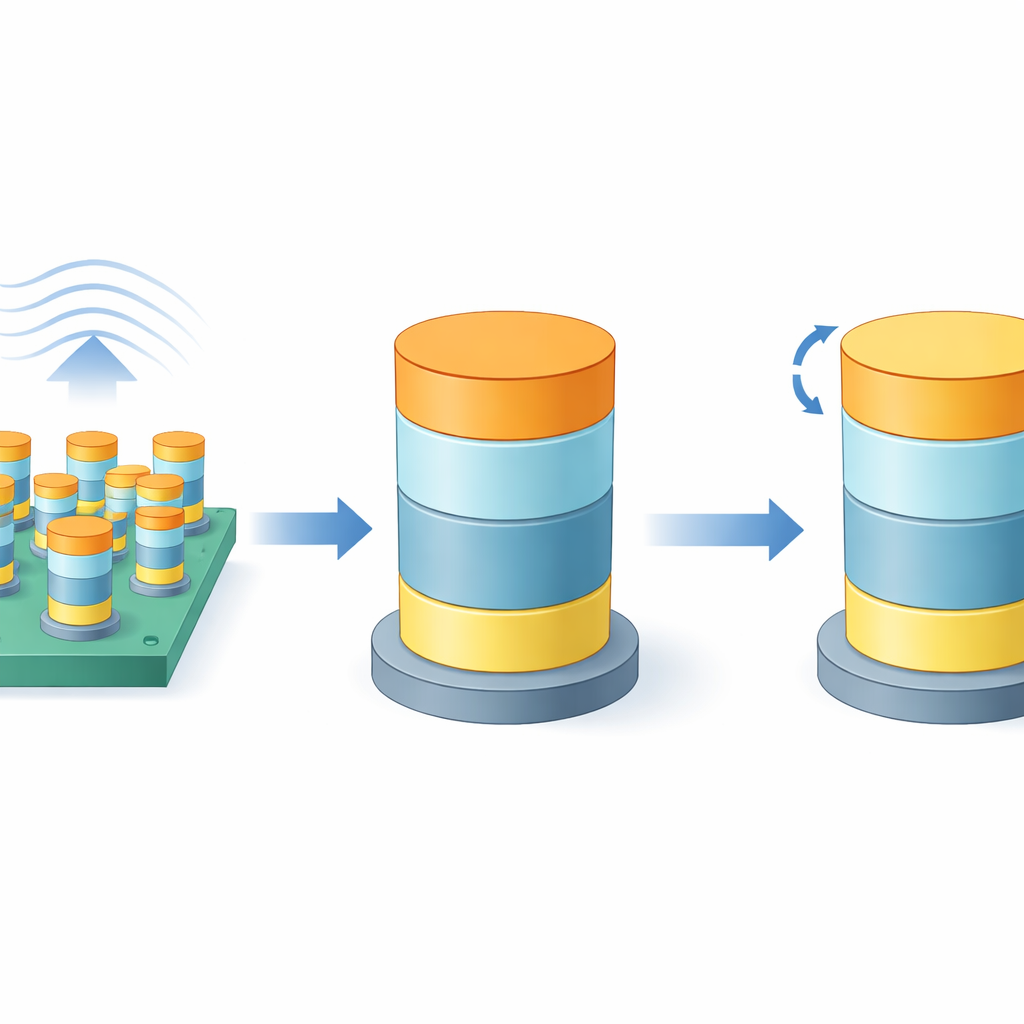
The building blocks of magnetic memory
The study focuses on perpendicular magnetic tunnel junctions, or p-MTJs, which are the core cells in state-of-the-art spin-transfer torque MRAM (STT‑MRAM). Each cell is a cylindrical stack only tens of nanometers across, made of two magnetic layers separated by an ultrathin insulating barrier. One layer has its magnetization fixed, while the other “free” layer can flip up or down, representing digital 0 or 1. When the two layers point in the same direction, electrical resistance is low; when they point opposite ways, resistance is high. Writing data requires sending a short, high-voltage pulse of electric current through the stack, but pushing the voltage too high or for too long can damage the fragile barrier and limit the lifetime of the memory.
A gentle radio push before the main shove
To relieve this stress, the authors test a write method that combines a brief RF pulse with the usual direct-current (DC) write pulse. The RF pulse is a small, oscillating voltage applied for about 30 nanoseconds just before, or partly overlapping with, the main DC pulse. This oscillation slightly shakes the free magnetic layer, nudging it out of its resting position without switching it by itself. Immediately afterward, the stronger DC pulse is applied. By first agitating the magnet with a low-power RF signal and then pushing it with DC, the team finds that the probability of successful switching increases, even though the RF pulse is much weaker than the DC pulse.
What the experiments reveal
The researchers fabricated circular p‑MTJs with diameters ranging from 25 to 85 nanometers and measured how often each device switched its magnetic state under repeated RF+DC pulse sequences. They tuned the DC pulse so that, without RF, each device switched about half the time, then quantified how much an added RF pulse increased that probability. They observed that a modest RF assist could raise the switching probability by up to roughly 30 percent, depending on device size and timing. Crucially, this improvement appeared even when the RF and DC pulses did not overlap in time, meaning the peak voltage across the junction never exceeded that of the DC pulse alone. That makes the method attractive for extending device endurance while keeping electrical stress in check.
Slower radio waves work better
An especially important finding is that lower RF frequencies helped more. While prior work mostly targeted the natural “ringing” frequency of the free layer—its ferromagnetic resonance in the multi-gigahertz range—this study shows that sub-gigahertz tones, which are simpler and cheaper to generate in standard chip technology, can be even more effective. At fixed RF power, the boost in switching probability grew as the RF frequency decreased, well below the natural resonance of the magnet. Because simple heating from the RF current would not depend strongly on frequency, this trend points to more subtle magnetic motion, possibly involving slow, inhomogeneous regions at the interface or even chaotic trajectories of the magnetization driven by the RF field.
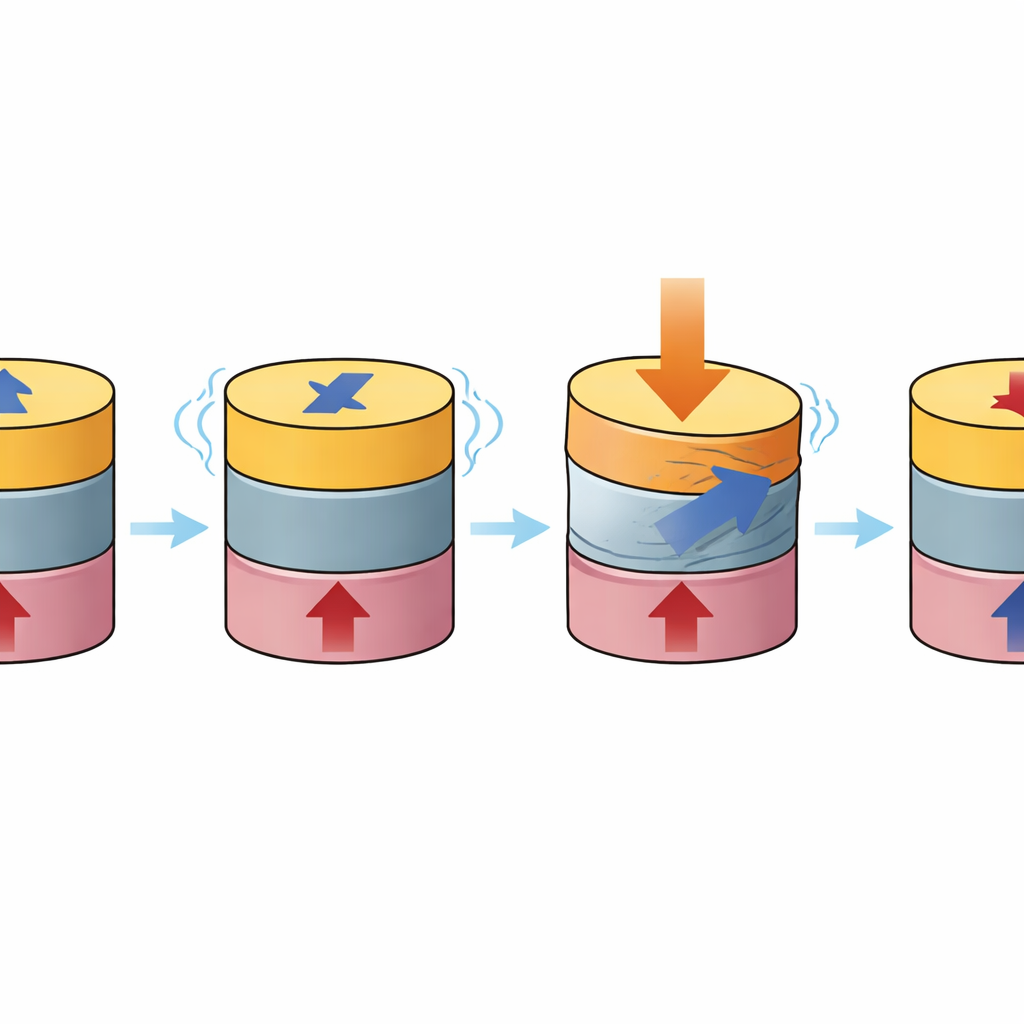
How theory helps explain the boost
To interpret these results, the authors carried out large-scale simulations and developed an analytical model that track the motion of the free layer’s magnetization under combined RF and DC drives at room temperature. The simulations reproduce key trends, such as the need for a threshold RF power and the drop in effectiveness as the delay between pulses grows. However, they underestimate how long the RF influence persists and predict slightly higher threshold powers than experiments show. These discrepancies suggest that real p‑MTJs host slower, more complex magnetic dynamics than the idealized models capture, likely linked to microscopic variations and additional in-plane anisotropies in the magnetic layer.
What this means for future memory chips
In practical terms, the study demonstrates that adding a small RF pre-pulse can make MRAM cells switch more reliably without increasing the maximum write voltage. That opens the door to shortening the main DC pulse, which is known to be one of the main culprits behind long-term damage to the tunnel barrier. Because the RF frequencies that work best are relatively low and compatible with standard chip circuitry, this approach could be integrated into future STT‑MRAM designs to improve endurance and possibly energy efficiency. The work also highlights that real magnetic devices behave more richly than simple textbook magnets, and that harnessing those complexities—rather than fighting them—may be key to building faster, tougher, and more efficient memory technologies.
Citation: Hayward, M., Perna, S., d’Aquino, M. et al. Radio-frequency assisted switching in perpendicular magnetic tunnel junctions. npj Spintronics 4, 19 (2026). https://doi.org/10.1038/s44306-026-00138-y
Keywords: spintronics, MRAM, magnetic tunnel junctions, radio-frequency switching, nonvolatile memory