Clear Sky Science · en
Efficient spin-pumping and spin transport across epitaxial Mn3Sn(0001) noncollinear antiferromagnet/permalloy interfaces
Why tiny magnetic currents matter
Modern computers and data centers burn a lot of energy just to flip microscopic magnetic bits on and off. Engineers know that if they could use the spin of electrons—an intrinsic tiny magnet built into every electron—instead of pushing large electric currents around, devices could become faster, smaller, and cooler. This paper explores a promising exotic material, the antiferromagnet Mn3Sn, grown as a high-quality thin film, to see how efficiently it can generate and carry these pure spin currents and turn them back into useful electrical signals for future low‑power electronics.
A new kind of magnetic building block
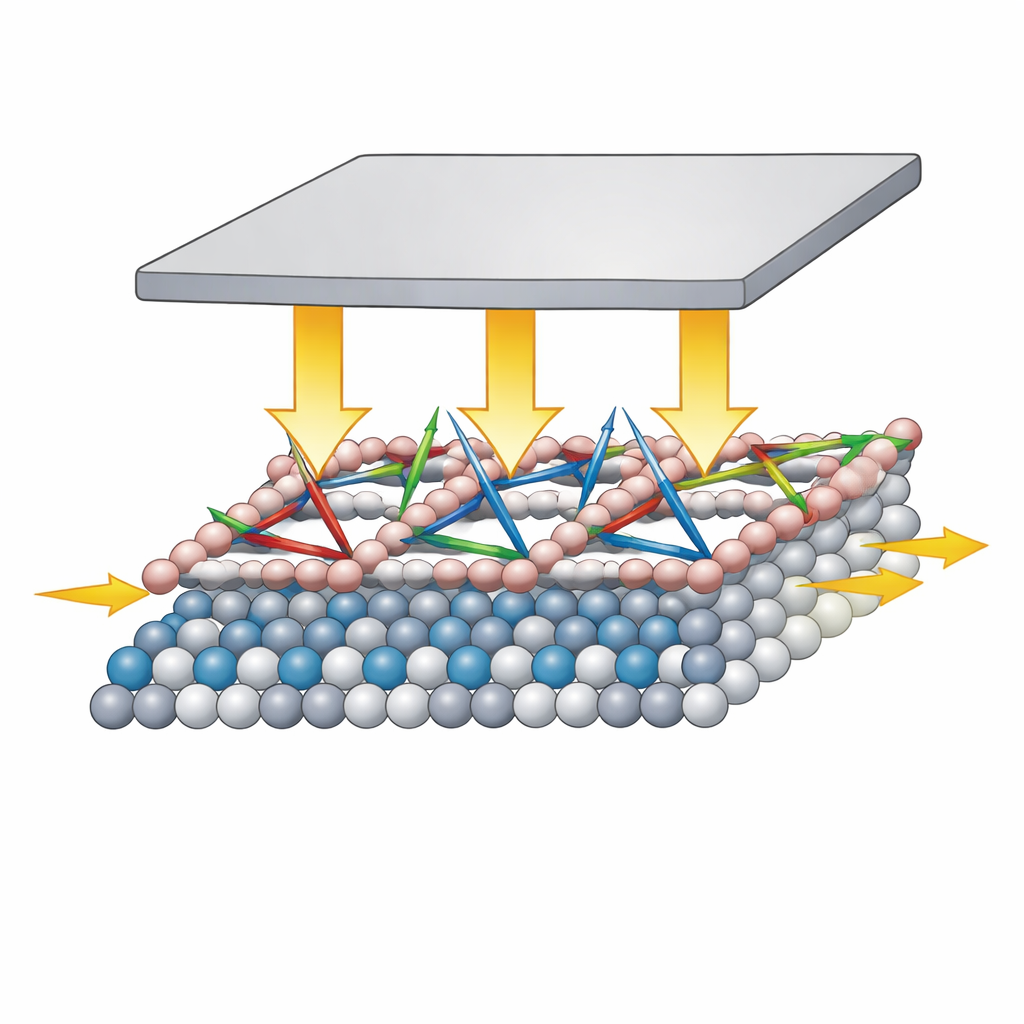
Most magnetic memory today relies on ferromagnets, where many atomic magnets line up in the same direction. Mn3Sn belongs to a different class called noncollinear antiferromagnets: its manganese atoms sit on a kagome lattice—an arrangement of corner‑sharing triangles—and their magnetic moments form a 120‑degree pattern around each triangle. Although this pattern nearly cancels the net magnetization, it produces strong internal “twists” in the electrons’ motion that can lead to unusual transport effects. The authors fabricate epitaxial Mn3Sn films, meaning the atoms are arranged in a single, well‑aligned crystal stack on a magnesium oxide substrate with a ruthenium buffer. X‑ray and microscope measurements show that the layers are smooth, well ordered, and have sharp interfaces, an essential prerequisite for clean spin transport.
Checking the basic electrical behavior
Before probing spin currents, the team verifies how electricity flows through these films. The Mn3Sn layers behave like ordinary metals: their resistance decreases smoothly as the temperature drops from room temperature to a few degrees above absolute zero. Hall measurements—where a magnetic field bends moving charges sideways—show only a very small anomalous contribution at room temperature, consistent with the expected subtle response of this antiferromagnet in the measured geometry. Importantly, when Mn3Sn is paired with a thin layer of a standard magnetic alloy called permalloy (nickel‑iron), there is no measurable exchange bias, a kind of built‑in directional preference that could complicate the interpretation of spin experiments. This clears the way to treat the interface mainly as a clean pathway for spin flow.
Pumping spin into the antiferromagnet
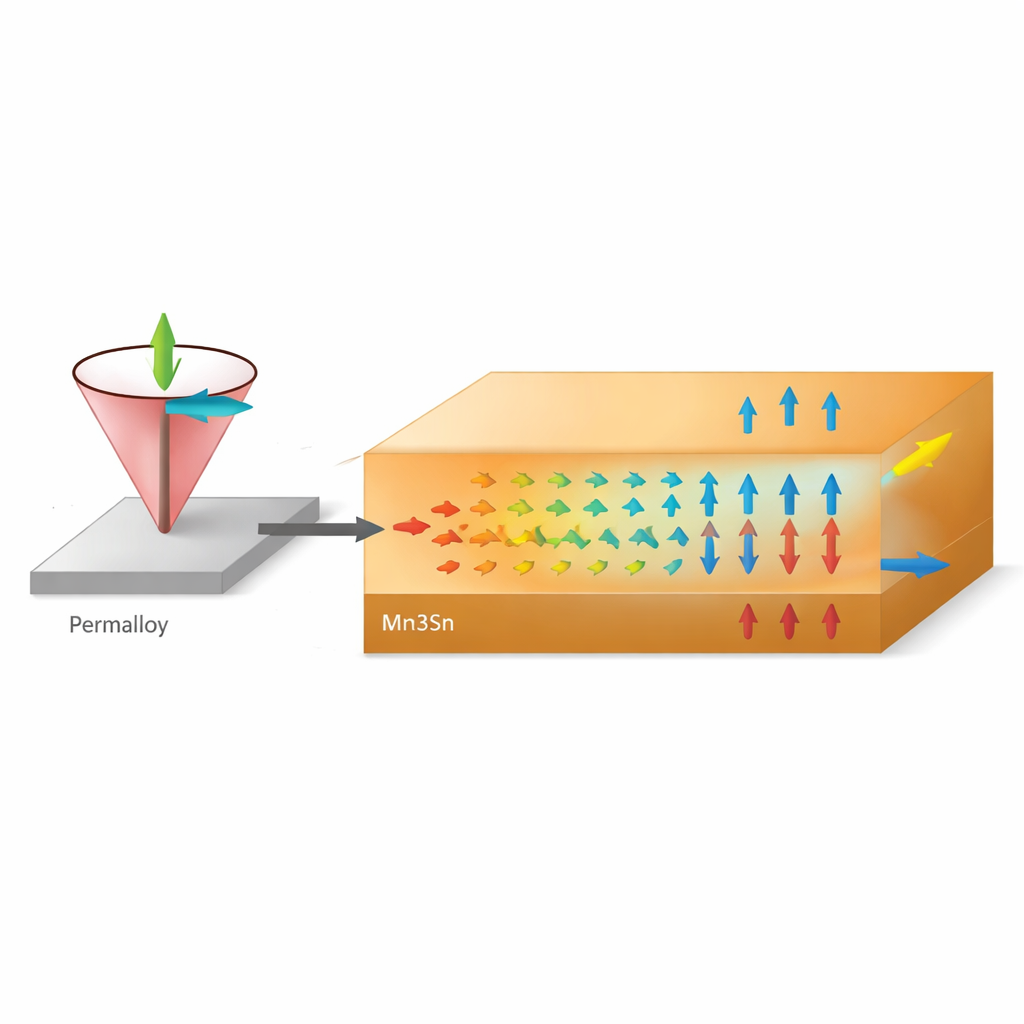
To generate spin currents, the researchers drive the permalloy layer into ferromagnetic resonance: they apply microwaves so that its magnetization precesses, or wobbles, coherently. This precession pumps a flow of spin angular momentum into the adjacent Mn3Sn without moving net charge. The extra channel for losing angular momentum shows up as an increased magnetic damping in permalloy. By measuring how this damping grows as the Mn3Sn layer becomes thicker, the authors extract two key quantities. First, the interface is very good at accepting spin: the spin‑mixing conductance is high, and the inferred spin transparency—how many incoming spins actually enter the Mn3Sn rather than bouncing back—is about 72 percent. Second, spins can travel relatively far inside Mn3Sn before losing their orientation: the spin diffusion length is at least about 15 nanometers, and possibly up to 25 nanometers, longer than in many conventional spin‑orbit materials.
Turning spin currents back into charge
Once spin is flowing inside Mn3Sn, the team measures how effectively it is converted into an ordinary electrical voltage via the inverse spin Hall effect: spin‑orbit interactions deflect spins of opposite orientation in opposite directions, creating a sideways charge current. They detect this as a tiny DC voltage that flips sign when the magnetic field is reversed. By tracking how this signal changes with Mn3Sn thickness and using a detailed model of the pumping process, they estimate an effective spin Hall angle—the ratio between generated spin or charge current and the original charge or spin flow—of about 0.6 percent. Correcting for the high spin transparency of the interface yields an intrinsic spin Hall angle around 0.9 percent and a corresponding spin Hall conductivity of roughly 44 (in the usual quantum units). Interestingly, this response is almost the same along two different in‑plane crystal directions, even though theory predicts strong directional differences for an ideal Mn3Sn crystal.
What this means for future technologies
For a layperson, the bottom line is that these carefully grown Mn3Sn films act as reasonably efficient converters between spin and charge while letting spin signals travel comparatively long distances and cross the interface to a ferromagnet with little loss. They are not as strong at spin‑to‑charge conversion as benchmark materials like platinum, but they offer other advantages: negligible stray magnetic fields, very fast intrinsic dynamics, and compatibility with dense device layouts. The authors conclude that epitaxial Mn3Sn is a promising building block for next‑generation spin‑based memory and logic, though its internal mechanisms are more complex than simple theories suggest. Further work tuning film quality, thickness, strain, and device geometries may unlock even better performance and clarify exactly how this unconventional antiferromagnet moves and converts tiny magnetic currents.
Citation: Panda, S.N., Mao, N., Peshcherenko, N. et al. Efficient spin-pumping and spin transport across epitaxial Mn3Sn(0001) noncollinear antiferromagnet/permalloy interfaces. npj Spintronics 4, 17 (2026). https://doi.org/10.1038/s44306-026-00136-0
Keywords: spintronics, antiferromagnets, spin Hall effect, Mn3Sn thin films, spin pumping