Clear Sky Science · en
Deep learning-driven statistical bias correction for climate risk assessment of projected temperature extremes in the Nordic region
Why this matters for people in the North
Summers that feel hotter, winters that no longer stay reliably cold, and swings between warm days and chilly nights are already reshaping life across the Nordic countries. This study asks a very practical question: how hot could it actually get in specific Nordic cities and towns by the end of the century, and when will these changes clearly stand out from natural weather ups and downs? To answer this, the authors use modern artificial intelligence to sharpen climate model forecasts, turning coarse global projections into locally relevant information for places from Copenhagen to Tromsø.
From global signals to local streets
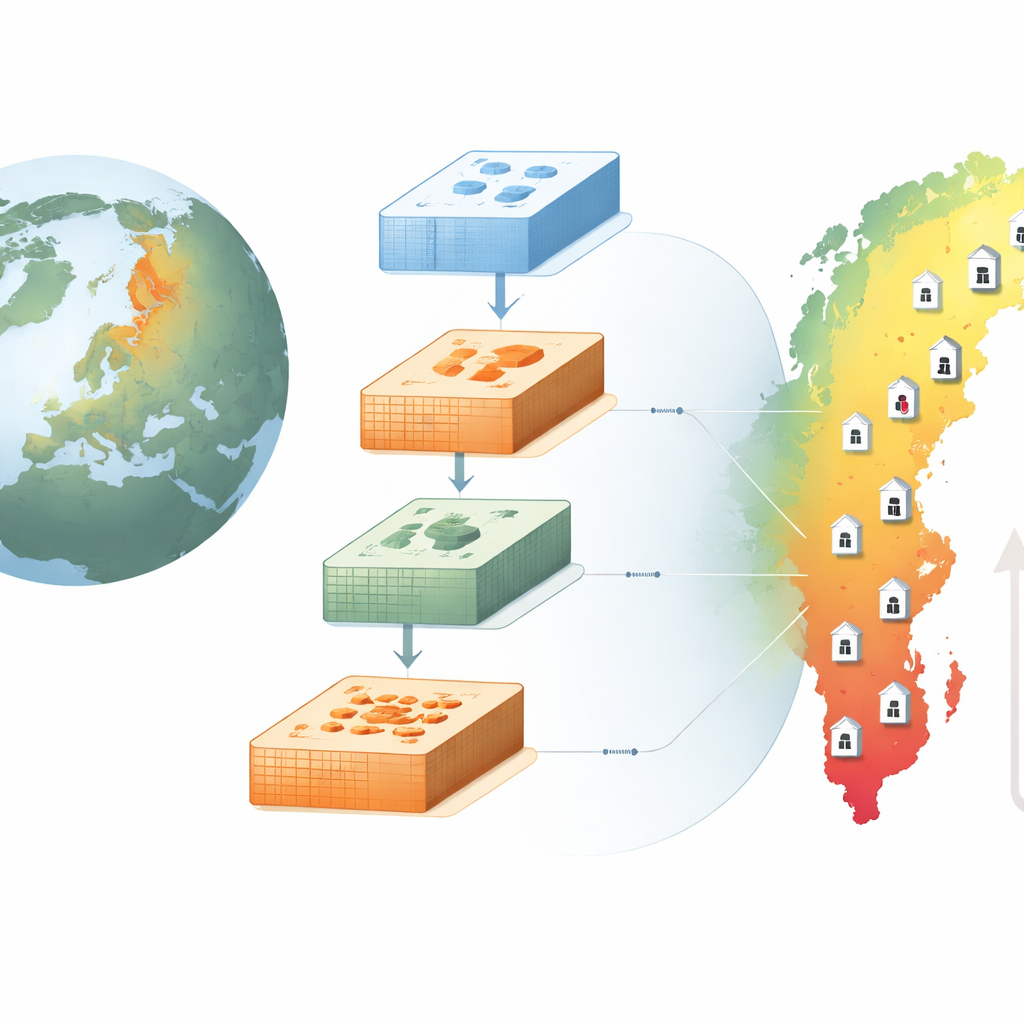
Climate models simulate the whole planet, but their grid cells are so large that they blur the details that matter for individual communities. Coastal mountains, fjords, and inland lakes across the Nordics all influence local temperature in ways that big models cannot fully capture. The researchers tackle this mismatch by combining global climate projections from a Norwegian Earth system model with detailed measurements from ten long-running weather stations that span four major climate zones, from mild oceanic Denmark to subarctic northern Scandinavia. This station network acts as a ground truth, showing how temperatures have actually behaved from 1951 to 2014.
Teaching machines to fix model errors
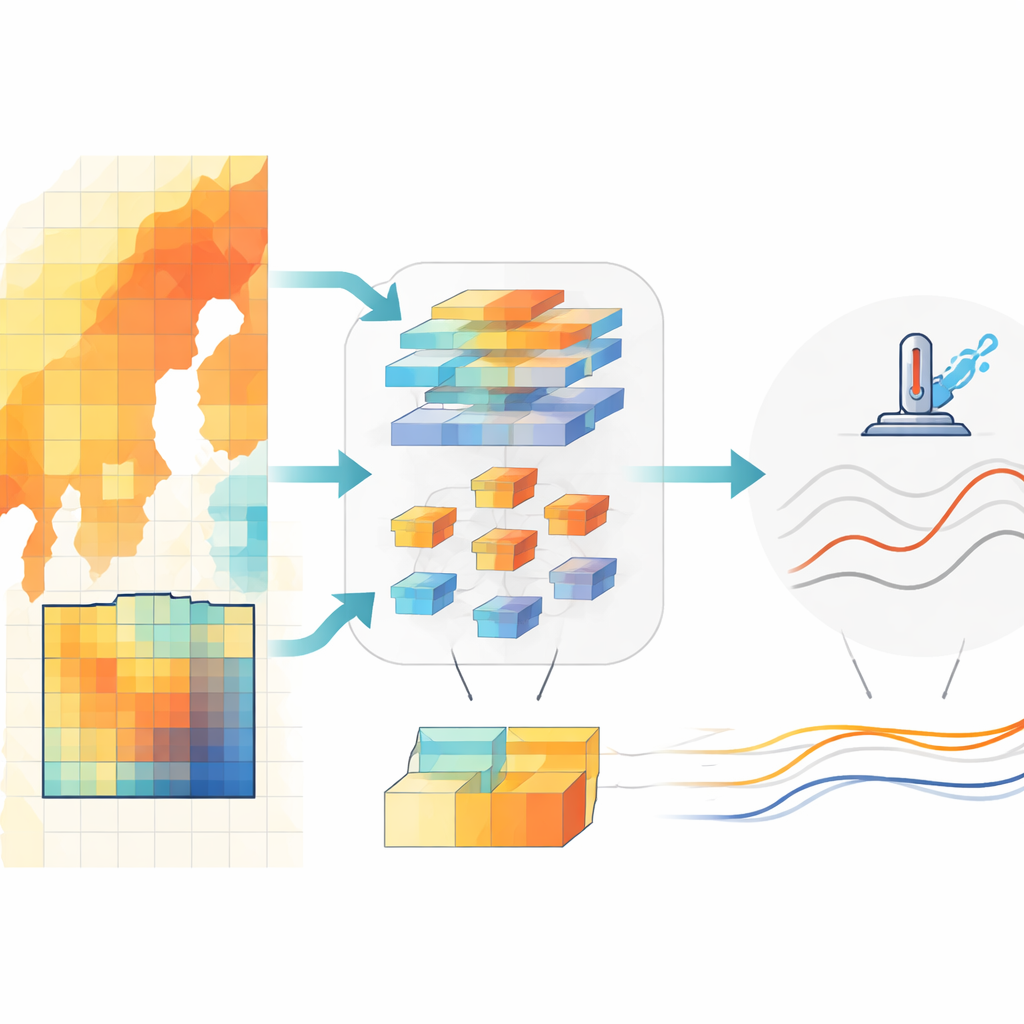
Instead of accepting the raw climate model output, the team uses a group of advanced deep-learning methods to “correct” the model’s systematic errors. These tools include a Vision Transformer, a type of neural network that can see broad spatial patterns; ConvLSTM, which is designed to follow changes over time and space; and a climate-focused model called GeoStaNet. Each method learns how past model output and real station data are related, then applies that knowledge to clean up future projections. The authors compare ten techniques in total, ranging from simple statistical corrections to sophisticated neural networks, and judge them with many different accuracy tests, including how well they reproduce heatwaves and the daily swing between daytime highs and nighttime lows.
Choosing the most trustworthy model
To avoid cherry-picking, the study uses a ranking approach borrowed from decision science, called DL-TOPSIS, which blends multiple performance measures into an overall score. Deep-learning models come out clearly on top. The Vision Transformer performs best, closely followed by ConvLSTM and GeoStaNet, while traditional statistical fixes lag behind, especially for very hot and very cold days. Importantly, the best models not only match average temperatures but also preserve the link between daytime maximum and nighttime minimum, which is crucial for understanding how heat affects both ecosystems and human health. With this ranking in hand, the authors select the Vision Transformer as their main tool for generating future projections.
What the future looks like for Nordic heat
Armed with their best-performing model, the researchers examine two futures: a moderate warming pathway (SSP2-4.5) and a high-emissions pathway (SSP5-8.5) from 2015 to 2100. Under the high scenario, inland and subarctic zones warm the most. By late century, summer daytime highs in continental areas are projected to rise by about 4.8 °C in one climate zone and 3.9 °C in a colder subarctic zone. The daily temperature range widens by more than 1.5 °C in some places, meaning hotter days without equally warm nights. Heatwave days are expected to roughly double in warmer inland regions and potentially triple in the coldest zones, while frost days decline sharply. The authors also track the “time of emergence” — the point when human-driven warming becomes unmistakable compared with natural variability — which appears first in subarctic winters around the 2030s.
Turning sharper forecasts into action
For non-specialists, the core message is that advanced AI methods can convert abstract global climate projections into concrete, station-level estimates of future extremes for the Nordic region. The results indicate that marked warming and more frequent intense heat days are very likely across all ten sites, with the strongest and earliest changes in high-latitude inland areas. Even though the underlying global model used here is on the conservative side compared with some others, the signals of change are already strong enough to guide planning. The authors argue that these bias-corrected, high-resolution projections can help energy planners, city officials, farmers, and health services prepare infrastructure and policies for a future in which Nordic summers are hotter, daily temperature swings are larger, and clear signs of human influence on local climate appear within a few decades.
Citation: Loganathan, P., Zea, E., Vinuesa, R. et al. Deep learning-driven statistical bias correction for climate risk assessment of projected temperature extremes in the Nordic region. npj Nat. Hazards 3, 43 (2026). https://doi.org/10.1038/s44304-026-00207-6
Keywords: Nordic climate change, temperature extremes, deep learning, bias correction, climate adaptation