Clear Sky Science · en
Assessing agricultural drought risk under CMIP6 scenarios using hybrid AI models and satellite-derived TVDI
Why future droughts in one Ghanaian orchard matter to us all
Rain-fed farms across Africa sit on the front line of climate change, where a few dry months can mean lost harvests, higher food prices and deepening poverty. This study zooms in on a single mango orchard near Tamale in northern Ghana to tackle a global question: can we reliably foresee when crops will run short of water in a warming world? By blending satellite images, climate model projections and advanced artificial intelligence, the researchers build an early-warning approach that could help farmers and planners act before drought turns into hunger.
Watching trees from space
Plants quietly record whether they have enough water in their leaves and in the soil beneath them. Satellites such as Landsat 8 and 9 can sense this by measuring both greenness and land surface temperature. The team used these data to calculate the Temperature Vegetation Dryness Index (TVDI), a number between 0 (wet) and 1 (dry) that captures how stressed the mango trees are. They checked the satellite-based TVDI against very detailed thermal images taken from a low-flying drone over the orchard. The close match between the two—errors were small and centered around zero—shows that freely available satellite snapshots can stand in for expensive field campaigns when tracking crop water stress over time. 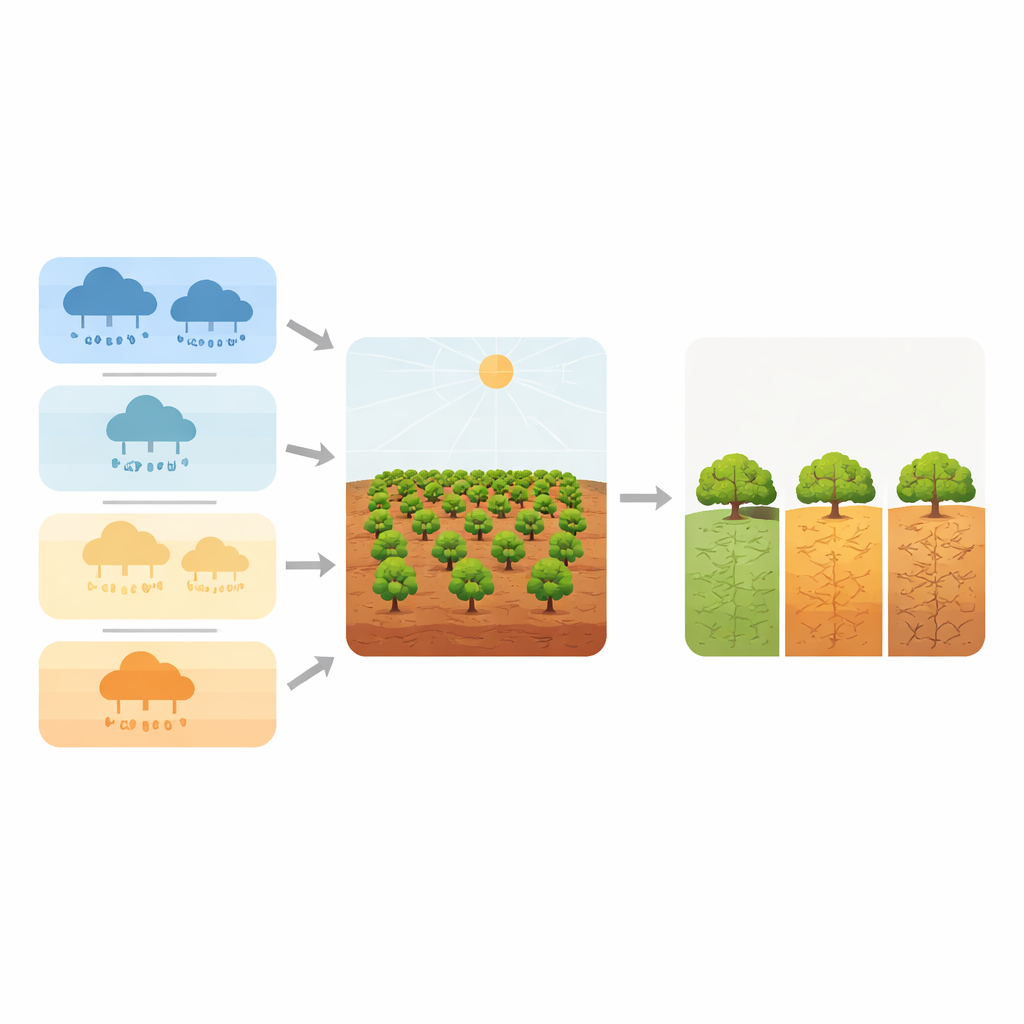
Linking missing rain to thirsty trees
Drought begins in the sky as a shortage of rain, but farmers feel it later, when plants start to wilt. To track the lack of rainfall, the study used a standard measure called the Standardized Precipitation Index (SPI), which turns months of rain data into a simple scale of wet and dry conditions. The authors compared SPI with the satellite-based TVDI and found that the relationship is delayed and nonlinear: in some scenarios, plant water stress reflected rainfall from one month earlier, in others from several months back. Using a mathematical tool called mutual information, they showed that these delayed links were stronger and more complex than a simple straight-line fit would suggest. This lag-aware view is crucial, because it determines how far ahead an early warning system can realistically look.
Cleaning up climate forecasts before using them
To peer into the future, the researchers turned to the latest global climate simulations from the CMIP6 project, which describe how rainfall might unfold under four different socioeconomic pathways, ranging from low to very high greenhouse gas emissions. Raw model outputs, however, often misrepresent local rainfall. The team therefore “bias-corrected” monthly precipitation from 35 climate models using two statistical techniques and local observations from 2015 to 2024. They selected, for each future pathway, the model and correction method that best reproduced observed rainfall patterns and then examined decade-by-decade trends and anomalies from 2015 to 2050. This careful clean-up ensured that subsequent drought calculations reflected both local weather behavior and the broader shifts expected from climate change.
Teaching an AI to forecast orchard stress
Armed with a history of rainfall shortages and tree dryness, the authors trained a hybrid artificial intelligence model to predict TVDI from SPI values, explicitly accounting for the time lags they had uncovered. Their approach combined wavelet analysis, which separates slow swings from rapid fluctuations in the data, with a neuro-fuzzy system that can learn nuanced input–output relationships, aided by fuzzy clustering to handle different patterns. They expanded the training set with synthetic but statistically consistent samples, improving the model’s ability to generalize. Across all four future pathways, the system reproduced past TVDI values with high accuracy, keeping typical prediction errors below 0.1 on the 0–1 dryness scale in both training and testing. 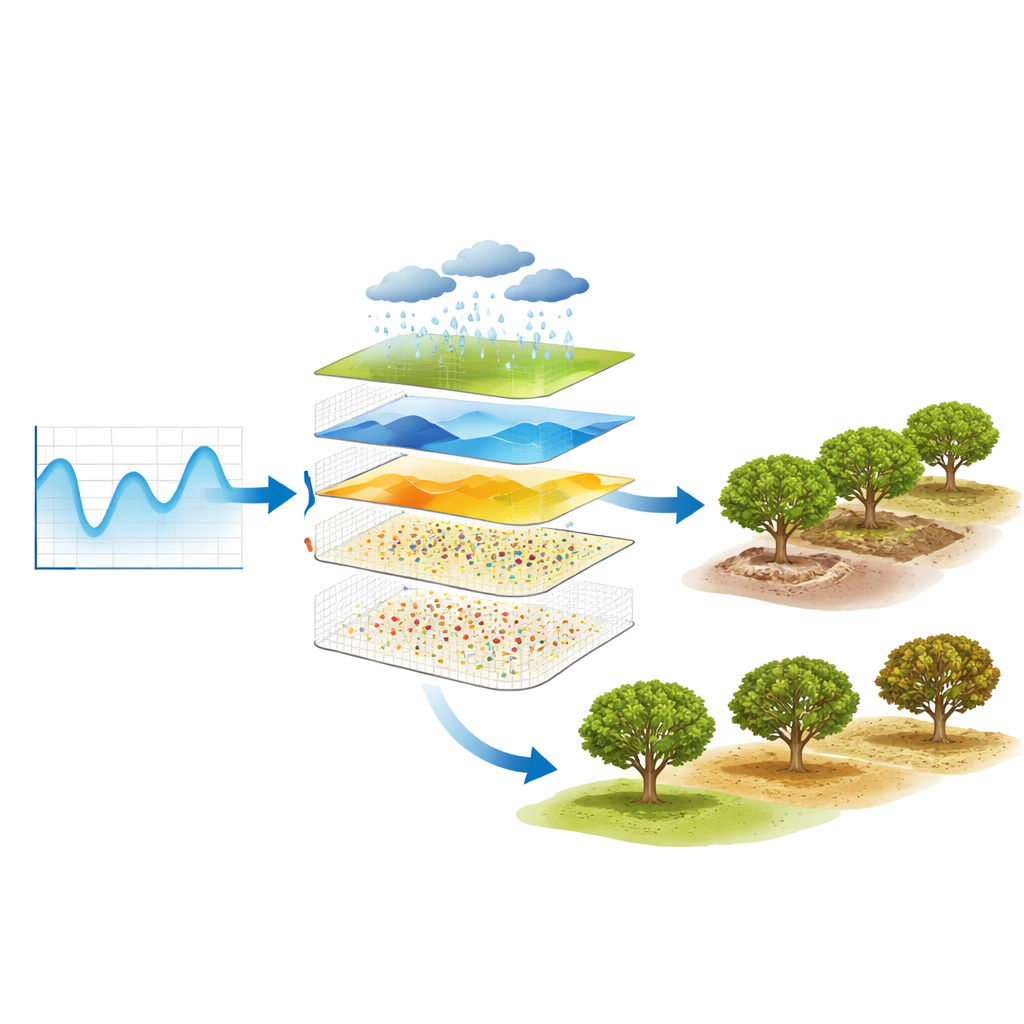
What the future may hold for these trees
When the trained model was fed with bias-corrected rainfall projections for 2025–2050, a clear picture emerged: agricultural drought grows more frequent and longer-lasting as emissions rise. In the mildest pathway, the orchard spent about 118 out of 312 months in moderate to severe dryness (TVDI above 0.5). Under the most aggressive warming pathway, this climbed to 163 months—more than 13 years of the 26-year period. The findings suggest that, without adaptation, water stress will increasingly threaten yields in this already vulnerable region. Yet the same tools that reveal this risk also point to solutions, such as scheduling supplemental irrigation, investing in small solar-powered drip systems and improving local water storage, all guided by advance warnings from AI-driven drought forecasts.
From one orchard to global food security
By tightly linking satellite observations, refined climate projections and advanced learning algorithms, this work demonstrates a practical way to turn abstract climate scenarios into concrete estimates of future crop stress. For non-specialists, the takeaway is straightforward: if emissions stay high, droughts that harm crops are likely to become more common and persistent, even at the scale of individual farms. But if we pair emissions cuts with smarter, data-informed farming—using early warnings to plan irrigation and other responses—regions like northern Ghana can better protect their harvests. The framework developed in this mango orchard is built on global open data and could be replicated in other data-poor areas, supporting broader efforts to reduce hunger and adapt agriculture to a changing climate.
Citation: Zare, M., Hobart, M. & Schirrmann, M. Assessing agricultural drought risk under CMIP6 scenarios using hybrid AI models and satellite-derived TVDI. npj Nat. Hazards 3, 42 (2026). https://doi.org/10.1038/s44304-026-00199-3
Keywords: agricultural drought, satellite monitoring, climate change scenarios, artificial intelligence, food security