Clear Sky Science · en
Bridging preclinical and clinical fluorescence-guided surgery with advanced cancer vision goggles
New Glasses That Help Surgeons See Cancer
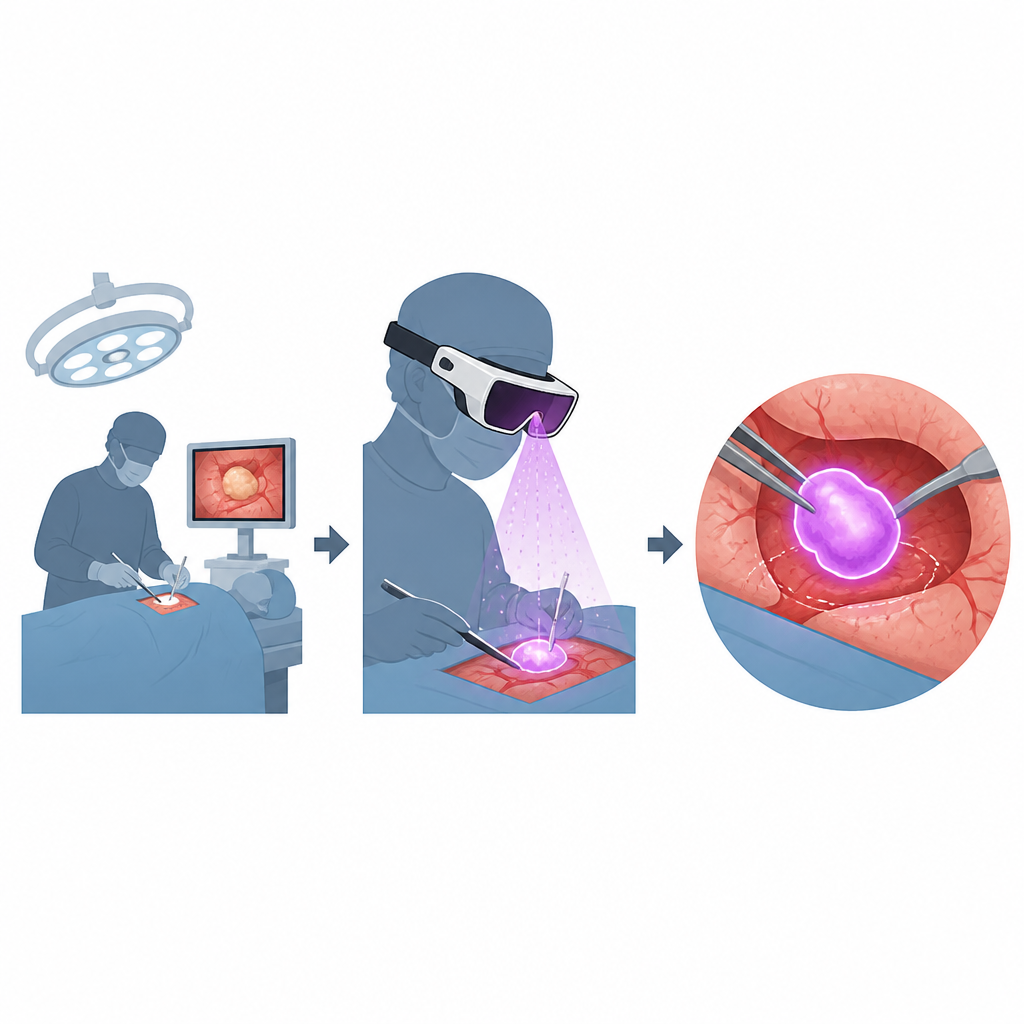
Cancer surgeons walk a tightrope: remove too little tissue and the tumor may return, remove too much and healthy organs and function are harmed. This study introduces advanced Cancer Vision Goggles, a wearable set of "smart" glasses that help surgeons see glowing cancer tissue in real time, and shows that the same device can work reliably in both animal experiments and human surgery.
Why Seeing Cancer Clearly Is So Hard
Surgeons increasingly rely on special dyes that make tumors glow under near infrared light. Several hospital devices already turn this glow into images, guiding surgeons as they operate. But these systems are often bulky, handheld, and sensitive to how each user holds and positions the camera. Small changes in distance, angle, or room lighting can change how bright a tumor looks, making it hard to compare results between hospitals, surgeons, or even different days in the same patient. Preclinical lab systems for mice are the opposite: they are very stable and precise, but they live in closed boxes that look nothing like an open operating room, making it difficult to translate findings from bench to bedside.
A Pair of Goggles for Lab and Operating Room
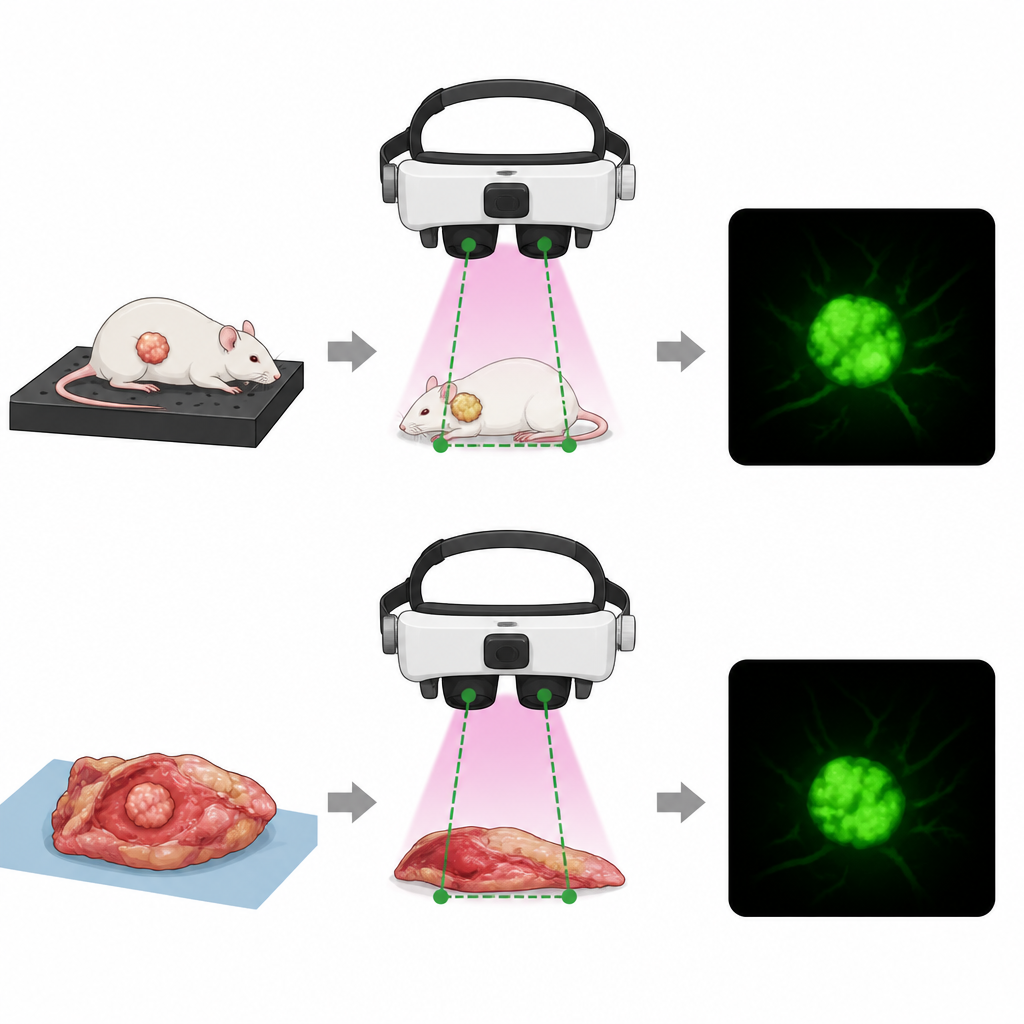
The Cancer Vision Goggles aim to bridge this divide. They are worn on the head like virtual reality glasses and show both normal color and near infrared glow directly in the surgeon’s line of sight. Two green pointer beams on the front of the device act as a built in ruler: when the spots overlap, the distance to the tissue is fixed at about half a meter. This simple trick locks in a repeatable viewing geometry, so measurements of brightness and contrast can be compared over time and between users. The system also includes automatic contrast adjustment, safety checks on the laser light, and a way to save data in a standard medical image format familiar to hospitals.
Testing the Goggles in Mice
To find out if the goggles match established imaging systems, the team first studied mice bearing breast tumors. They injected a dye that behaves similarly to a common clinical dye and imaged the same tumors with the goggles and with commercial lab machines that sit inside light tight boxes. Across skin on, open, and removed tumor views, the goggles produced tumor to background contrast that was just as good as the benchtop systems and often showed less stray signal in nearby normal tissue. Careful pixel by pixel comparisons showed that the glowing regions picked out by the goggles overlapped strongly with those from the reference devices. Unlike a handheld clinical camera, the goggles kept tumor contrast nearly constant across a wide range of working distances, because both tumor and background faded together while their ratio stayed stable.
Putting the Goggles to the Test in Human Tumors
The researchers next moved to the operating room, imaging tumor samples removed from patients with head and neck cancers who had received a tumor seeking fluorescent nanoprobe. They compared the goggles with an FDA approved handheld system already used in clinics. The grayscale images of the tumors looked similar between the two devices, but the goggles added real time glow maps that highlighted subtle differences within the tumor. Quantitative measures showed that the goggles often delivered higher contrast between tumor and non tumor areas, while still agreeing closely on where the glowing regions were located. Because the goggles use a fixed distance guide, each specimen was imaged under the same conditions, while image quality with the handheld device varied with distance and settings.
What This Means for Future Cancer Surgery
Together, the experiments show that a single wearable system can provide quantitative, reliable fluorescence images in both animal studies and human surgery. For a layperson, this means surgeons may one day wear lightweight goggles that let them see cancer more clearly, without turning off the operating room lights or looking away at separate screens. The same tool could be used by researchers in the lab to test new tumor targeting dyes under conditions that mimic real surgery, making it easier to compare results and move promising agents into clinical trials. While more multi center studies and clinical trials are needed, these Cancer Vision Goggles point toward a more consistent and intuitive way to see and measure cancer during operations.
Citation: Zhang, H., Xu, X., Ta, C. et al. Bridging preclinical and clinical fluorescence-guided surgery with advanced cancer vision goggles. npj Imaging 4, 36 (2026). https://doi.org/10.1038/s44303-026-00170-x
Keywords: fluorescence-guided surgery, cancer imaging, near infrared imaging, wearable goggles, tumor visualization