Clear Sky Science · en
Non-invasive measurement of accelerated gastrointestinal transit in pediatric patients using Contrast-enhanced Multispectral optoacoustic tomography
Why this matters for kids with stomach pain
Many children suffer from recurring stomach aches, bloating, diarrhea, or constipation, yet standard tests often come back normal. This can leave families frustrated and doctors unsure how to help. The study described here explores a new, gentle imaging method that watches how food—or in this case, a special drink—moves through a child’s intestines in real time, without using X-rays. Understanding how fast or slow the gut moves could finally provide concrete answers for some of these mysterious symptoms.
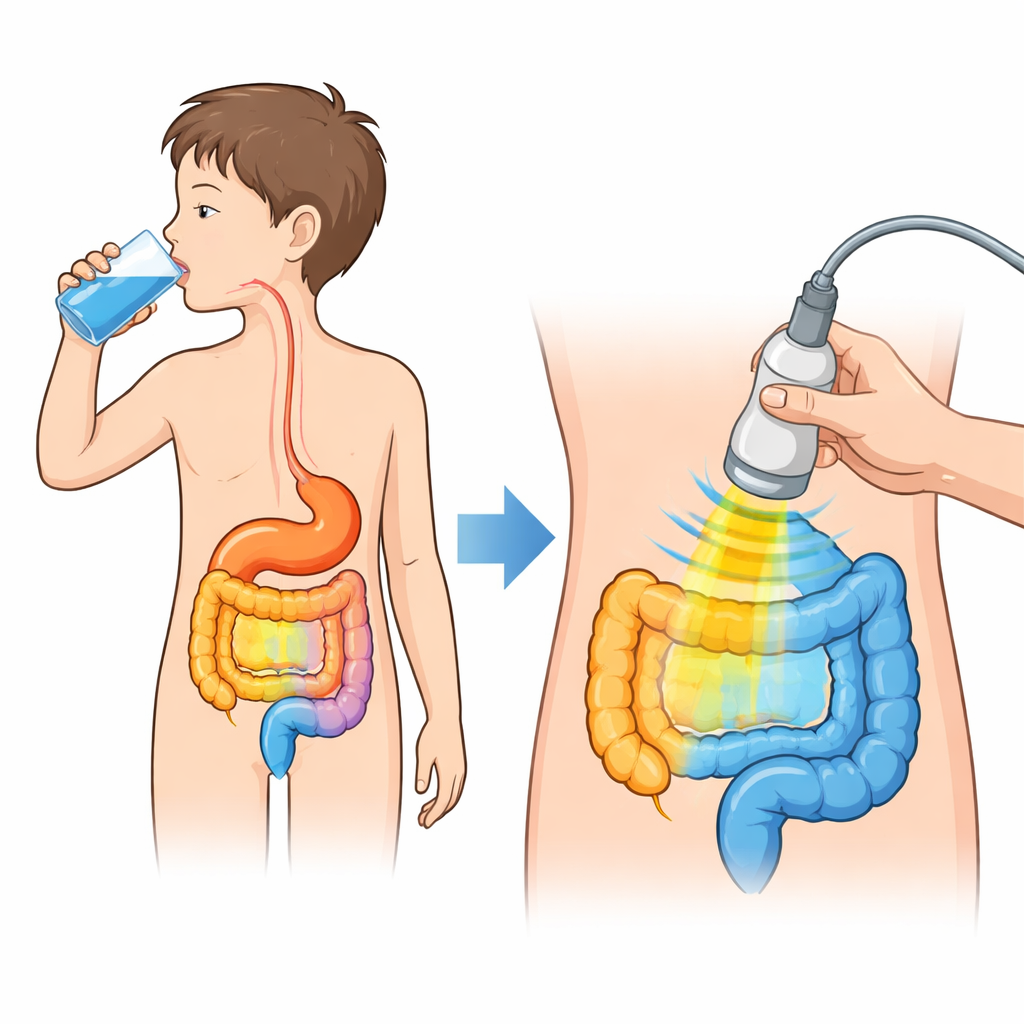
A new way to watch the gut in action
The research team tested a technique called contrast-enhanced multispectral optoacoustic tomography, or CE-MSOT, in ten children who were already undergoing a common test for lactose intolerance. Instead of adding another invasive procedure, the scientists slipped their new method into the existing hospital routine. After an overnight fast, each child drank water enriched with lactose and a harmless green dye used in medicine. Then, at several time points over a few hours, a handheld scanner was placed on the belly to capture images of two specific regions deep inside the abdomen: the end of the small intestine (terminal ileum) and a part of the large intestine (sigmoid colon).
Turning light and sound into pictures of movement
CE-MSOT works by shining very short pulses of laser light through the skin. When this light is absorbed by the dye in the intestines, it causes tiny, rapid expansions that generate ultrasound waves—like miniature sound echoes from inside the body. The scanner picks up these waves and a computer translates them into color images that show where the dye is located. By “unmixing” the different colors of light, the system can separate the dye signal from the background tissue. The researchers defined a strict threshold so that only signals clearly above the starting level counted as true dye detection. This allowed them to pinpoint when the dye first arrived in each intestinal segment and to chart how strongly the signal grew over time.
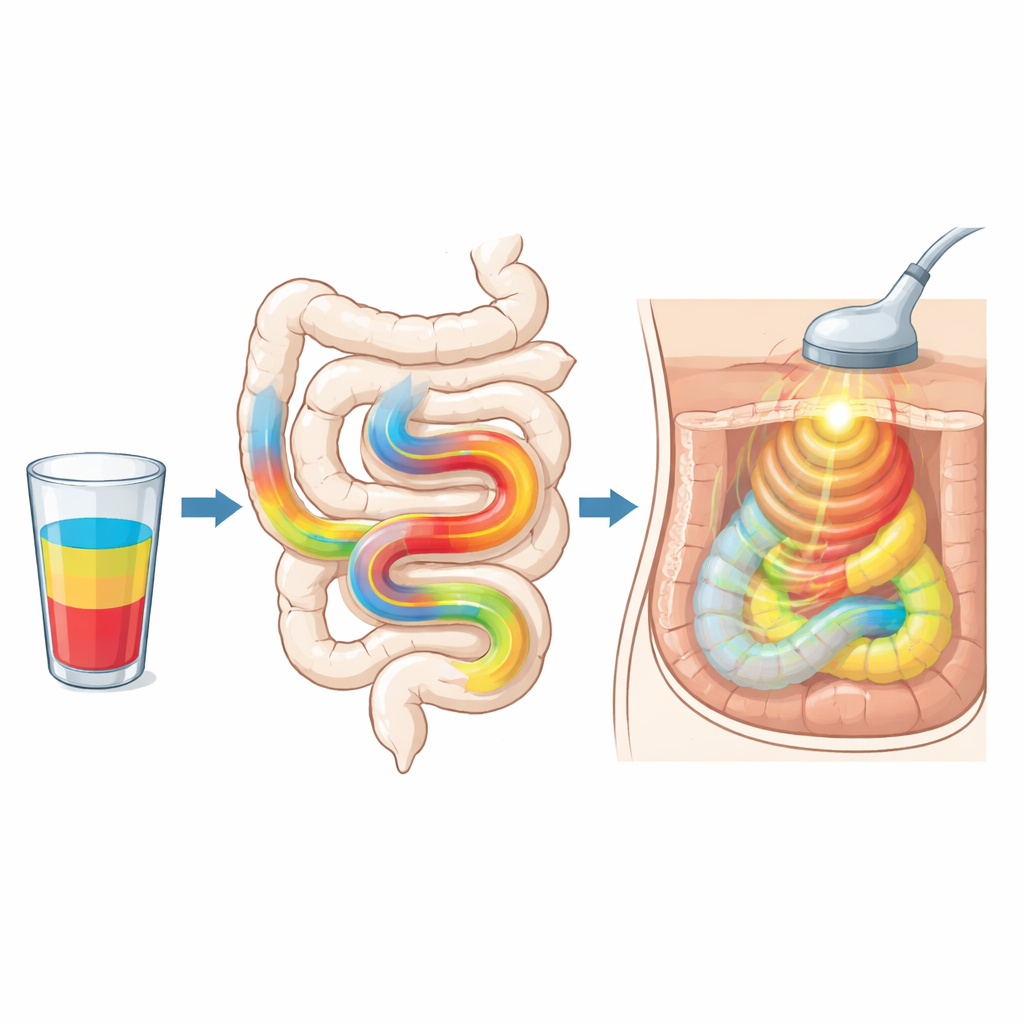
What the timing revealed about symptoms
By tracking the dye’s journey, the team could estimate how quickly material moved through each child’s gut. They found that, compared with published values from healthy children, many of these patients had unusually short transit times—sometimes with dye appearing in the small intestine in just over ten minutes, and in the large intestine in under an hour. Importantly, the method could tell whether the problem lay in the small intestine or the colon. Some children with constipation, for example, showed normal or even rapid movement through the small intestine but very slow arrival in the colon, suggesting that the blockage of movement was confined to the large bowel rather than the entire digestive tract.
Linking fast transit to how children feel
During the scans, four children developed symptoms such as abdominal discomfort and bloating. These children tended to have faster movement of the dye, especially into the end of the small intestine, than those who felt fine during the test. Their dye signals rose sooner and more sharply, hinting that accelerated transit and more active gut motion might be tied to their complaints. Interestingly, some children showed rapid transit and symptoms even though their standard lactose breath test was negative. This suggests that the new imaging method may reveal functional disturbances that routine tests miss, and might help explain why some children feel sick after a meal despite apparently “normal” results.
Promise and next steps
Because CE-MSOT is non-invasive, does not use radiation, and takes only a few minutes per scan, it could be especially suitable for children. The authors argue that measuring gut transit in this way might become a new marker of digestive health, helping clinicians localize problems, distinguish between different types of functional disorders, and give families more tangible explanations for distressing symptoms. The current study is small and covers only two intestinal sites over a limited time, so larger, carefully controlled trials will be needed. Still, this early work shows that it is possible to safely and clearly measure how fast the intestines move in children using light and sound, opening a path toward more precise—and less stigmatizing—care for young patients with chronic stomach troubles.
Citation: Caselitz, L., Claßen, M., Bühler, A. et al. Non-invasive measurement of accelerated gastrointestinal transit in pediatric patients using Contrast-enhanced Multispectral optoacoustic tomography. npj Imaging 4, 32 (2026). https://doi.org/10.1038/s44303-026-00169-4
Keywords: pediatric gut imaging, intestinal transit time, functional abdominal pain, noninvasive diagnostics, photoacoustic tomography