Clear Sky Science · en
3D biocement printing: scaling up living mineral structures
Building with Helpful Microbes
Concrete has made our modern cities possible, but it comes with a heavy climate cost because making cement releases large amounts of carbon dioxide. This study explores a very different kind of "cement" that uses living bacteria to grow stone-like minerals at room temperature, and shows how this living material can be shaped by 3D printing into architecturally useful forms.
From Concrete Printing to Living Stone
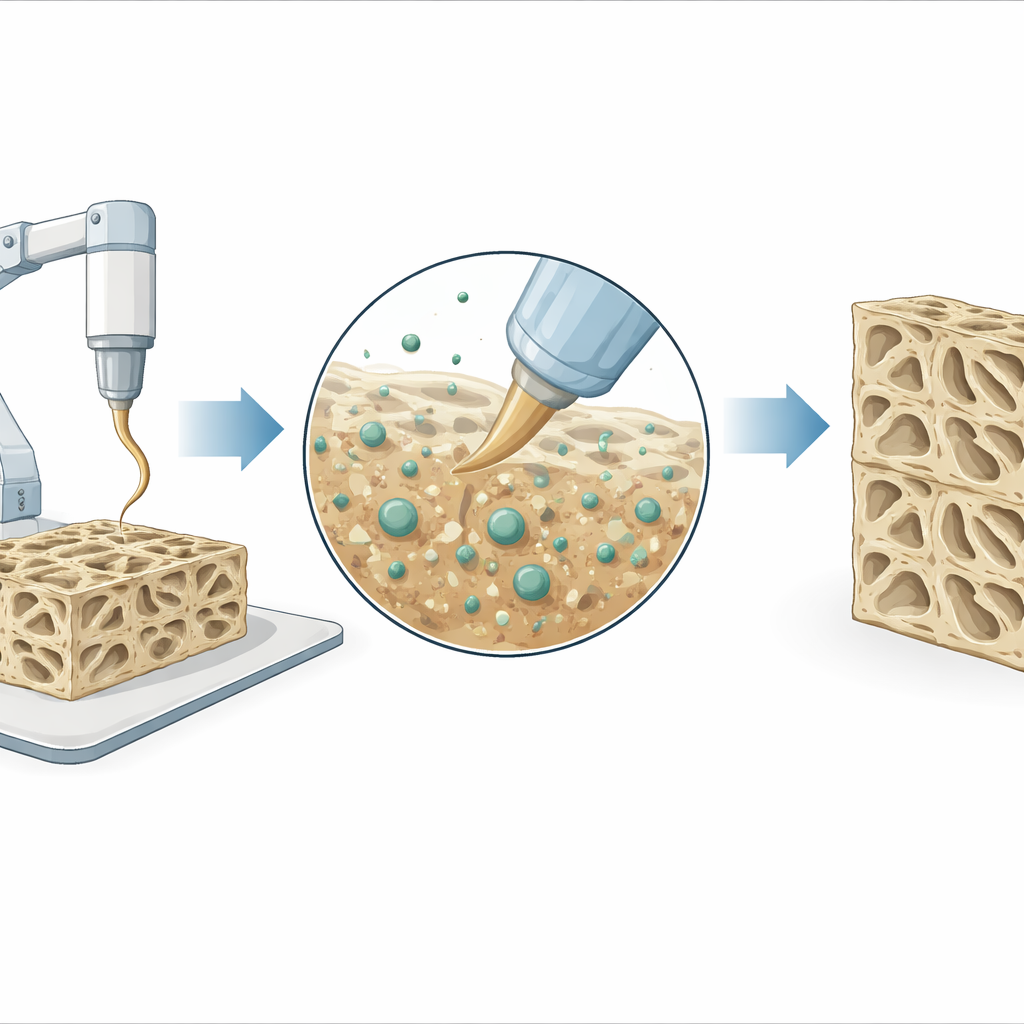
In recent years, robots and 3D printers have begun to construct buildings by squeezing out layers of concrete, allowing architects to create complex shapes without traditional molds. However, these systems still rely on cement, a major source of global CO₂ emissions, and printed elements often suffer from weak bonds between layers. The authors ask whether we can keep the geometric freedom and automation of 3D printing while replacing cement with a low-energy mineral binder grown by microbes. They build on a process in which specific bacteria trigger the formation of calcium carbonate, the same mineral found in limestone and seashells, to glue grains of sand together.
A Printable Living “Ink”
To make this idea practical, the team designs a printable "bio-ink" that behaves like a thick paste but also keeps bacteria alive. The ink combines sand grains for structure, a soft gel made from common natural polymers to hold everything together, and tiny plate-like particles to fine-tune its flow during printing. Microscopy shows that bacteria stay evenly distributed and remain trapped inside the gel when the printed pieces are later soaked in a mineral-rich bath. By adjusting the mix, the researchers can control how easily the ink is squeezed out and how well it holds its shape once deposited, which is crucial for building tall or intricate forms without slumping.
Letting Minerals Grow in the Right Places
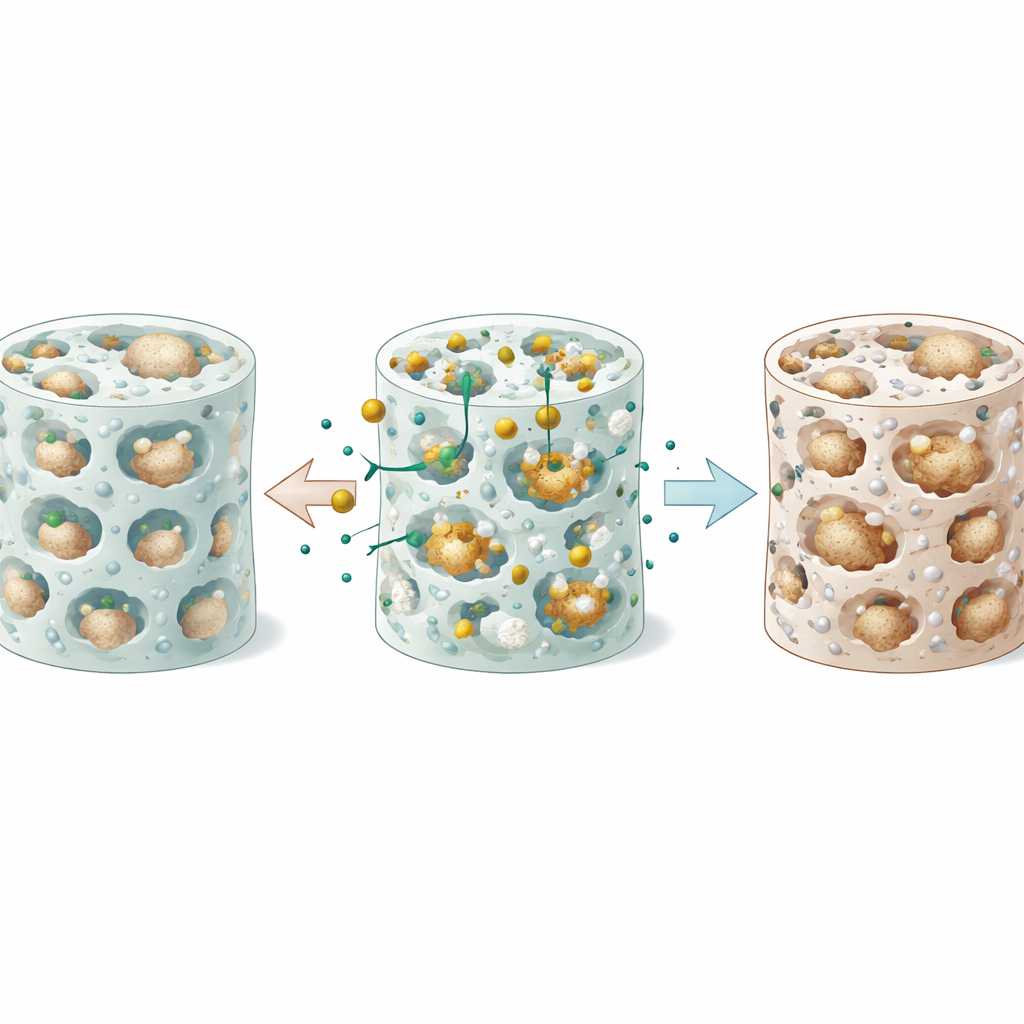
Once printed, the objects are immersed in a solution that feeds the bacteria and supplies the ingredients needed for mineral growth. The microbes convert these ingredients into solid calcium carbonate that forms mainly on surfaces and near open pores, gradually stiffening the material. Tests on simple cylindrical samples show that the presence of bacteria greatly increases stiffness compared with non-living controls, even though strength improvements are modest when the interior remains largely unmineralized. By studying how mineral content changes with depth, the team discovers that growth is limited by how easily dissolved substances can move through the material. This insight leads them to design printed filaments only a few millimeters thick and to introduce deliberate porosity so that the mineral-forming solution can reach more of the internal surfaces.
Stronger Grids and Better Layer Bonds
Using these design rules, the researchers print cube-shaped grids with either closely spaced or widely spaced filaments, then compare versions with and without active bacteria. Sparse grids with more open space accumulate more mineral, distribute cracks more evenly, and become significantly stronger and stiffer than their non-living counterparts in compression tests. In contrast, dense grids develop a hard outer shell but a weak inner core, limiting their performance. The team also examines one of the main weaknesses of layered printing: poor adhesion between successive strands. In ordinary printed samples, the layers separate easily along their boundaries. In living samples, however, newly grown mineral crystals pack into the tiny gaps between layers and act as stone bridges. Bending tests reveal that these bridges boost the ability to resist cracking by more than an order of magnitude and cause failures to cut across layers instead of along them.
From Laboratory Blocks to Architectural Pieces
Although the current material is not yet strong enough to replace structural concrete, its performance is comparable to some lightweight earthen and ceramic materials used for non-load-bearing components. The process works at room temperature and can produce porous, lightweight elements such as façade panels, shading screens, and landscape pieces where airflow, light, and the ability to host plants or small organisms are advantages rather than drawbacks. As a demonstration, the team prints and mineralizes a curved element roughly the size of a small stool, showing that the method can handle objects on the order of tens of centimeters while maintaining shape and internal detailing.
Promise and Practical Challenges Ahead
The work points toward a future in which builders could "grow" mineral materials in place using bacteria and carefully programmed geometry, potentially lowering the embodied energy of building components. At the same time, scaling up this approach will require managing liquid consumption, ensuring even mineral growth in thicker parts, and dealing responsibly with ammonia, a by-product of the microbial process that can harm the environment if released untreated. If these engineering and environmental hurdles can be overcome, 3D biocement printing could offer architects a new family of living, programmable mineral materials that merge digital fabrication with biological growth.
Citation: Antorveza Paez, K., Kindler, R.O., Terzis, D. et al. 3D biocement printing: scaling up living mineral structures. npj Mater. Sustain. 4, 20 (2026). https://doi.org/10.1038/s44296-026-00110-1
Keywords: biocement, 3D printing, microbial materials, sustainable construction, calcium carbonate