Clear Sky Science · en
Sustainable materials selection with emerging structural materials
Why the stuff we build with matters
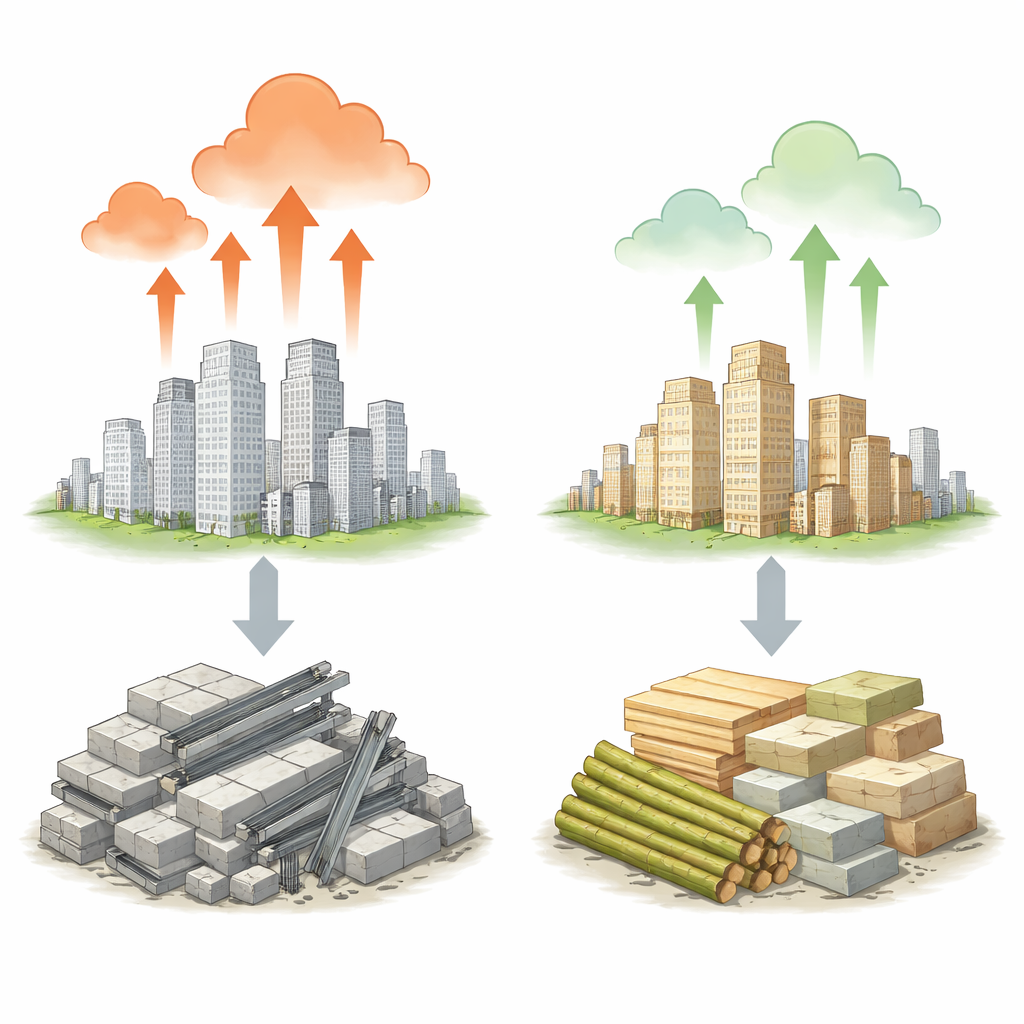
The buildings we live and work in quietly shape the climate. Every beam, column, and slab of concrete or steel represents energy and emissions that have already been spent before anyone turns on a light or heater. As architects and engineers get better at reducing day‑to‑day energy use in buildings, the hidden climate impact locked into construction materials themselves is becoming just as important. This paper explores how switching from conventional to newer structural materials could dramatically cut the carbon footprint of the built environment.
From energy use to hidden building emissions
For decades, most attention in green building design focused on “operational” emissions: the fuel and electricity needed for heating, cooling, lighting, and equipment. Thanks to better insulation, efficient systems, and more renewable power, these emissions are slowly falling. What remains stubbornly large is “embodied” carbon – the greenhouse gases released when raw materials are dug from the ground, processed in factories, transported, and assembled into structures. In many new buildings, especially in countries like the UK, embodied emissions already make up well over half of their lifetime climate impact. Because structural materials such as concrete, steel, and engineered wood make up the bulk of a building’s mass, they also dominate this hidden carbon bill and offer the biggest opportunity for cuts.
New materials entering the construction toolbox
The authors assembled a large dataset of 409 different construction materials, splitting them into traditional options and “emerging” ones that have not yet seen wide use. These include new concretes that replace ordinary cement with blends of limestone and clay, industrial by‑products, or magnesium‑based binders; lightweight aggregates made from waste ashes and carbonated residues; and a growing family of engineered wood products such as cross‑laminated timber, laminated bamboo, and densified wood. For each material, they gathered up to 21 different properties, from stiffness and strength to density and measures of environmental impact. They then plotted these data on material selection charts that show how properties trade off against each other, helping designers see where emerging materials can match or extend the performance of familiar ones.
Strength, lightness, and carbon compared
The study finds that many next‑generation materials already match or outperform conventional ones on basic engineering performance. Several new concretes reach similar stiffness and compressive strength to ordinary cement concrete, meaning they can safely carry the same loads. Engineered timber products – including laminated timber, structural composite timber, and bamboo – often equal or exceed the strength and stiffness of standard glued laminated wood. Densified wood can achieve particularly high strength. At the same time, many of these materials are lighter than their conventional competitors, which reduces the total mass that must be produced and transported. However, the authors also reveal a major data gap: fewer than one in three of the materials they studied had reliable numbers for embodied carbon, and fewer than one in ten had embodied energy data, making it difficult to fully judge their environmental advantages.
Beams, columns, and the climate difference
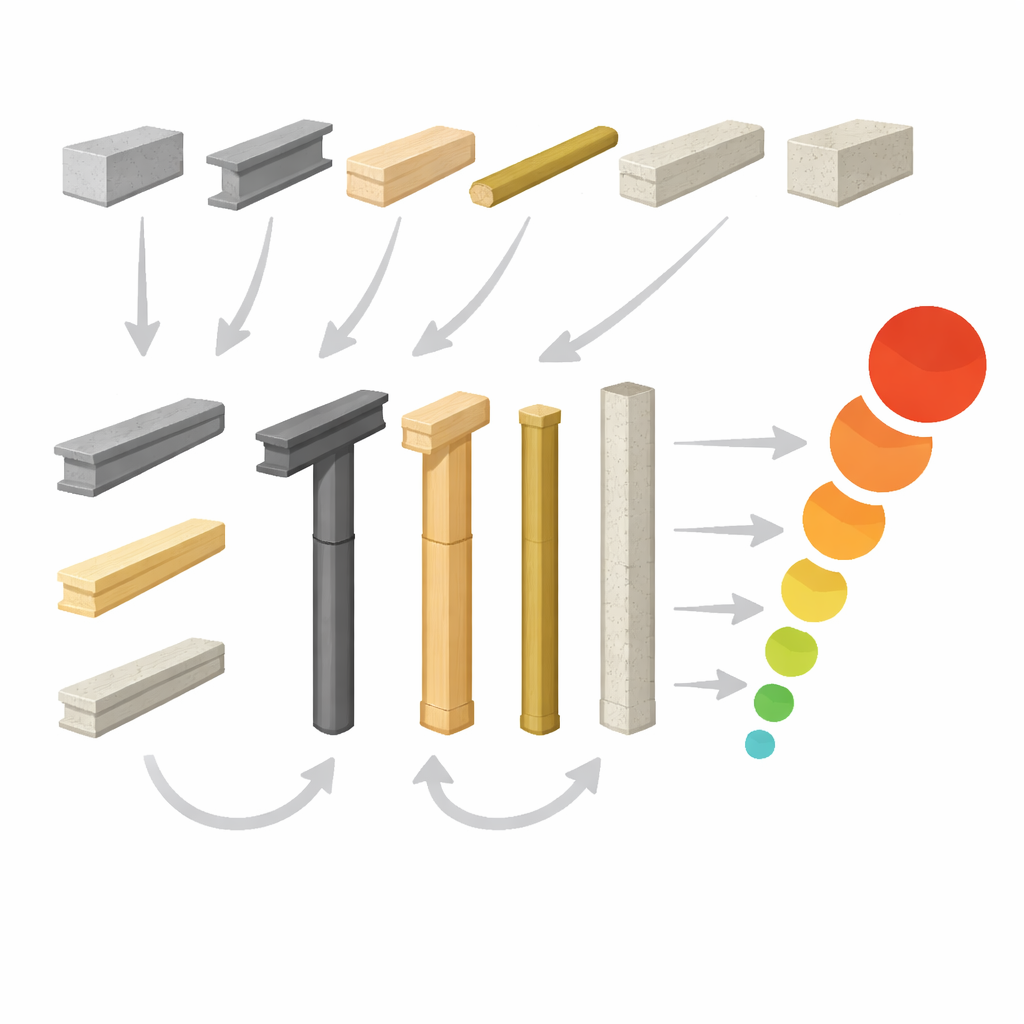
To show what these numbers mean in practice, the researchers carried out two simplified design exercises: one for a floor beam and one for a vertical column. They designed each element to meet the same structural demands – in span, load, and safety – but allowed the material to change. When they compared total embodied carbon for equivalent beams, reused steel and engineered timber products came out best. Reused steel beams, made from salvaged sections cleaned and certified for new use, emitted only around 3–5 percent of the carbon of beams made from new steel. Timbers such as cross‑laminated or glued laminated wood, as well as bamboo, also showed large reductions compared with both traditional steel and concrete. Similar patterns appeared for columns, where reused steel and engineered wood again delivered the lowest embodied carbon, with newer low‑carbon concretes outperforming conventional cement mixes but still trailing the very best options.
What this means for future buildings
The authors conclude that there is already a strong technical basis for replacing high‑carbon materials with lower‑carbon alternatives in major structural roles, particularly by reusing steel and expanding the use of engineered timber and bamboo. Their database shows that many emerging materials can provide equal strength and stiffness while slashing climate impact. Yet progress is held back by gaps in environmental data, limited testing and certification, and a lack of integration of these materials into mainstream design tools and standards. By systematically gathering and comparing material properties, this work offers designers and policymakers a clearer map of the options available today and highlights where better data and support are needed to make low‑carbon construction the norm rather than the exception.
Citation: Burdett, S., Arora, M. & Myers, R.J. Sustainable materials selection with emerging structural materials. npj Mater. Sustain. 4, 13 (2026). https://doi.org/10.1038/s44296-026-00099-7
Keywords: embodied carbon, low-carbon concrete, engineered timber, reused steel, sustainable construction materials