Clear Sky Science · en
Perceptual rhythms by phase-aligned perceptual performance peaks across trials
Why our senses may not tick like a clock
For years, scientists have suggested that our perception of the world rises and falls in steady mental "beats," as if the brain were rhythmically turning attention up and down several times each second. This idea helps link behavior to the natural brain waves seen in electrical recordings. The new work in this article proposes a different view: instead of perception itself endlessly pulsing, our brain may create just one brief moment of heightened sensitivity on each attempt, timed to line up with a helpful phase of an ongoing brain rhythm.
Looking for hidden patterns in quick flashes
Much of the evidence for rhythmic perception comes from experiments where people detect or judge very brief visual targets that appear at different delays after a reference event, such as a cue on the screen. When performance at each delay is plotted over time, it often shows gentle wiggles within a second, and mathematical tools like the Fourier transform reveal strong peaks at certain frequencies. This has been taken to mean that perception itself regularly cycles through high and low efficiency, following an internal rhythm of around 7 to 10 cycles per second. These behavioral findings match many brain imaging studies that link the phase of ongoing brain waves to how well people see or respond.
A single spotlight instead of a blinking strobe
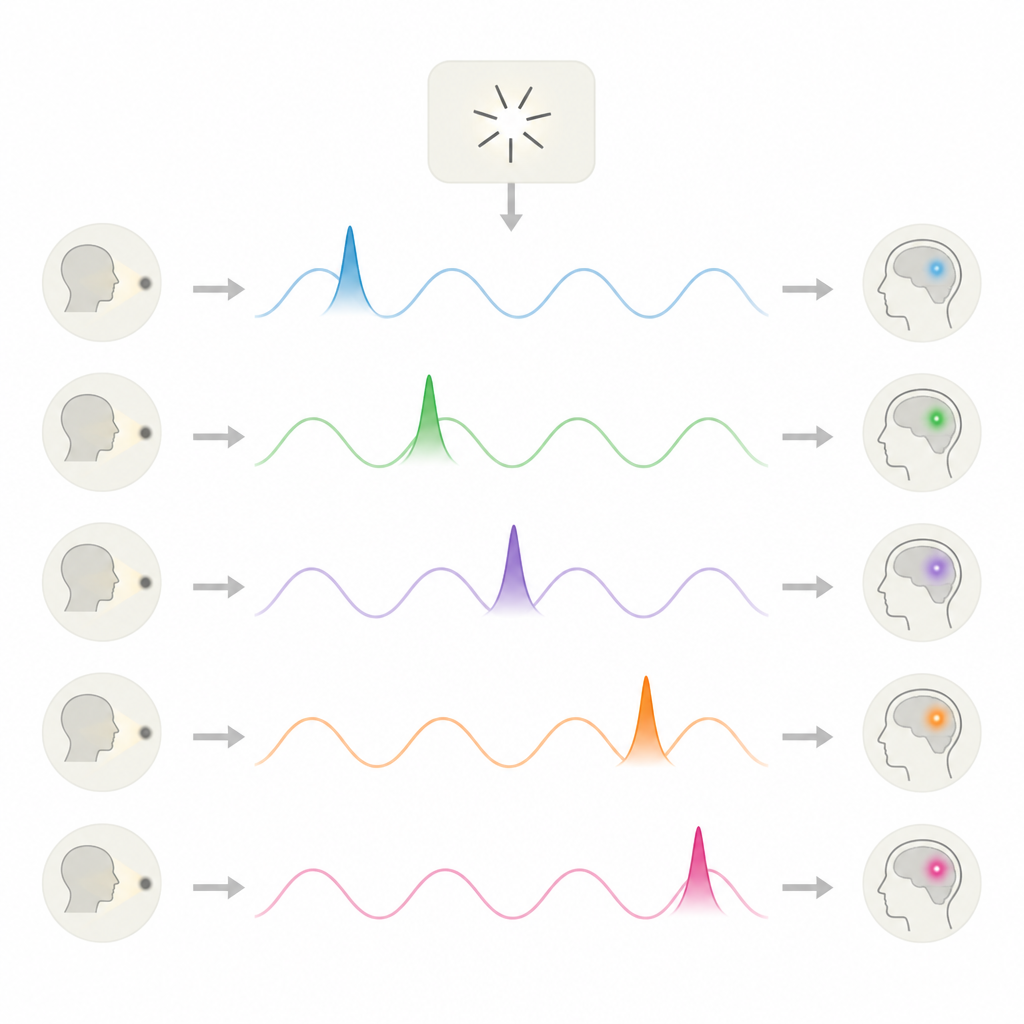
The authors argue that the same data can be understood without assuming that perceptual efficiency itself rhythmically rises and falls many times each second. They introduce the phase-alignment model, which says that in each trial the brain creates just one strong "spotlight" of efficiency over time. This spotlight does not need to trace out a repeating wave. Instead, its timing is restricted: it can only fall at a few favorable points that match certain phases of a continuing brain rhythm in the background. Across many trials, the spotlight can land on different favored phases, but always in alignment with one of them. When all trials are averaged, this produces neat rhythmic wiggles in the performance curve even though no single trial contains a true rhythm of multiple peaks and dips.
How recent experience shapes the best moment
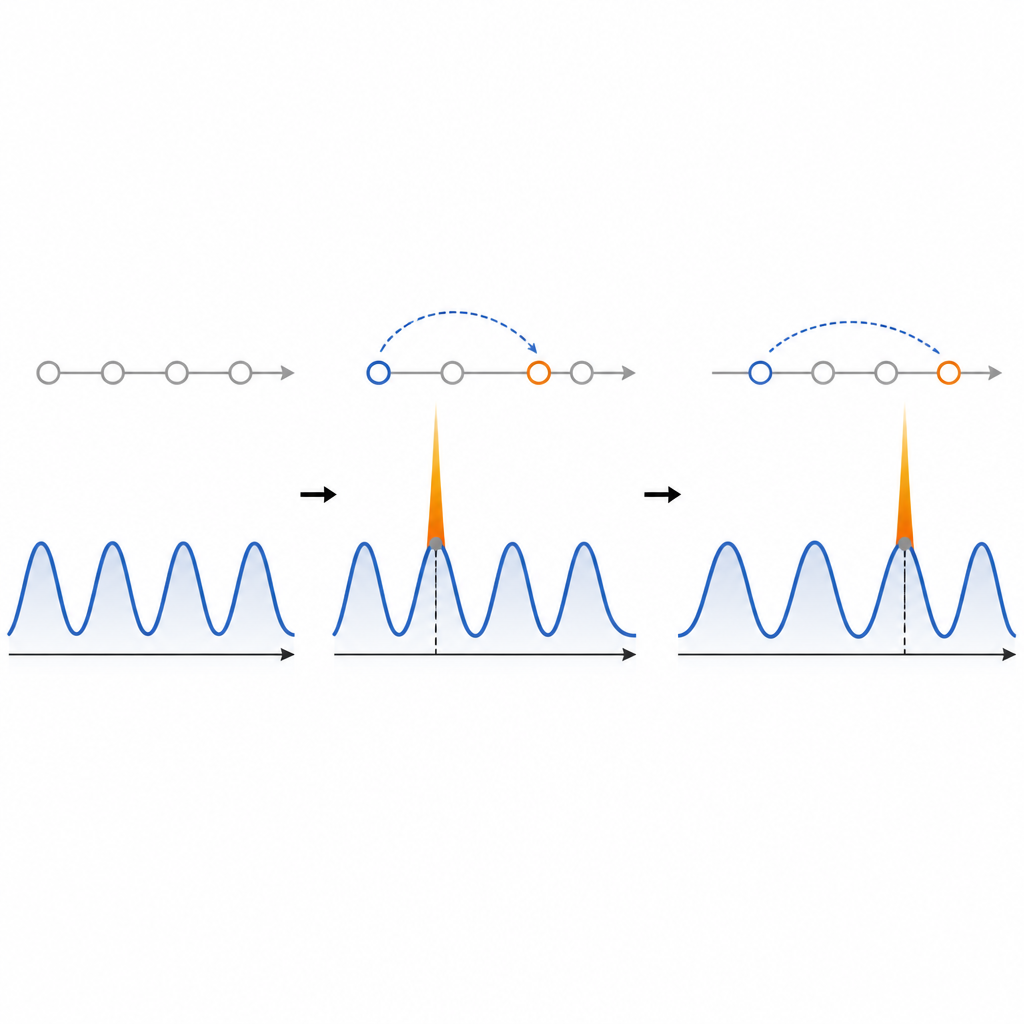
A key ingredient in this model is foreperiod priming, the well-known tendency for people to prepare for an event at about the same delay as on the previous trial. The authors simulate thousands of trials in which the brain’s single efficiency peak is shifted so that, on each trial, it aligns with the phase of the ongoing rhythm that lies closest in time to the previous delay. In these simulations, standard analysis methods still detect strong rhythmic patterns in performance, matching what many experiments report. Crucially, the model also predicts that the strength of foreperiod priming itself should rise and fall over time: some delays are easy to prime because a peak can be placed there precisely, while delays that fall between favored phases are harder to prime.
Checking real data for rhythmic priming
To test this prediction, the authors reanalyzed three existing datasets from visual attention and perception studies involving 44, 34, and 11 participants. In each case, they tracked how much faster or more accurate people were when the same delay repeated from one trial to the next, across a range of delays. They then examined whether this priming effect itself showed rhythmic fluctuations. In all three datasets, they found clear peaks in a frequency range around 7 to 10 cycles per second. Additional checks using more conservative statistical methods suggested that these rhythmic components could not easily be explained by non-rhythmic trends in the data.
What this means for how the brain uses time
To a lay observer, the conclusion is that our perception may not be governed by an ever-blinking internal metronome. Instead, the brain seems to place brief moments of extra sensitivity at carefully chosen times, guided by both a background brain rhythm and recent experience of when events tend to occur. This phase-alignment view still respects the importance of brain waves, but it treats them as a scaffold for timing, not as the direct shape of perception itself. Understanding whether our mental "spotlight" is truly rhythmic or simply snaps to favored moments could deepen how we think about attention, working memory, and the way neural activity gives rise to what we consciously see.
Citation: Schoeberl, T., Treue, S. Perceptual rhythms by phase-aligned perceptual performance peaks across trials. Commun Psychol 4, 84 (2026). https://doi.org/10.1038/s44271-026-00453-4
Keywords: perceptual timing, brain rhythms, attention, temporal expectation, visual perception