Clear Sky Science · en
The association between the error-related negativity and self-control is moderated by impulsivity and compulsivity
Why Everyday Slips Matter
Why do we sometimes stick to our goals—like eating healthier or cutting screen time—and other times give in almost automatically? This study looks at how the brain’s built-in “error alarm” works together with personality traits to shape self-control in daily life. By combining brain recordings with smartphone surveys, the researchers explore why some people can use internal warning signals to stay on track, while others notice problems but still get pulled into rigid habits or impulsive choices.

Moments of Temptation in Daily Life
The researchers followed 221 adults over seven days using short phone questionnaires. Several times a day, participants reported whether they had felt a desire—such as for food, social media, or rest—how strong it was, whether it clashed with a goal (like working or saving money), whether they tried to resist, and whether they ultimately gave in. From these snapshots, the team built a picture of real-world self-control: how often desires were enacted, how often people experienced inner conflict, and when resistance succeeded or failed.
Listening to the Brain’s Error Signal
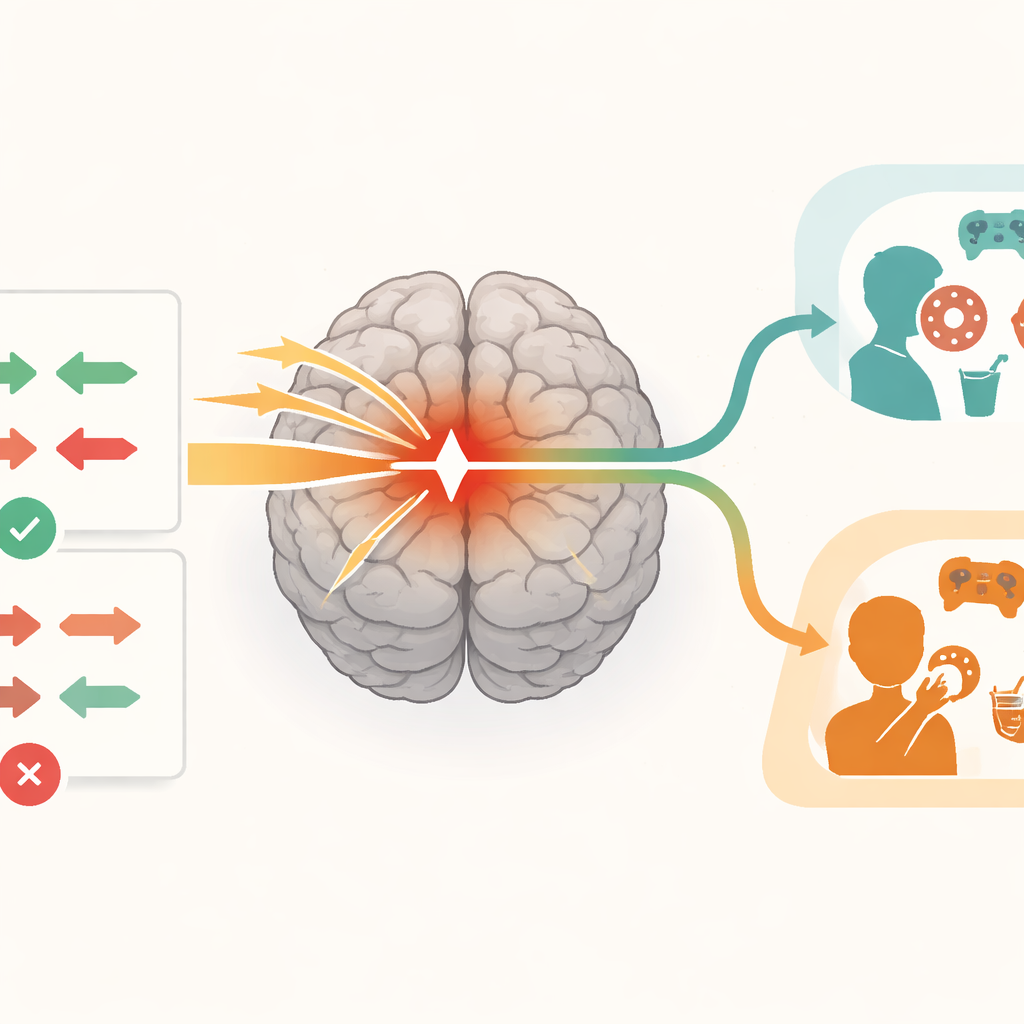
In the lab, the same participants completed a demanding button-press task while their brain activity was measured. When people make a mistake in such tasks, the brain produces a rapid electrical spike called the error-related negativity, or ERN. This signal, measured with EEG, is thought to flag that “something went wrong” and to help recruit mental control for better behavior next time. The key question was how strongly this internal alarm predicts everyday self-control—and whether that depends on traits like impulsivity (a tendency toward hasty actions) and compulsivity (a tendency toward rigid, repetitive behavior).
When Traits Tip the Balance
The study found that people high in compulsivity, but not necessarily in impulsivity, reported more frequent enactment of desires and more self-control failures. They also experienced more desires, more conflict about those desires, and stronger feelings of conflict. In other words, highly compulsive individuals did not simply have “too much control”; they faced more inner struggle and were more likely to act against their longer-term aims. At the same time, both higher impulsivity and higher compulsivity changed how desire strength and conflict translated into behavior, making actions less tightly tuned to how tempting or problematic a situation felt.
When the Alarm Stops Guiding Action
A central finding was that the ERN helped predict better self-control only in people low in both impulsivity and compulsivity. In these individuals, a stronger error signal was linked to fewer desire enactments and fewer failures to stick with goals. But as impulsivity and compulsivity increased—especially when both were high—the link between the ERN and daily self-control shrank or disappeared. A cluster analysis supported this pattern: participants with a profile marked by higher compulsivity, anxiety, and worry had more self-control failures, and in this group the brain’s error signal had much less impact on behavior. This suggests that for some people, the monitoring system is active, but the message does not effectively change what they do.
What This Means for Everyday Willpower
To a layperson, the study’s conclusion is that self-control is not just about having a strong inner alarm or a strong will. Many people with high anxiety and compulsive tendencies may notice errors and conflicts intensely, yet still struggle to change course, while those with high impulsivity may not use these warning signals efficiently. Effective self-control seems to depend on a finely tuned partnership between brain monitoring systems and personality traits. Understanding this partnership may help explain why standard “try harder” advice often fails—and why treatments for addiction, obsessive–compulsive problems, and other conditions may need to focus not only on detecting problems, but on helping people translate that awareness into flexible, goal-directed action.
Citation: Overmeyer, R., Kräplin, A., Goschke, T. et al. The association between the error-related negativity and self-control is moderated by impulsivity and compulsivity. Commun Psychol 4, 62 (2026). https://doi.org/10.1038/s44271-026-00446-3
Keywords: self-control, impulsivity, compulsivity, error-related negativity, performance monitoring