Clear Sky Science · en
Decarbonizing desert greenhouse crop production with direct air capture–based CO2 enrichment
Fresh Food from Harsh Desert Heat
Growing salad greens and tomatoes in scorching deserts might sound impossible, yet high tech greenhouses already do it using very little water. The catch is that these glass fortresses depend on carbon dioxide delivered by truck, which adds cost and pollution. This study asks whether greenhouses could instead pull CO2 directly from the air at the farm, cutting both fuel use and climate impact while still feeding people in some of the driest, hottest places on Earth.
Why Desert Greenhouses Need Extra Help
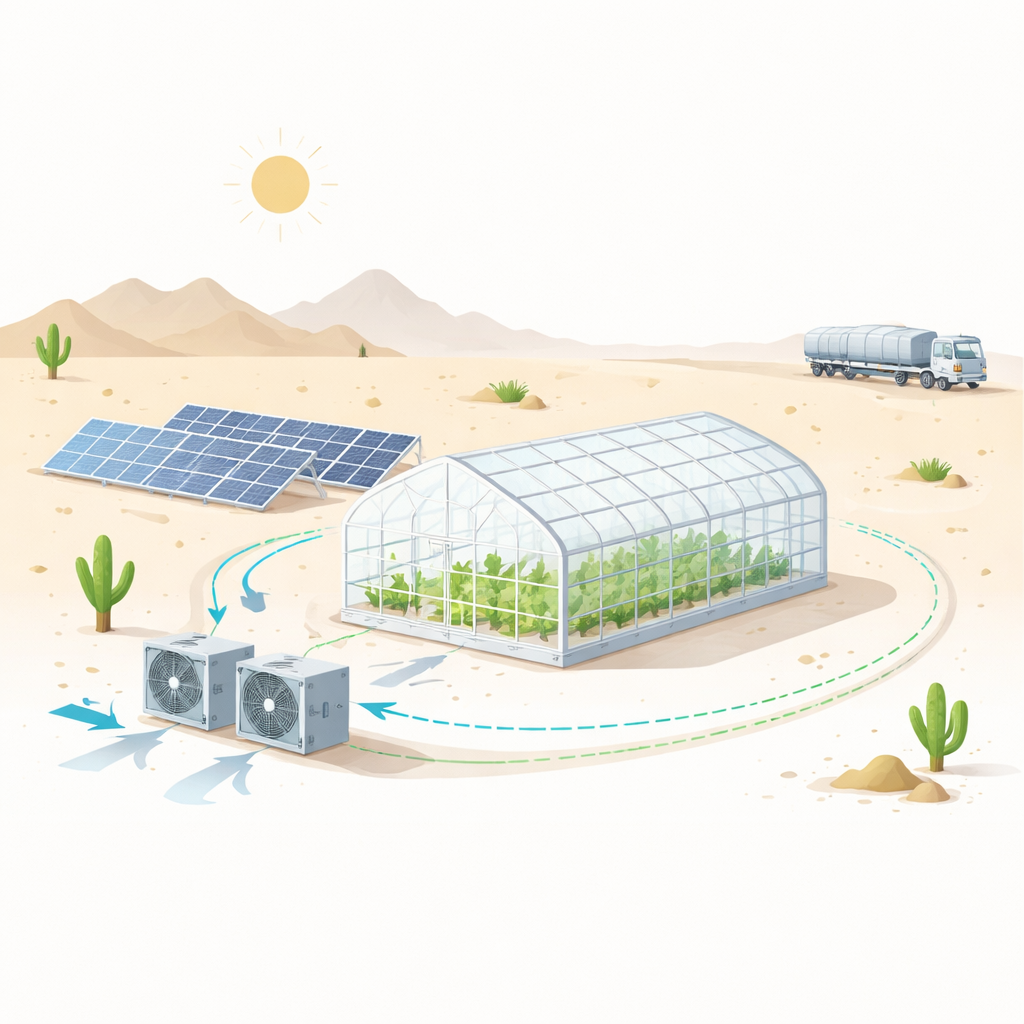
Modern desert greenhouses are tightly sealed buildings cooled by powerful chillers and powered by cheap solar electricity. Inside, growers carefully manage light, temperature, water, and nutrients to get several times more yield per hectare than open fields while using a fraction of the water. But there is a missing ingredient. Because the structure is closed to keep heat out, plants quickly draw down the carbon dioxide in the air. Levels inside can drop to half of what is outdoors, slowing photosynthesis and limiting how much lettuce and cherry tomato the greenhouse can produce.
Today’s Solution Relies on Trucks
To fix this, most commercial operators buy pure liquid CO2 captured from industrial plants, truck it to the greenhouse, store it in large tanks, and vaporize it into the growing space. This process reliably boosts yields and profits but comes with trade offs. The price a farmer pays for each ton of CO2 includes production, road transport, and supplier markups. For many desert sites that are far from gas sources, these costs are high and the truck journeys add substantial greenhouse gas emissions. In addition, safely handling pressurized tanks and frequent deliveries increases operational complexity.
Pulling Carbon from Thin Air On Site
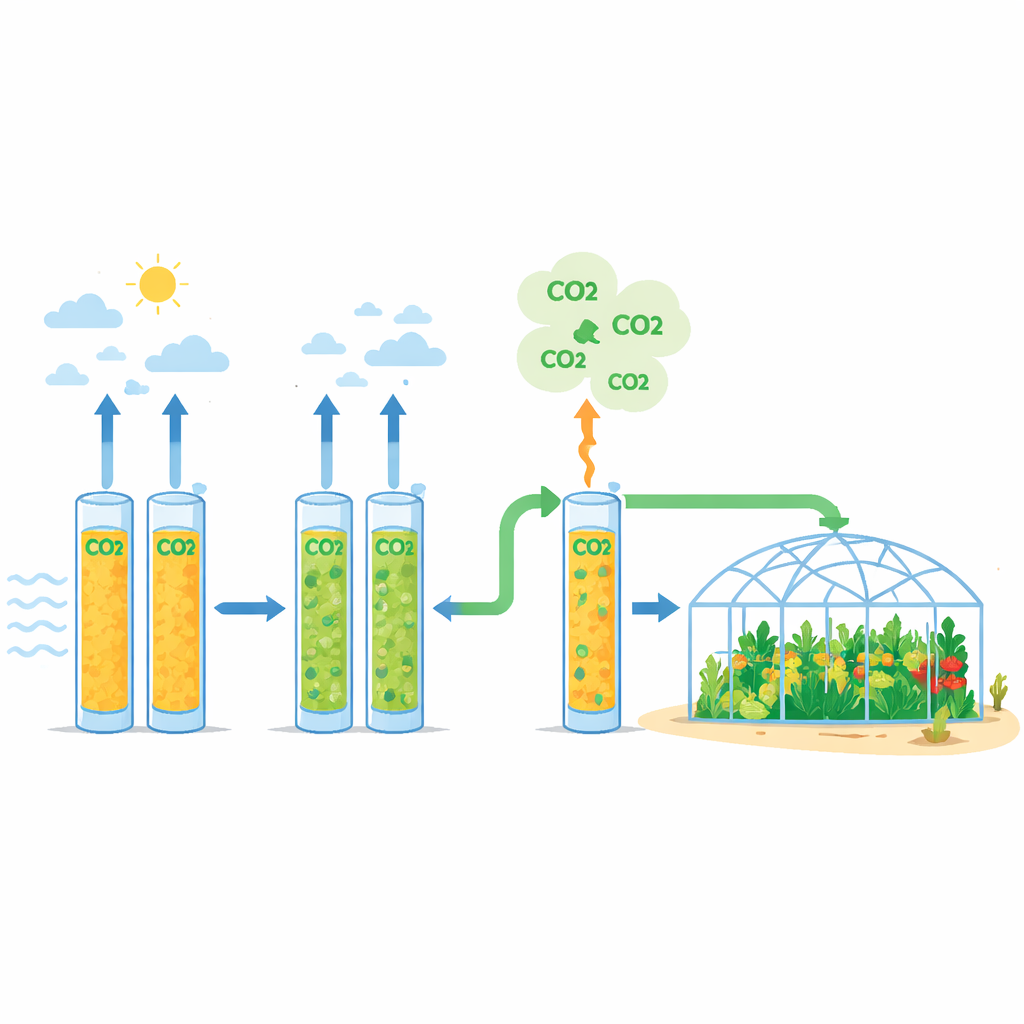
The researchers explored a different approach known as direct air capture, which uses special solid materials to grab CO2 directly from ambient air. They modeled two designs that could sit next to a one hectare desert greenhouse. In a temperature vacuum system, fans push air through a column filled with a porous sorbent that binds CO2. Once the material is saturated, the column is sealed, gently heated, and exposed to a mild vacuum so that the CO2 is released as a low purity stream that is good enough to feed the crops. In a moisture swing system, the sorbent holds CO2 when it is dry and lets it go when wetted, so the cycle is driven by adding and removing water rather than heat and deep vacuum.
What the Numbers Say about Cost and Climate
Using computer models tied to real weather data from Jeddah, Saudi Arabia, the team estimated how much CO2 the greenhouse would need over an entire year, based on detailed crop photosynthesis calculations. They then sized each enrichment option to meet that demand and worked out lifetime equipment and operating costs, including electricity and water use. For both lettuce and cherry tomato, the direct air capture systems delivered CO2 at roughly 240 to 252 US dollars per ton, similar to or cheaper than trucked liquid CO2 in many realistic market conditions. When they added a life cycle assessment, which tracks emissions from materials, energy, and transport from cradle to farm gate, they found that running the capture units on solar heavy electricity cut overall climate impact compared with trucking CO2, especially for tomato crops that require more enrichment.
Key Levers and Trade Offs for Growers
The analysis showed that the two capture designs have different strengths. The moisture swing option needs fewer components, so its upfront hardware cost is lower, but it uses more fan power and water during operation. The temperature vacuum system costs more to build because it needs a heat pump and vacuum pump, yet it uses electricity slightly more efficiently and tends to have lower emissions. In both cases, the biggest factors shaping cost are the local price and cleanliness of electricity and how much CO2 each kilogram of sorbent can cycle in a day. Improvements in sorbent performance and low cost solar power in hot desert regions can therefore make these systems even more attractive over time.
What This Means for Future Desert Food
In clear terms, the study suggests that desert greenhouses do not have to rely on diesel trucks hauling CO2 across long distances. With the right design, compact air capture units powered by solar panels can provide the CO2 needed to keep crops growing fast while trimming greenhouse gas emissions. Cooling the greenhouses still dominates their climate footprint, but pairing efficient cooling with low carbon electricity and on site CO2 capture offers a promising path to grow more food in water stressed regions without proportionally increasing their impact on the planet.
Citation: Lopez-Reyes, Z., Hopwood, W., Jones, J. et al. Decarbonizing desert greenhouse crop production with direct air capture–based CO2 enrichment. npj Sustain. Agric. 4, 39 (2026). https://doi.org/10.1038/s44264-026-00149-6
Keywords: desert greenhouse, direct air capture, CO2 enrichment, solar energy, sustainable agriculture