Clear Sky Science · en
Alleviating water scarcity by alternative cropping systems in the North China Plain
Why this matters for our food and water
Across many of the world’s breadbasket regions, farmers are drawing more water from underground than nature can put back. Nowhere is this more worrying than in the North China Plain, a region that feeds hundreds of millions of people. This study asks a deceptively simple question with global relevance: can we rearrange what farmers plant, and how often they plant it, so that we keep harvests high while letting underground water levels recover instead of sink year after year?
A thirsty landscape under pressure
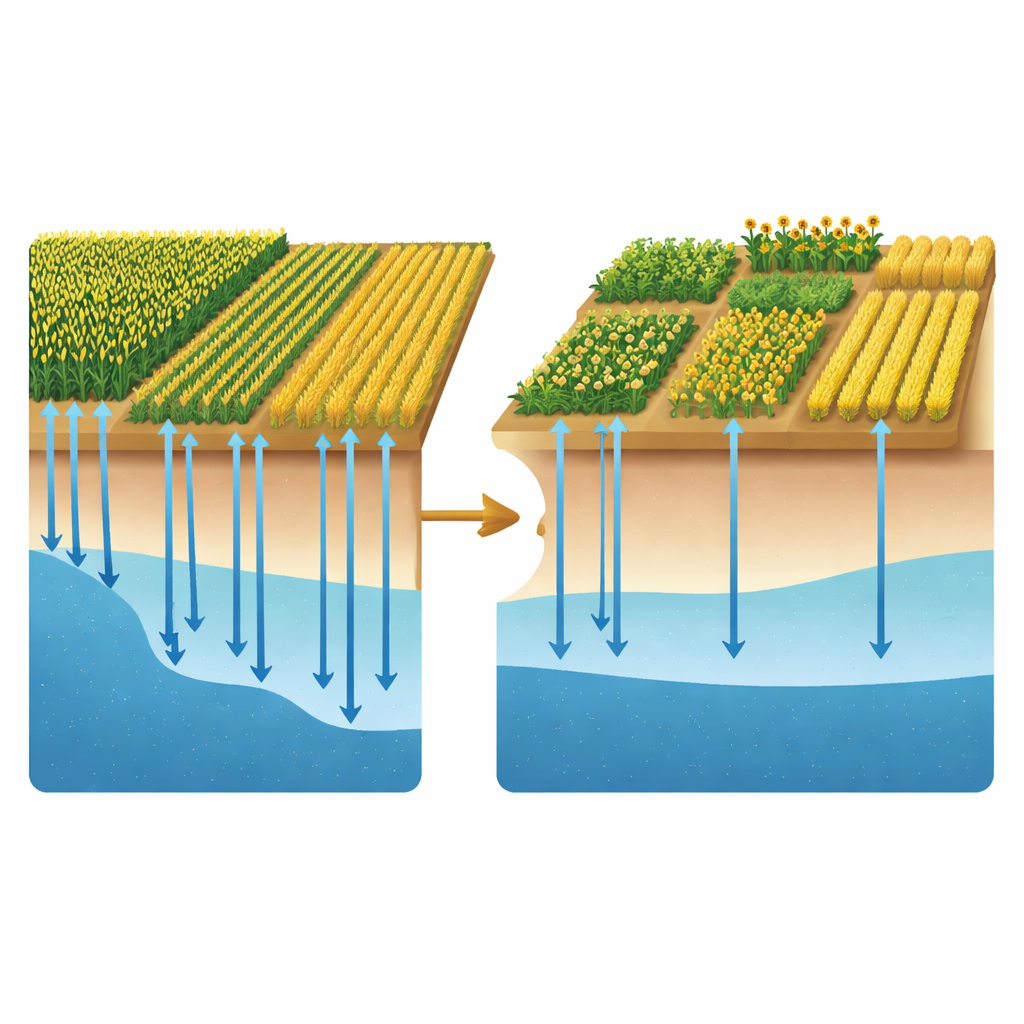
In the North China Plain, most fields follow a demanding schedule: winter wheat is grown first, followed by summer maize on the same land each year. This double-cropping pattern delivers high yields, but it also drinks far more water than local rainfall can supply. Because only about a third of yearly rain arrives during the wheat season, farmers rely heavily on pumping groundwater for irrigation. Over decades, this has created a growing gap between water taken out and water naturally seeping back into the aquifer, causing the underground water table to fall by roughly a meter each year in some places.
Testing new planting patterns on a virtual farm
To explore ways out of this dilemma, the researchers used a detailed computer model of crops, soils, and water, known as APEX, and ran it with 30 years of real weather data from 1994 to 2023. They compared the traditional wheat–maize system with eight alternative planting patterns. Some of these reduced how often crops were grown, such as planting only one crop per year. Others kept a relatively high number of harvests but mixed in different crops, including a new rotation that alternates spring peanut with the familiar winter wheat–summer maize pair over two years. For each planting pattern, they also tested four water strategies, from generous irrigation to rainfed conditions with no added water.
Balancing harvests and water use
The model showed that the conventional wheat–maize system, when fully irrigated, produced the biggest harvests but at a steep hidden cost: the underground water table dropped about 0.7 meters every year. Cutting back irrigation slowed the decline but did not stop it unless farmers switched entirely to relying on rainfall, which sharply reduced yields. Alternative planting patterns told a more hopeful story. Systems that spread three harvests over two years, especially those including spring peanut, reduced the total amount of water lost through crops and soils by 12–49 percent while keeping yields surprisingly close to the traditional system when water was limited. One standout option—spring peanut followed by winter wheat and summer maize—delivered nearly the same production as the conventional system under modest irrigation, yet almost halted the long-term fall of groundwater.
How a small nut makes a big difference
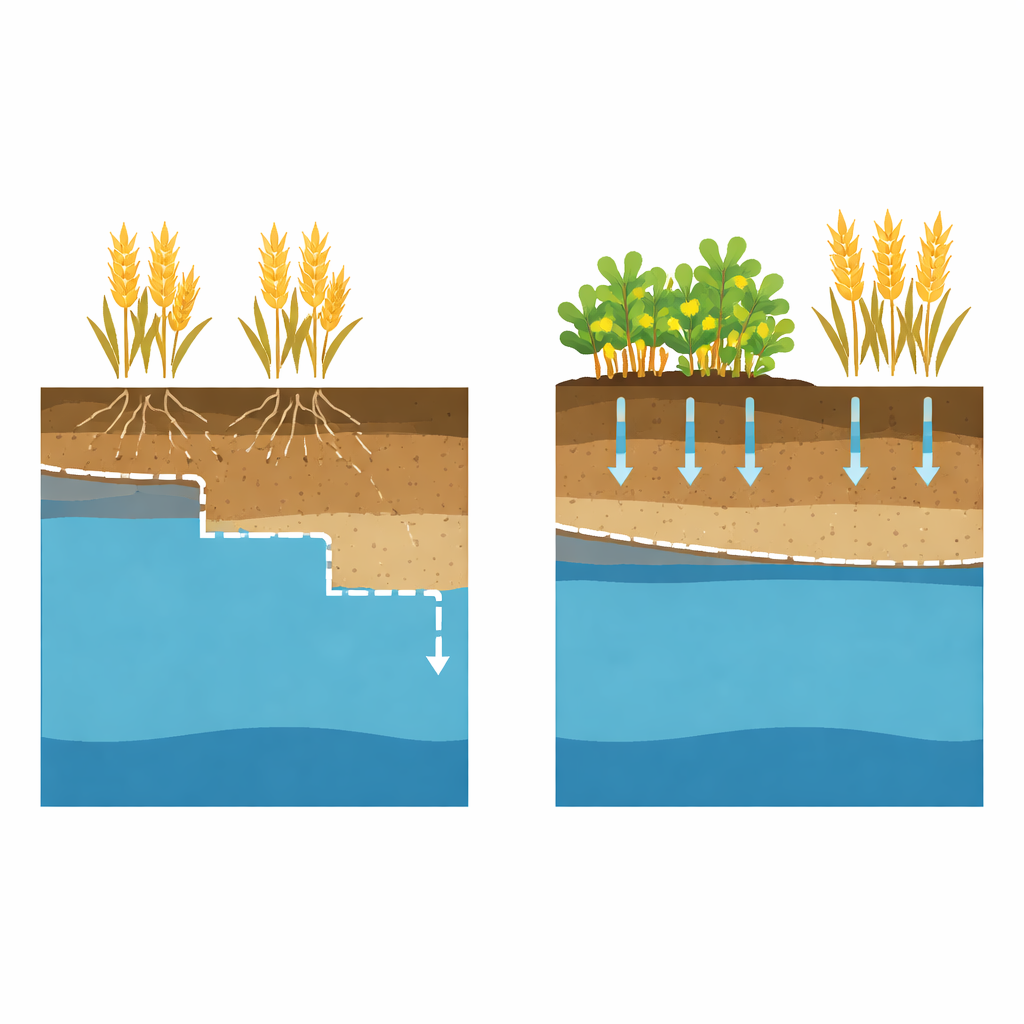
Why does adding peanut help so much? Peanuts use water differently than wheat and maize, and they bring side benefits. Their roots explore different soil layers over the year, improving how rainwater is stored and tapped. As a legume, peanut can capture nitrogen from the air, leaving some behind for the following crops and reducing fertilizer needs. The modeled rotations that included spring peanut used less water overall, had higher “crop per drop” efficiency, and produced more stable yields from year to year. In some scenarios with less frequent planting or lower irrigation, these systems even allowed extra water to seep downward, helping to refill the aquifer rather than drain it.
A path toward shared water and food security
The study concludes that simply fine-tuning irrigation on today’s crop combinations is not enough to solve groundwater decline. Instead, rethinking what is grown, and how often, offers a powerful tool. In the North China Plain, shifting from continuous wheat–maize to diversified rotations that include spring peanut could sharply slow or nearly stop groundwater depletion while maintaining reliable food production. Because the approach relies on changing cropping patterns rather than expensive new infrastructure, it could be adopted in other water-stressed farming regions around the world. In essence, the work shows that smarter planting schedules can help farms live within their water means without sacrificing the harvests that societies depend on.
Citation: Zhao, J., Yang, Y., Meki, M.N. et al. Alleviating water scarcity by alternative cropping systems in the North China Plain. npj Sustain. Agric. 4, 33 (2026). https://doi.org/10.1038/s44264-026-00145-w
Keywords: groundwater depletion, cropping systems, irrigation, North China Plain, sustainable agriculture