Clear Sky Science · en
A platinum butterfly effect: small changes turn an anticancer drug into a non-toxic metalloantibiotic with in vivo efficacy
Why a cancer drug cousin could help fight stubborn bacteria
Antibiotic resistance is turning once routine infections into hard-to-treat illnesses. This study explores an unexpected ally in that fight: a platinum-based compound related to a common chemotherapy drug. By tweaking its structure, scientists turned a toxic cancer medicine concept into a non-toxic "metalloantibiotic" that kills dangerous skin bacteria in mice while sparing healthy cells.
New weapons against hard-to-kill germs
Many existing antibiotics are losing their power, and very few new types reach patients. Most efforts focus on flat, carbon-based molecules, which may miss promising chemical spaces. Metal-containing compounds offer more three-dimensional shapes and unusual ways of interacting with cells. In a large screening effort, platinum complexes stood out as especially active against bacteria yet surprisingly gentle to human cells. Building on that, the authors focused on a family of platinum compounds built around a ring-shaped organic piece called cyclooctadiene, previously shown to attack Gram-positive bacteria such as Staphylococcus aureus.
Finding the sweet spot in the molecule
The team systematically modified different parts of these platinum compounds to see which changes helped or hurt their germ-killing power. When they decorated a key double bond on the ring with bulky chemical groups, activity against bacteria almost vanished. Changes at another site, the so-called allylic position, preserved some power but never surpassed the simplest original molecule, named Pt1. Tests against a wide panel of drug-resistant S. aureus, including strains resistant to the hospital drug vancomycin, showed that Pt1 stopped growth at very low concentrations, while leaving human red blood cells and kidney cell lines largely unharmed at those same levels.
How the platinum compound attacks bacteria
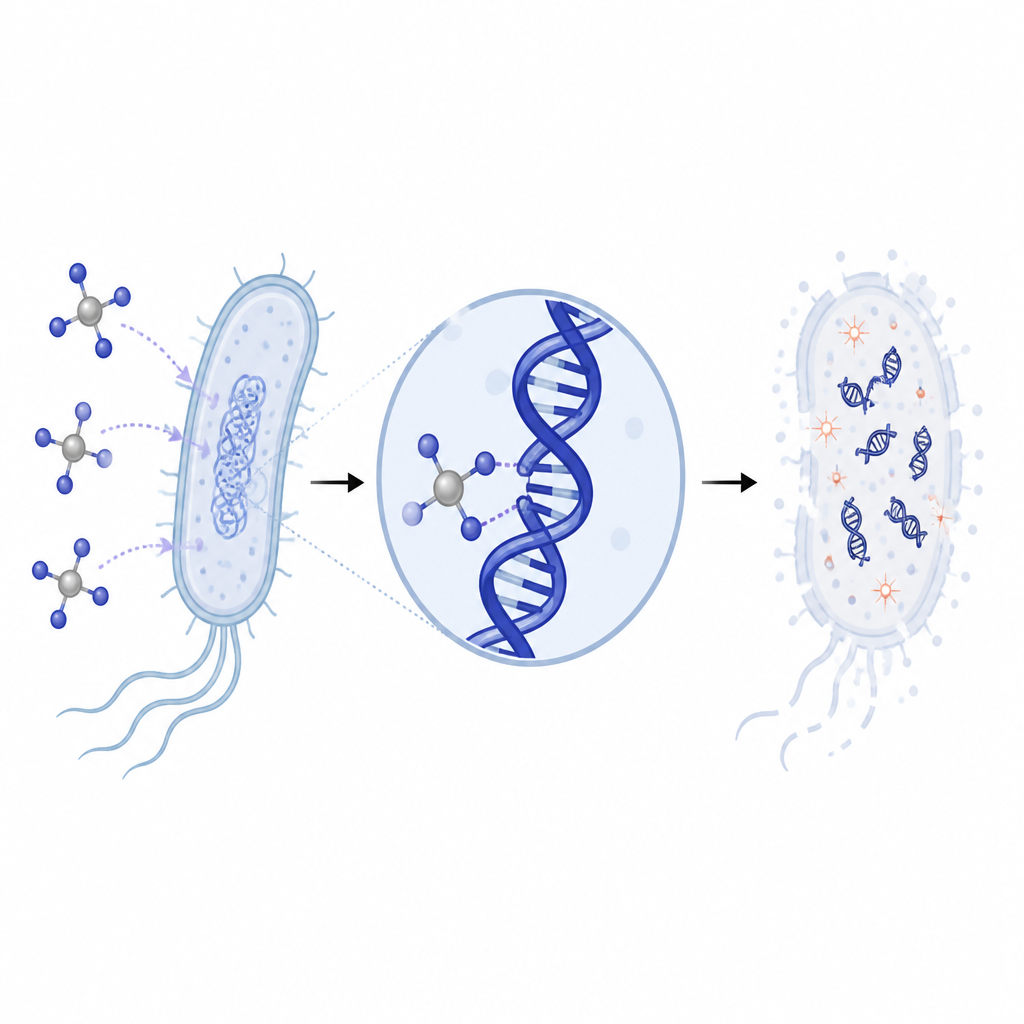
To understand what Pt1 actually does inside a cell, the researchers used fluorescent dyes and protein markers in the model bacterium Bacillus subtilis. Microscopy revealed that after exposure to Pt1 and a related compound, Pt8, the bacterial DNA clumped together and became less brightly stained, a sign of structural damage. A DNA repair protein called RecA quickly gathered into bright spots on the chromosomes, showing that the cells sensed breaks in their genetic material. In a separate single-molecule assay, purified viral DNA exposed to Pt1 or Pt8 became shorter and more fragmented, confirming that these compounds directly damage DNA. Unlike many antibiotics, Pt1 did not punch holes in membranes, disrupt cell wall building, or block protein production.
Why bacteria struggle to resist this drug
The story did not end with simple DNA damage. Measurements of platinum inside bacterial cells showed that Pt1 enters them more efficiently than Pt8 or the classic chemotherapy drug cisplatin, explaining part of its superior antibacterial activity. The team also tested whether reactive oxygen species, highly reactive forms of oxygen, contributed to its effect. When they added chemicals that mop up these radicals, the activity of Pt1 dropped sharply, especially when hydroxyl radicals were removed. Pt8, in contrast, was barely affected. This suggests that Pt1 has a dual punch: it binds and breaks DNA directly and at the same time promotes harmful oxidative stress. In long-term experiments where S. aureus was grown for over a month in the presence of low Pt1 levels, the bacteria showed almost no increase in resistance, unlike those exposed to the standard antibiotic levofloxacin, which became highly resistant.
From lab dish to infected skin
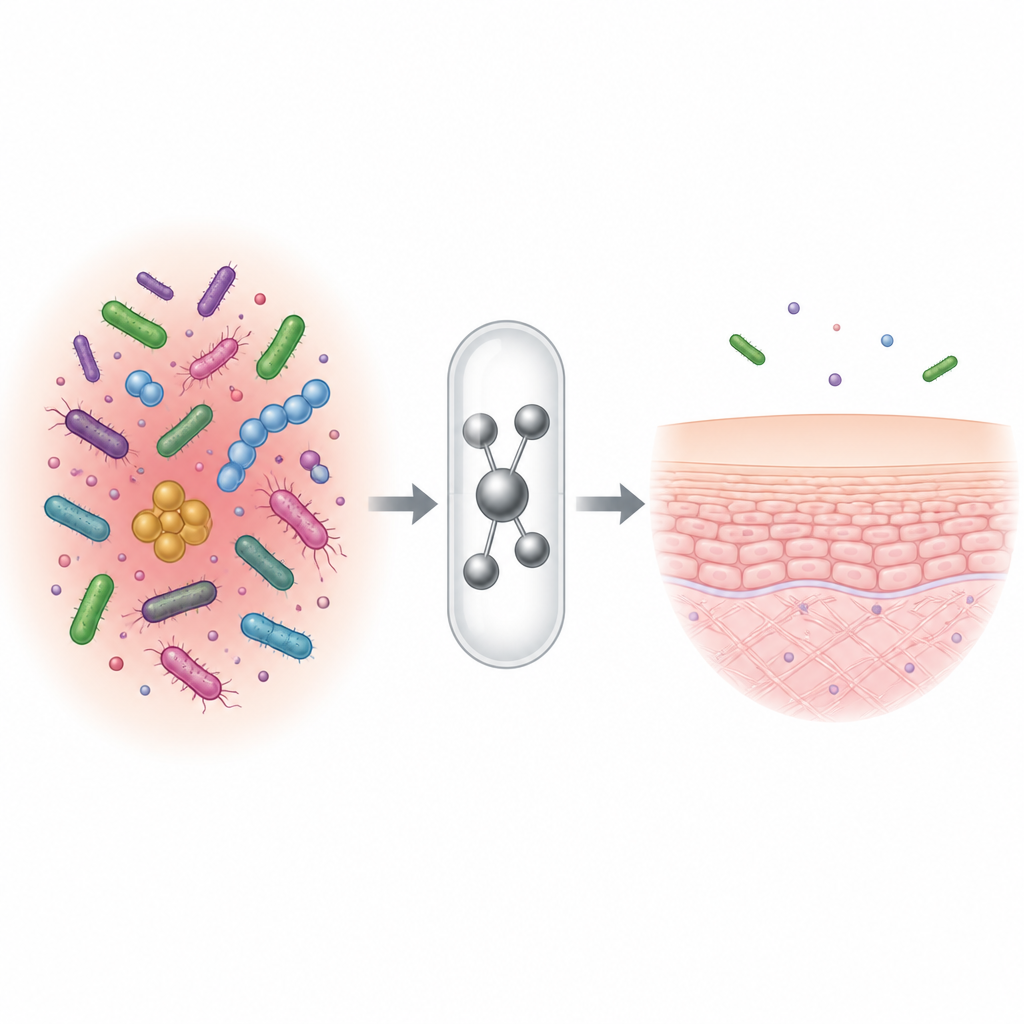
Because Pt1 binds strongly to components in blood, it is not suitable for use as a pill or injection. The authors therefore tested it as a cream in a mouse skin infection model. Mice with superficial wounds infected with S. aureus received a 2 percent Pt1 cream twice daily. After several days, the treated skin contained about one hundred times fewer bacteria than skin treated with the cream base alone, a reduction similar in scale to that seen with a standard topical drug, fusidic acid. At the same time, previous safety tests in insect larvae and cultured mammalian cells indicated low toxicity at effective doses.
What this means for future antibiotics
This work shows that a carefully tuned platinum compound can act as a potent, selective antibiotic rather than a harsh chemotherapy agent. Pt1 zeros in on bacterial DNA and also stirs up damaging oxygen chemistry, a combined strategy that makes it difficult for microbes to evolve resistance. While its current form seems best suited for creams and other local treatments, the results open the door to designing related platinum drugs that might work in the bloodstream. More broadly, the study highlights metal-based molecules as a rich and still underused source of future antibiotics.
Citation: Özsan, Ç., Schäfer, AB., Akhir, A. et al. A platinum butterfly effect: small changes turn an anticancer drug into a non-toxic metalloantibiotic with in vivo efficacy. npj Antimicrob Resist 4, 37 (2026). https://doi.org/10.1038/s44259-026-00211-w
Keywords: antibiotic resistance, platinum antibiotic, bacterial DNA damage, Staphylococcus aureus, metalloantibiotic