Clear Sky Science · en
Short- and long-term incidence of obsessive–compulsive disorder after objectively recorded potentially traumatic events
Why this study matters
Many people know obsessive compulsive disorder, or OCD, as a condition of intrusive thoughts and repetitive rituals, but fewer realize that it often follows a mix of stressful life events and inherited vulnerability. This large Swedish study asks a simple but important question for anyone concerned about mental health after violence: does being assaulted or otherwise victimized raise a person’s chance of developing OCD, and if so, for how long and through which kinds of influences in the family?

Looking at life events over many years
To answer this, researchers followed more than 3.3 million people born in Sweden between 1975 and 2008, using nationwide health and population registers. Instead of relying on memory, they used medical records to identify two kinds of serious events: interpersonal assault or victimization, and transport accidents such as traffic crashes. They then checked who later received an OCD diagnosis in specialist care, tracking people from childhood into adulthood. This design allowed the team to examine both short term risk in the year after a traumatic event and long term risk in the many years that followed.
Violence linked to higher OCD risk
People who had been recorded as victims of assault were clearly more likely to be later diagnosed with OCD than those with no such record. Overall, their risk was about three quarters higher, and it more than doubled during the first year after the assault before settling into a still raised but lower level over time. By contrast, people who had experienced transport accidents did not show any meaningful increase in OCD diagnoses. This suggests that intentional harm from another person, rather than injury in general, may be especially important for the development of OCD.
What runs in families
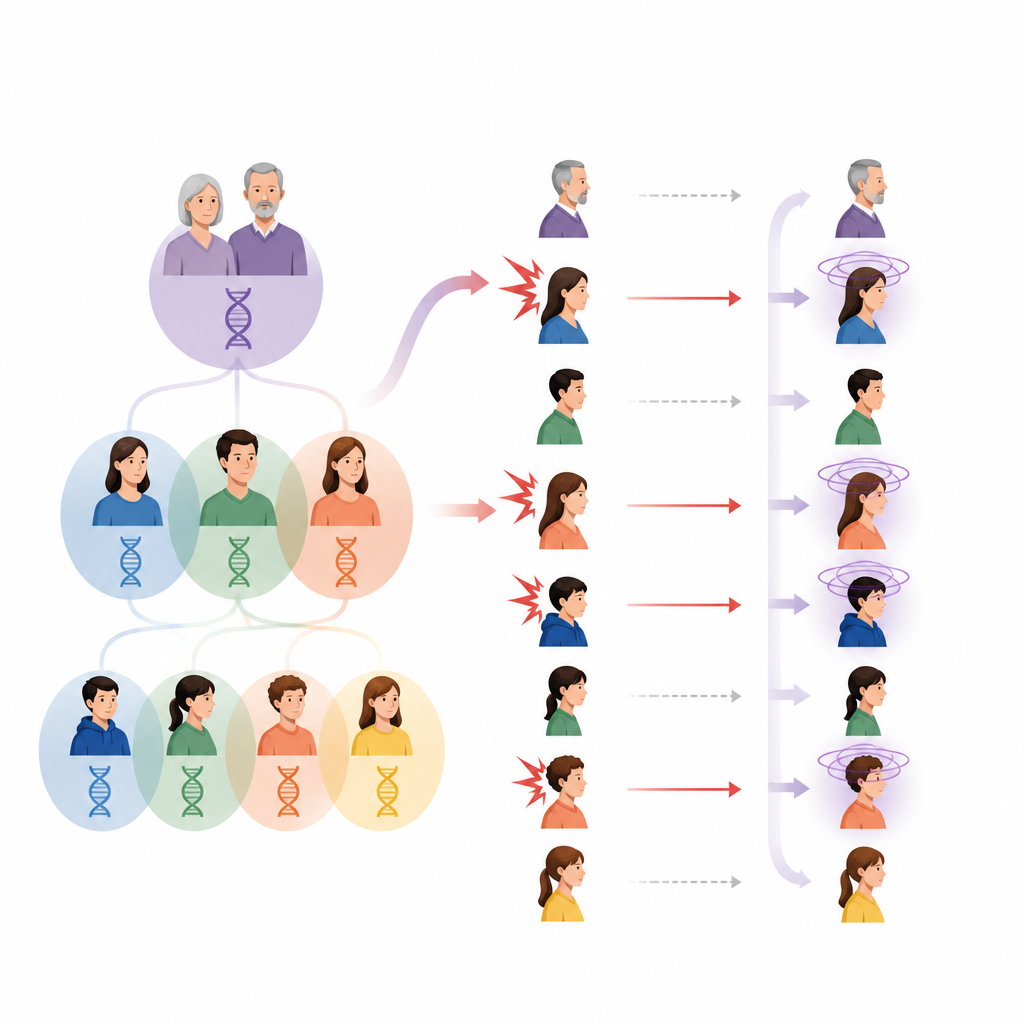
Because mental health problems and exposure to violence can both cluster in families, the researchers went a step further. They compared brothers and sisters from the same families where one sibling had been assaulted and another had not. Even within these families, the assaulted sibling remained more likely to develop OCD, which means the connection cannot be fully explained by family background alone. At the same time, relatives of assaulted people were themselves more likely to have OCD, even if they had not been assaulted, and this pattern was strongest in the closest relatives. Using statistical models that separate genetic and environmental influences, the team estimated that roughly two thirds of the link between assault and OCD reflects shared genetic factors, with the remaining third due to experiences unique to individuals.
Limits and careful interpretation
The study has important strengths, including its nationwide coverage, long follow up and objective recording of both assaults and diagnoses. Still, there are caveats. The registers mainly capture more severe events that lead to specialist care, so unreported or less physically injurious forms of violence are likely underrepresented. People who have just experienced an assault may also receive closer medical attention, which could make OCD more likely to be detected shortly afterward. Finally, the estimates for how much of the association is genetic versus environmental are based on complex models and have wide uncertainty ranges, so their exact size should be interpreted with caution even if the overall pattern is clear.
What this means for people and families
For a lay reader, the core message is that serious interpersonal violence is followed by a noticeable rise in OCD diagnoses, especially in the first year, and that this link reflects both inherited vulnerability and the direct impact of the traumatic event. Not everyone who is assaulted will develop OCD, and many people with OCD have never experienced such violence, but the findings underline the value of close monitoring and support after victimization, particularly for those with a family history of mental health problems. Understanding how genes and lived experience combine to shape OCD risk may ultimately help clinicians identify who is most vulnerable and when help is most urgently needed.
Citation: Pol-Fuster, J., Fernández de la Cruz, L., Kuja-Halkola, R. et al. Short- and long-term incidence of obsessive–compulsive disorder after objectively recorded potentially traumatic events. Nat. Mental Health 4, 829–836 (2026). https://doi.org/10.1038/s44220-026-00639-z
Keywords: obsessive compulsive disorder, trauma, assault victimization, genetic vulnerability, mental health risk