Clear Sky Science · en
Optimizing functional connectivity scanning conditions for predicting autistic traits
Why paying attention in the scanner matters
Autism affects how people communicate, interact, and respond to the world around them, yet brain scans have not always done a good job of capturing this complexity. This study asks a simple but powerful question: what are children doing in the MRI scanner when we try to link brain activity to autistic traits, and does that choice matter? The answer, the researchers find, is yes. Having young people focus on a demanding attention task in the scanner can reveal clearer brain markers of autistic traits than simply lying still or passively watching social scenes.
Looking for clearer brain fingerprints
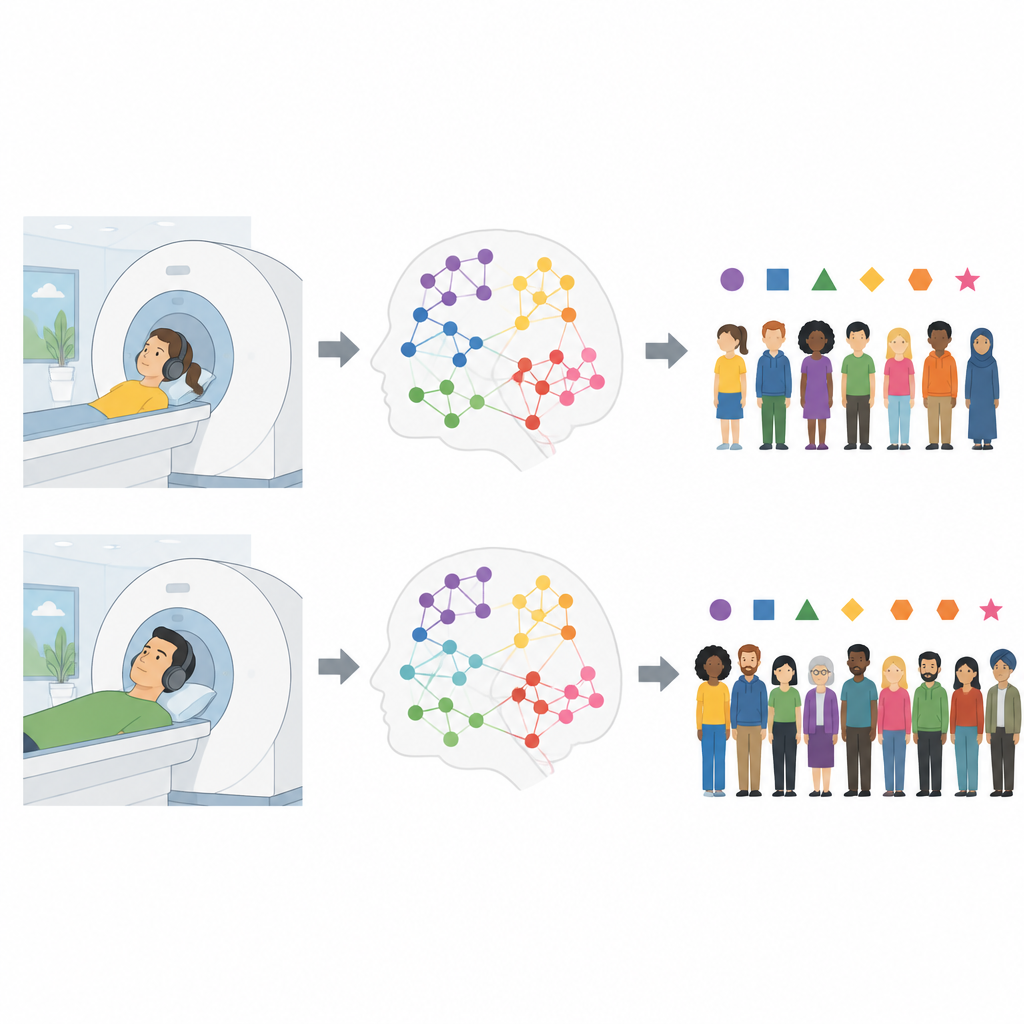
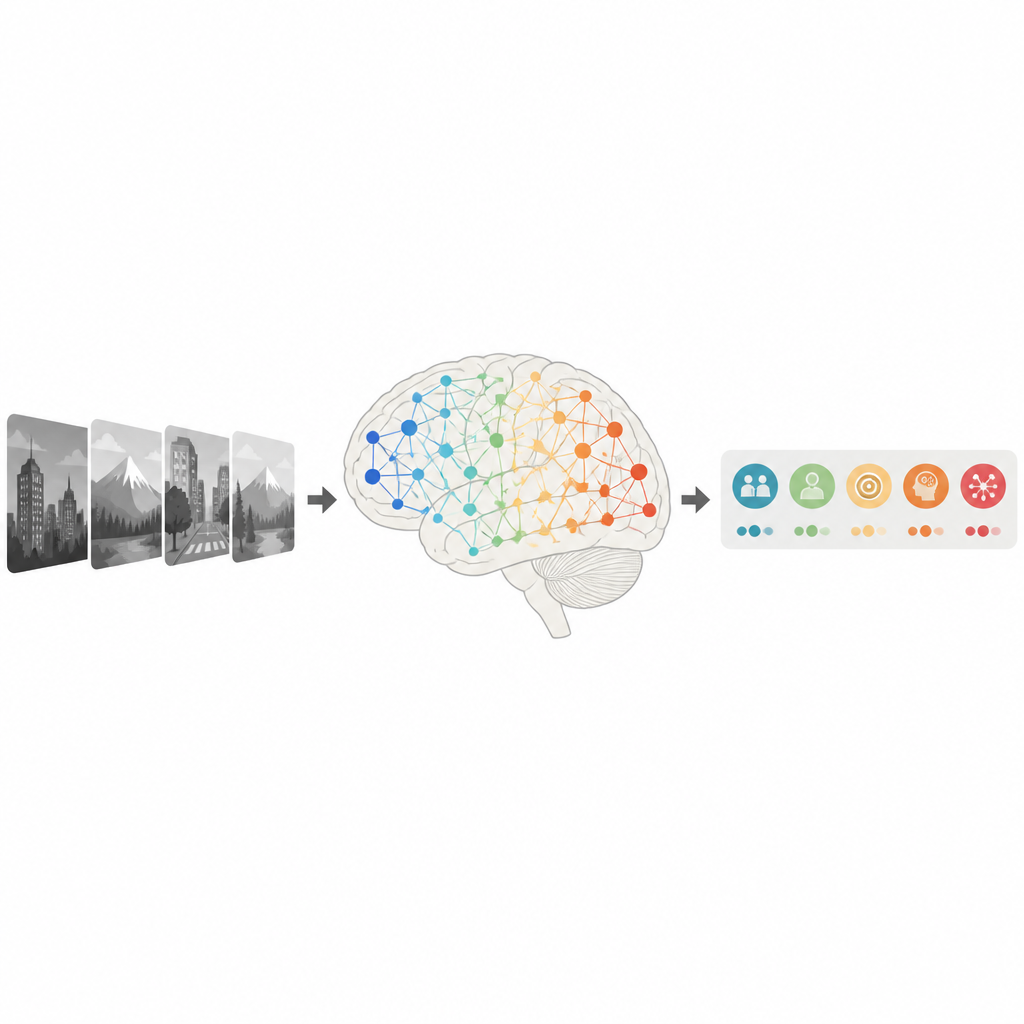
To explore this, scientists worked with a group of 63 young people, some with autism and some without, who took part in several types of brain scans. In one condition, they simply rested while looking at a fixation cross. In another, they watched short video clips of a person at a table, with eye contact and speech carefully varied. In a third, they performed a challenging attention task that required them to watch a rapid stream of city and mountain scenes and press a button for most images while withholding responses for a minority. The team used a data-driven approach called connectome-based predictive modeling to see how well patterns of brain connections under each condition could predict each child’s autism symptom scores.
Attention tasks outshine quiet rest
The results showed a clear winner. Brain connectivity measured during the sustained attention task provided the most accurate predictions of clinicians’ ratings of autistic traits. In contrast, scans collected while children rested, or passively watched the social attention videos, produced weaker and more variable predictions. Even when the researchers doubled the amount of resting data, the attention task still did better. This pattern held up across many analytical variations, including different ways of cleaning the data, different brain maps, and models that focused on specific aspects of autism such as social affect or repetitive behaviors.
From autism traits to everyday attention and social skills
The team then asked whether the brain network discovered in the youth sample would be meaningful beyond the original group. They built a “consensus” set of connections that consistently tracked with higher or lower autism scores during the attention task. Applying this network to a separate group of 25 neurotypical adults who performed the same task, they found that people whose brain patterns suggested higher autistic traits tended to have lower sustained attention on the task. Next, they used resting or movie-watching scans from two large public datasets of children and teens, some with autism and some with attention difficulties, to estimate “predicted” autism scores from the same network. These predicted scores were modest but reliable predictors of standardized parent reports of social responsiveness, including total scores and subscales for communication, social motivation, and repetitive mannerisms.
What the brain maps reveal
When the researchers visualized the connections in their consensus network, they saw a widespread pattern involving many parts of the brain rather than a single “autism center.” Connections within and between higher-order association regions were especially prominent, including networks that support self-reflection, planning, and flexible control of attention. In many cases, stronger connectivity in these systems was linked to higher autistic traits or poorer attention, echoing other work that finds differences in these networks in both autism and attention deficit hyperactivity disorder. This overlap supports the idea that autistic traits and attention abilities are intertwined and shaped by broad circuits that help people navigate complex social and cognitive demands.
What this means for future brain scans
Overall, the study suggests that what people do in the scanner strongly influences how well brain data can capture real-world autistic traits. A structured, rule-based attention challenge appears to place the brain in a state that makes individual differences in social and attention-related traits more visible. These findings do not provide a diagnostic test, and the effects are modest, but they point to practical ways to design future studies so that brain scans better reflect the lived experiences of autistic people. Choosing tasks that reliably engage attention and higher-level thinking may be a key step toward more useful brain-based markers of autism and related conditions.
Citation: Horien, C., Mandino, F., Greene, A.S. et al. Optimizing functional connectivity scanning conditions for predicting autistic traits. Nat. Mental Health 4, 792–805 (2026). https://doi.org/10.1038/s44220-026-00623-7
Keywords: autism, functional connectivity, sustained attention, brain networks, fMRI tasks