Clear Sky Science · en
Multivariate genetic analyses of 2.2 million individuals reveal broad and substance-specific pathways of addiction risk
Why some people are more vulnerable
Many families have seen how addiction can affect health, work, and relationships, yet it is still hard to predict who is most at risk. This study tackles that puzzle by asking whether the same genetic tendencies that make some people more impulsive or rule-breaking also raise the risk for addiction, and how those broad tendencies interact with genes that act on specific drugs like alcohol, nicotine, opioids, or cannabis. Using genetic data from more than 2.2 million people, the researchers map out both the shared and substance-specific roots of addiction risk in unprecedented detail.
A big-picture look at self-control and substance use
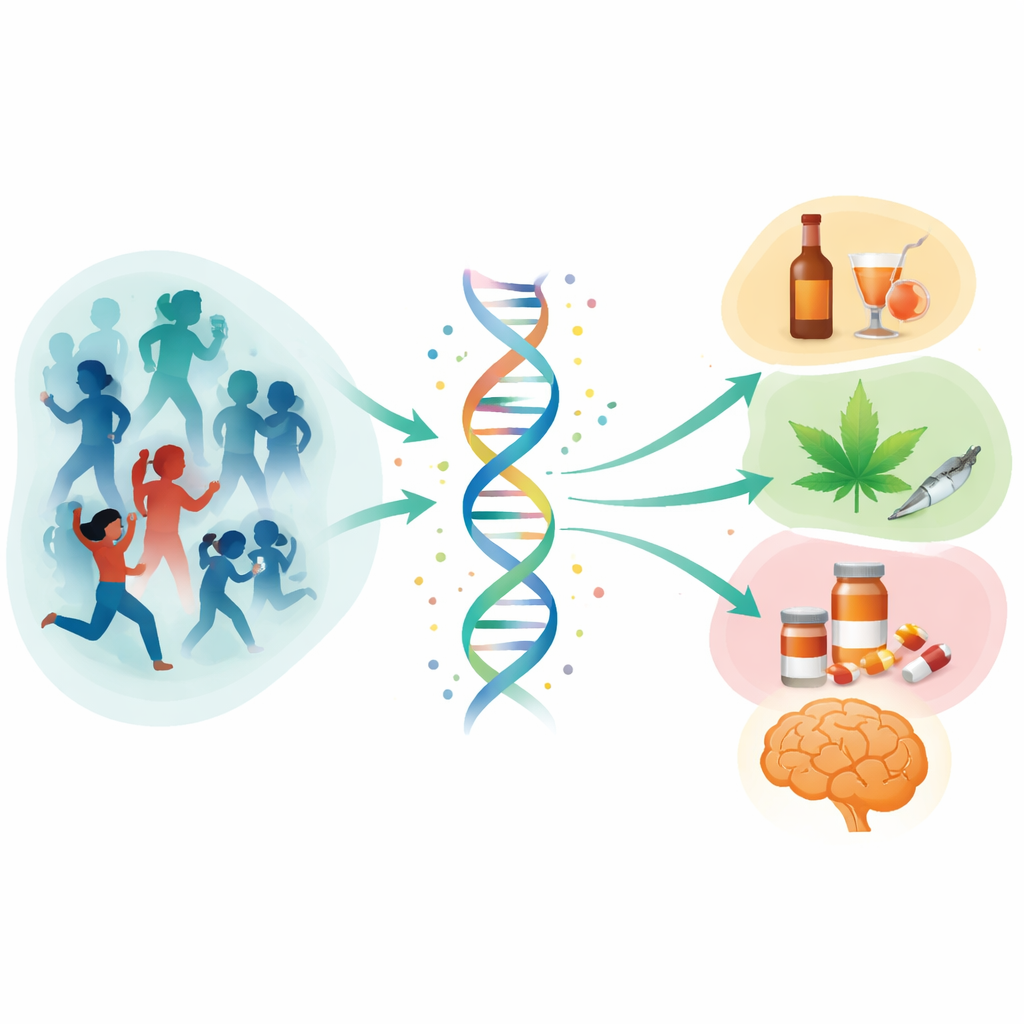
The authors start from a long-standing observation: people with substance use disorders often also struggle with problems like attention-deficit/hyperactivity disorder, early and risky sex, or antisocial behavior. Decades of twin studies suggested that these problems tend to cluster together because of common genetic influences, a broad trait sometimes called "externalizing." Instead of treating each disorder in isolation, the team used new statistical tools to model this shared dimension directly, testing whether genes linked to externalizing also carry much of the genetic risk for substance use disorders.
Two ways to organize addiction-related genes
The researchers compared two genetic maps. In the first, all behaviors—attention problems, risk taking, early sexual activity, smoking, cannabis use, and four substance use disorders—were treated as different faces of one underlying externalizing tendency. In the second, they separated this tendency into two but closely related pieces: one factor capturing general behavioral disinhibition and another capturing addiction-specific risk across alcohol, tobacco, opioids, and cannabis. In both approaches, they could also examine what was left over for each substance after subtracting the shared part, highlighting truly substance-specific genetic effects.
Shared wiring and substance-specific pathways
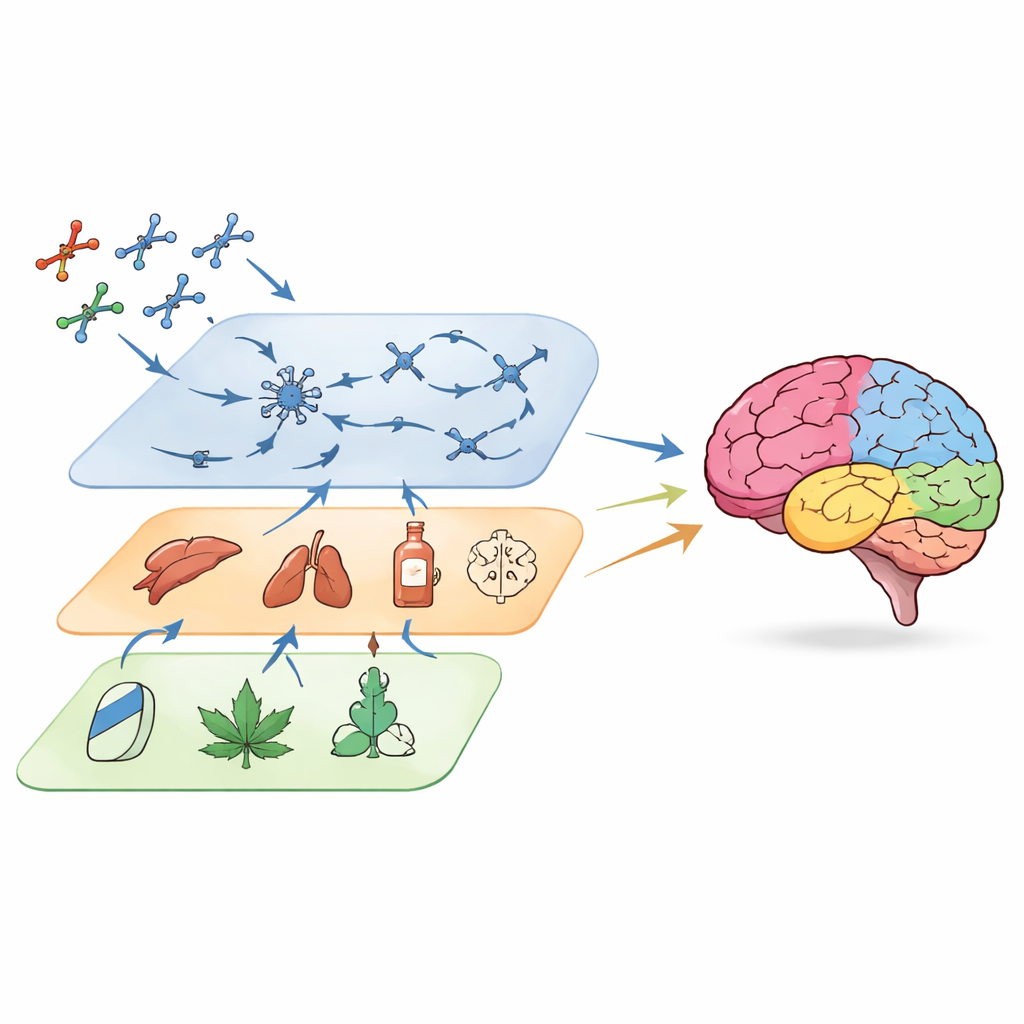
Joint analyses revealed hundreds of genetic regions tied to the broad externalizing factor, many more than when substance use disorders were studied on their own. These regions pointed to gene networks involved in the brain’s communication systems—how signals move between nerve cells, how receptors are organized, and how cellular cargo is transported. At the same time, when the team zoomed in on what remained for each drug after accounting for this shared liability, they saw clear substance-specific signatures. For example, alcohol-specific risk was enriched in genes that control how alcohol is broken down in the body, and tobacco-specific risk in genes that encode nicotinic receptors, the proteins to which nicotine binds.
From gene patterns to real-world prediction
To see how these discoveries translate to individuals, the team built polygenic scores—summary measures of someone’s inherited risk—based on the broad and specific genetic factors. In two independent cohorts, these scores showed that the broad externalizing score captured the largest share of risk for multiple substance use disorders, acting as a kind of general addiction liability. Yet the residual, substance-focused scores still added useful detail: an alcohol-specific score best predicted alcohol problems, and a tobacco-specific score best predicted nicotine dependence. People in the highest risk groups for these scores were much more likely to show moderate levels of the corresponding disorder than those in the lowest groups.
Hints for future medicines and treatments
The genetic maps also highlighted potential treatment targets. Many of the identified genes are already linked to existing medications for alcohol and tobacco problems, suggesting paths for refining or repurposing treatments. However, most data came from people of European ancestry, so the results may not yet generalize to all populations. The study also focused mainly on externalizing traits, even though addiction is intertwined with other conditions like depression and anxiety that were not fully modeled here.
What this means for understanding addiction
Overall, the work suggests that addiction risk is best viewed as a combination of two forces: a broad inherited tendency toward impulsive, rule-breaking behavior, and additional genetic quirks that shape how each person’s body and brain respond to specific drugs. Studying these forces together, rather than one disorder at a time, sharply improves the ability to find relevant genes without losing sight of what is unique about alcohol, nicotine, opioids, or cannabis. For people and families affected by addiction, this research underscores that vulnerability is not simply a matter of willpower, but reflects deep-seated biological patterns that could eventually guide more precise prevention and treatment.
Citation: Poore, H.E., Chatzinakos, C., Leger, B. et al. Multivariate genetic analyses of 2.2 million individuals reveal broad and substance-specific pathways of addiction risk. Nat. Mental Health 4, 582–593 (2026). https://doi.org/10.1038/s44220-026-00608-6
Keywords: addiction genetics, behavioral disinhibition, substance use disorders, polygenic risk, externalizing traits