Clear Sky Science · en
Testing bidirectional associations of major depressive disorder with medical conditions: two-sample Mendelian randomization study
Why Your Mood Matters for Your Whole Body
Most people think of depression as an illness of thoughts and feelings, but growing evidence suggests it may also affect the rest of the body. This study asked a simple yet far-reaching question: does major depression actually help cause many physical health problems, or are they just found together because of shared life stresses and risks? Using large-scale genetic data, the researchers set out to untangle cause from coincidence and to see whether physical illnesses also push back, raising a person’s risk of depression.
Following the Clues Written in Our Genes
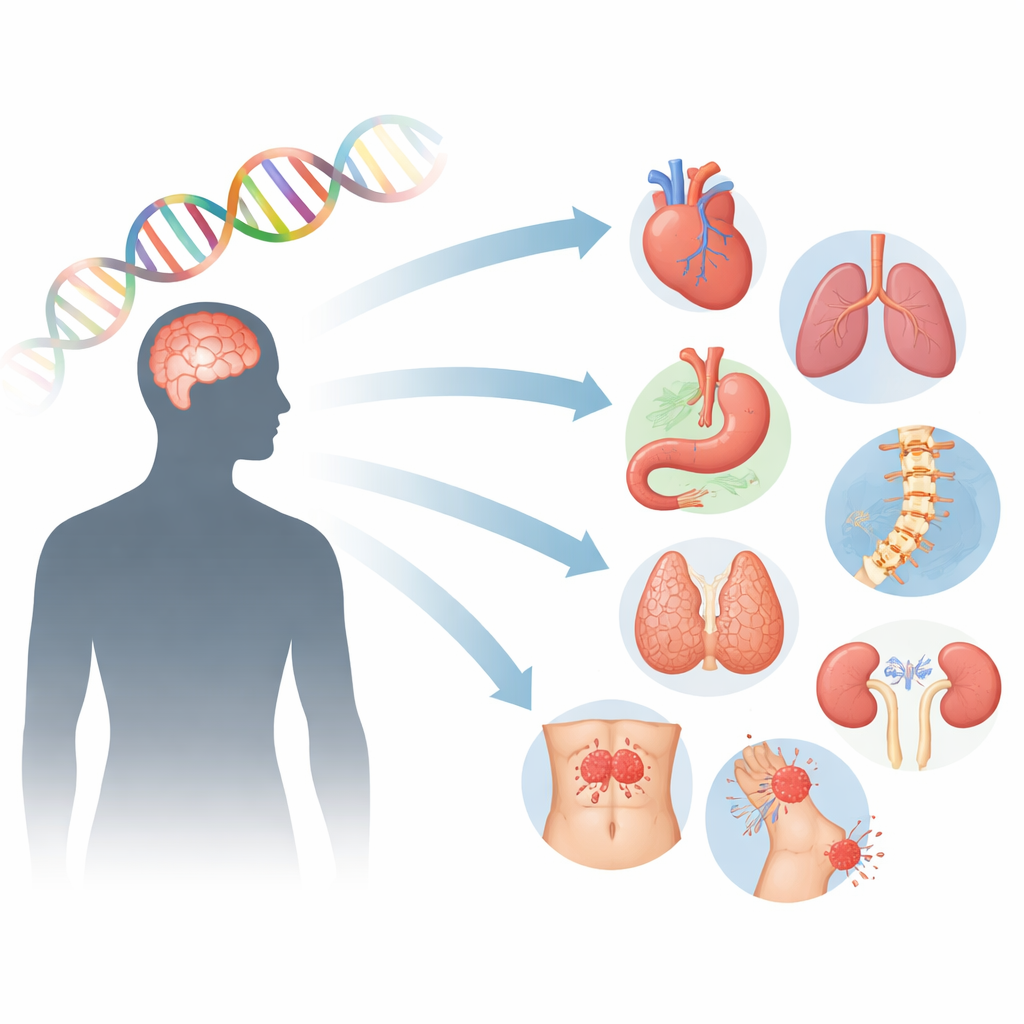
To probe cause and effect, the team used a method called Mendelian randomization, which treats natural genetic differences as a kind of lifelong experiment. They began with 249 medical traits that earlier studies had found to be linked with a genetic tendency toward major depressive disorder. By searching a public database of genome-wide association studies, they found good-quality genetic data for 183 of these traits, ranging from heart disease and asthma to pain conditions and infections. They then asked, in two directions, whether genetic liability to depression appeared to increase the risk of these conditions, and whether genetic liability to those conditions appeared to increase the risk of depression.
Depression as a Driver of Many Health Problems
The central finding was striking: genetic risk for major depression was linked to higher risk for 109 of 182 testable medical traits, and the evidence remained strong for 105 traits after extensive checks for bias. All of these links pointed in the same direction—toward increased risk—not just for other mental health diagnoses, but also for conditions affecting breathing, digestion, circulation, hormones, nerves, joints and muscles, the urinary system, skin, and pain. For example, people with genetic liability to depression were more likely to have pain syndromes, chronic lung conditions, reflux disease, urinary infections, back problems, dizziness, and skin infections. When the researchers focused only on the largest and most reliable datasets, the pattern became even clearer: depression appeared to causally influence more than four out of five of the traits examined.
When the Body Pushes Back on the Mind
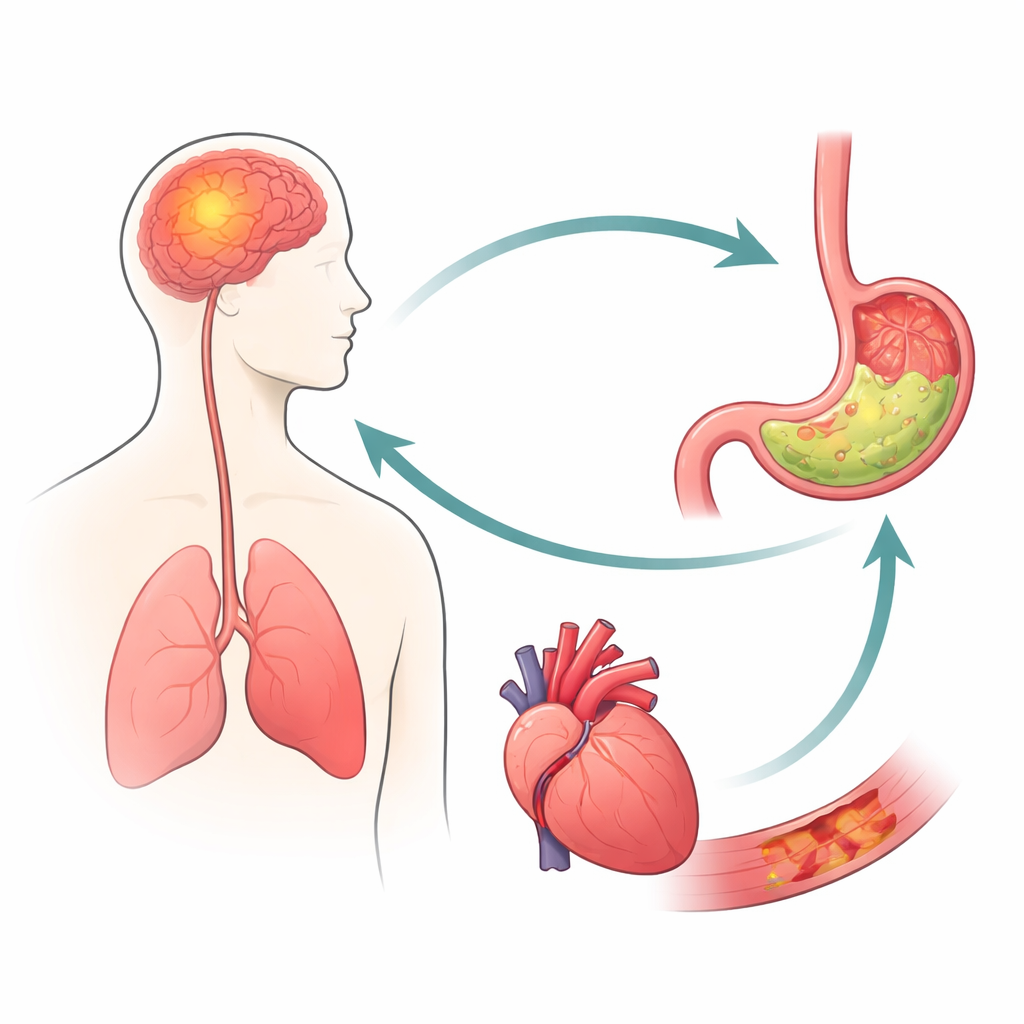
The team also asked the reverse question: do physical illnesses, in turn, help cause major depression? Here the picture was far more selective. Among the traits with enough genetic information to test, only two—gastroesophageal reflux disease (GERD) and high blood pressure—showed convincing signs of increasing depression risk. GERD stood out as special: genetic liability to depression raised the chance of GERD, and genetic liability to GERD raised the chance of depression, suggesting a two-way relationship. For asthma, diabetes, and several thyroid problems, the results suggested that depression increases risk for these illnesses, but those illnesses do not meaningfully increase risk for depression, at least at the genetic level captured here.
Strengths, Limits, and What Still Needs to Be Learned
The study drew strength from several features: it combined results from very large genetic studies of depression, examined a wide swath of the medical record, and used multiple technical checks to guard against false signals. It also used a negative control—human height—to show that simply having a large genetic study does not automatically generate many spurious links. Still, important limits remain. Not every disease had strong enough genetic data to analyze, and the work focused only on people of European ancestry. The genetic approach estimates average lifelong effects, so it cannot tell us how short-term treatment at a particular age changes disease risk. And while the results strongly suggest that depression can help cause other illnesses, they do not yet reveal the exact paths, which may run through behavior (such as smoking or inactivity), biology (such as inflammation), or both.
What This Means for Health and Care
For a non-specialist, the takeaway is that major depression is not just about mood—it appears to play a causal role in many physical health problems across the body. The evidence suggests that preventing and effectively treating depression could lower the risk of conditions such as reflux disease, chronic lung disease, heart problems, pain disorders, obesity, certain infections, and more. At the same time, conditions like GERD and high blood pressure may feed back into depression, underscoring the value of integrated care that treats mind and body together. In short, looking after mental health may be one of the most powerful ways to protect overall health, and medical care for physical illness should routinely consider a person’s emotional well-being as part of the same story.
Citation: Fang, Y., Sen, S., Pathak, G.A. et al. Testing bidirectional associations of major depressive disorder with medical conditions: two-sample Mendelian randomization study. npj Mental Health Res 5, 24 (2026). https://doi.org/10.1038/s44184-026-00204-7
Keywords: major depressive disorder, physical health, genetic epidemiology, Mendelian randomization, gastroesophageal reflux disease