Clear Sky Science · en
Beam manipulation for terahertz communications
Why bending invisible beams matters
Our phones, headsets, and factories are hungry for ever-faster wireless links. The familiar radio and microwave bands are getting crowded, so engineers are eyeing terahertz waves—frequencies between microwaves and infrared light—to deliver fiber-like data rates through the air. But terahertz signals are weak and easily lost. This review article explains how carefully shaping and steering narrow beams of terahertz energy can overcome those weaknesses, enabling future 6G-and-beyond networks that are fast, robust, and even capable of sensing the environment.
From spreading waves to controllable beams
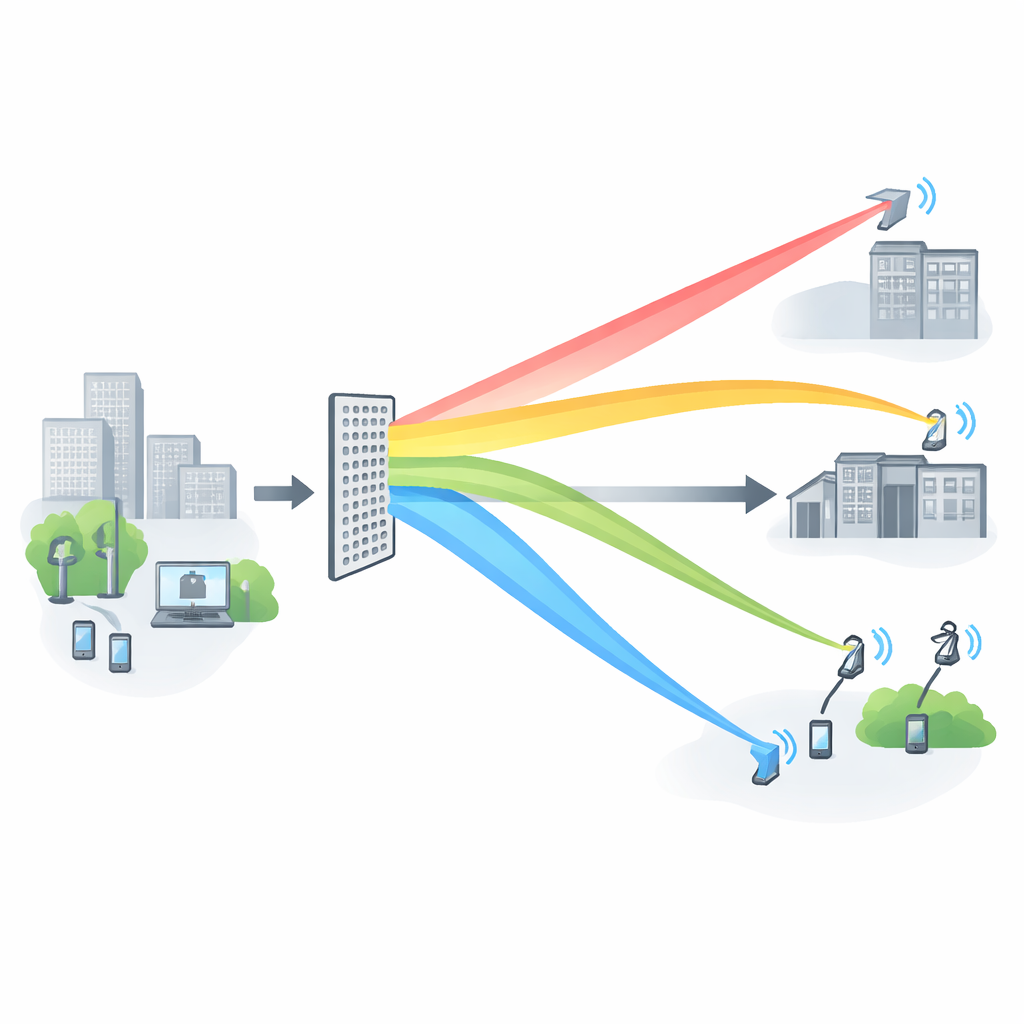
In free space, any wireless signal spreads out and fades as it travels. At terahertz frequencies this fading is especially severe, and today’s compact sources provide only modest power. To cope, transmitters must concentrate energy into sharp beams rather than broadcasting in all directions. The authors use ideas borrowed from optics to describe how beams form and evolve: every point on a wavefront can be treated as a tiny secondary source, and their combined effect determines how the beam looks at any distance. In the far field, this behavior can be captured with simple Fourier-like descriptions; closer to the transmitter, in the so-called near field, more detailed models are needed because the wavefront can be strongly curved instead of nearly flat.
Shaping beams for different jobs
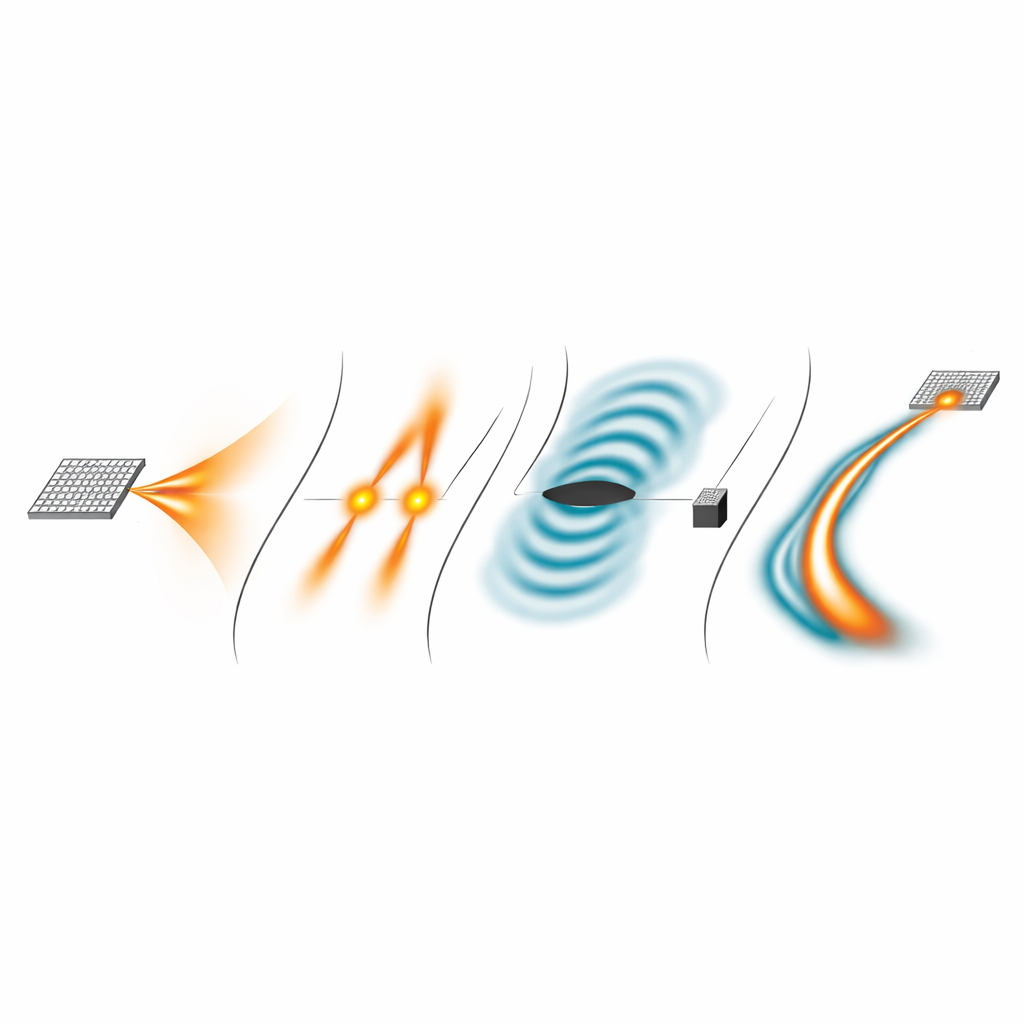
Once this propagation picture is in place, the article shows how tweaking the phase of the wave—essentially, when the tiny ripples of the field peak and trough across the antenna aperture—lets engineers sculpt beams for specific communication tasks. A beam can be tightly focused to boost the signal at a single nearby device, or split into multiple focus points to serve several users at once. Its focus can be stretched along distance so that a moving user stays within a high-signal zone without constant retuning. The beam’s cross-section can also be flattened into a “top-hat” shape, delivering nearly uniform power across a large receiver, which is useful for high-gain links and imaging systems.
Beams that dodge and heal around obstacles
Real environments are cluttered, and narrow beams can be blocked by everyday objects. The review highlights two families of exotic beam shapes that tackle this problem. Bessel-like beams, built from concentric rings of energy, stay almost unchanged over a certain distance and can “self-heal” after partial blockage: if a small object interrupts the center, the rings reconstruct the main beam behind it. Airy-like beams take a different approach: they naturally follow a gently curved path, bending around larger obstacles while still delivering energy to a receiver hidden from direct view. Experiments at hundreds of gigahertz show that links using these beams maintain data quality where ordinary straight beams fail, keeping constellation diagrams and eye diagrams clean even under challenging blockage.
Smart patterns for capacity and security
Beam shaping is not only about raw signal strength or obstacle avoidance. Certain patterns create dark zones where little or no power arrives—useful for enhancing physical-layer security by starving would-be eavesdroppers that sit between a transmitter and its intended user. Other patterns, inspired by families of mathematical solutions known as modes, allow multiple independent data streams to coexist in the same frequency band without interfering, potentially boosting capacity. The article also discusses “holographic” beam control, where complex field patterns are computed to sculpt nearly arbitrary intensity shapes in space, opening the door to finely tailored wireless channels and integrated sensing-and-communication functions.
Hardware that makes beam tricks real
All of these patterns must ultimately be produced by physical hardware. The authors survey three main toolkits. Traditional dielectric lenses, often 3D printed, can focus and reshape beams over wide bandwidths but are bulky and can be lossy at terahertz frequencies. Ultra-thin metasurfaces, built from arrays of subwavelength structures etched or deposited on substrates, provide compact and efficient static beam control by locally delaying parts of the wavefront. Pushing further, reconfigurable intelligent surfaces replace static elements with active electronics or tunable materials, so that the phase of each unit can be changed on demand. This allows real-time steering and reprogramming of beam patterns, but at the cost of tighter fabrication tolerances, power consumption, and currently smaller practical apertures.
What this means for future wireless
For nonspecialists, the central message is that the path to practical terahertz wireless will not rely only on building stronger transmitters or ever-smarter signal processing chips. Instead, it will come from learning to sculpt the very shape of the waves in space, matching beam patterns to the needs of each link and environment. The review argues that as devices, buildings, and even walls become part of the communication fabric, intelligent beam manipulation—implemented with lenses, metasurfaces, and programmable surfaces—will be a cornerstone for delivering fast, reliable, and secure terahertz connections in everyday settings.
Citation: Li, M., Jornet, J.M., Mittleman, D.M. et al. Beam manipulation for terahertz communications. Commun Eng 5, 83 (2026). https://doi.org/10.1038/s44172-026-00676-7
Keywords: terahertz communications, beamforming, metasurfaces, 6G networks, reconfigurable intelligent surfaces