Clear Sky Science · en
Beyond 350 GHz: Single-channel 112 Gbps photonic wireless transmission at 560 GHz using soliton microcombs
Why future phones need new invisible waves
Our phones and wireless gadgets are hungry for data, but the airwaves they use are getting crowded. This study explores a fresh patch of the spectrum, far above today’s mobile bands, to see whether tiny light-powered chips can send internet traffic through the air fast enough to replace some fiber cables. The work shows that these little photonic engines can push wireless links into a little-used region of terahertz waves while still carrying more than 100 billion bits of data every second.
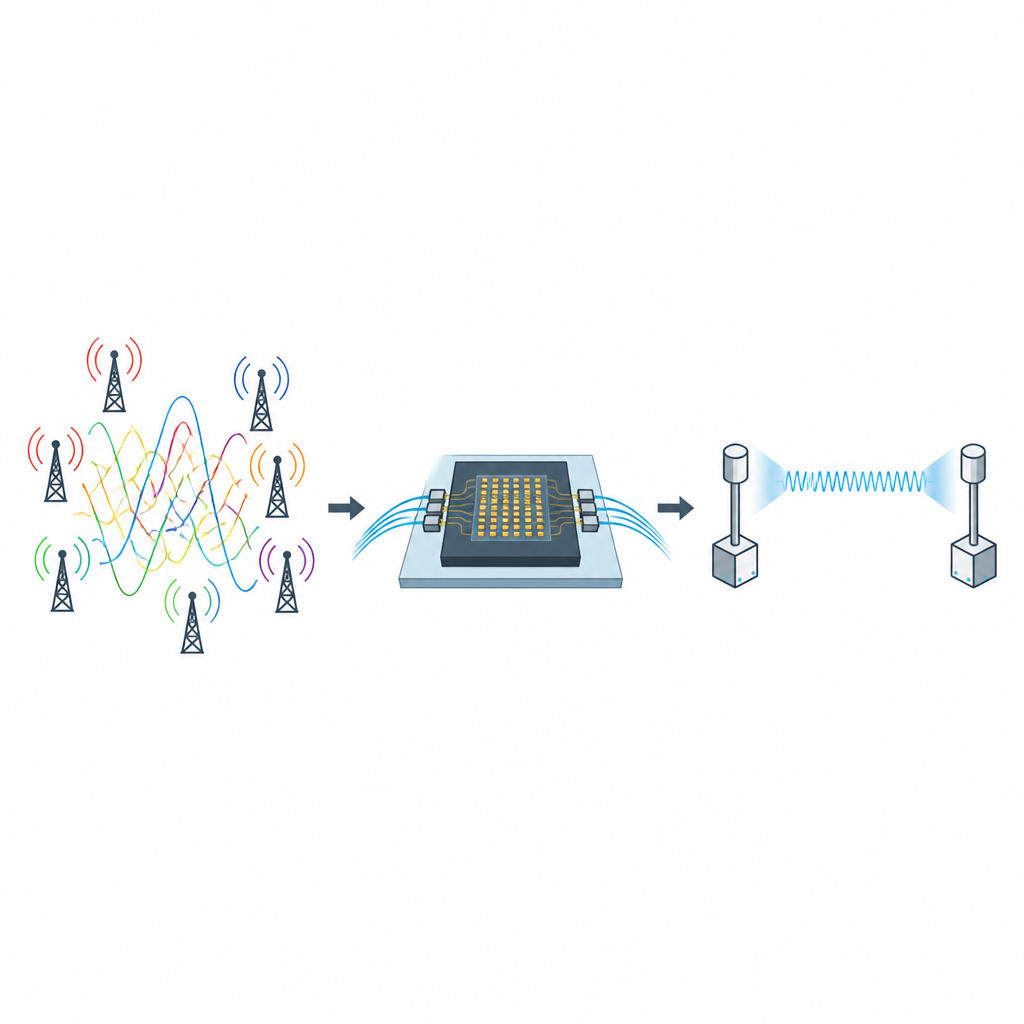
Stepping beyond today’s crowded airwaves
Current 5G networks mostly operate below 28 gigahertz, where frequencies are busy and radio channels are relatively narrow. To meet the demands of future 6G systems, researchers are eyeing the terahertz band, between about 0.3 and 1 trillion cycles per second. This range offers wide, clean slices of spectrum that could support extremely fast backhaul links between base stations. However, the higher the frequency, the more strongly signals fade in air, and conventional electronics struggle to generate stable, low-noise waves much above 300 gigahertz. The region above 350 gigahertz has therefore remained largely unused for high speed links, even though it is not yet assigned to many services.
Using light to make ultra fast radio waves
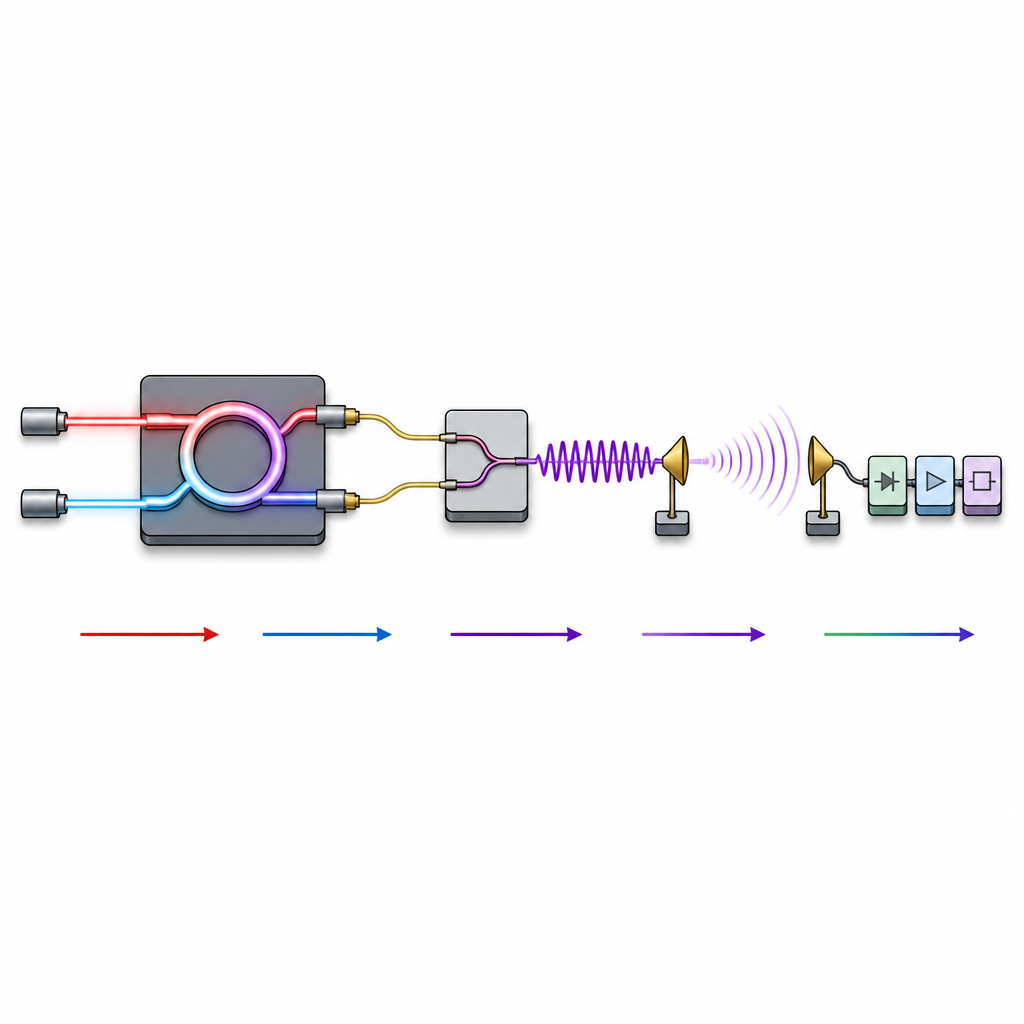
To leap into this higher range, the team turns to photonics, using light rather than pure electronics to create the radio signal. At the heart of their setup is a silicon nitride chip that produces a “comb” of many evenly spaced colors of laser light, all locked in phase with one another. This comb is generated by a special pattern of light pulses called a soliton circulating around a tiny ring on the chip. Two ordinary laser diodes are forced to follow, or lock onto, two neighboring colors from the comb. When these two locked lasers shine together on a very fast photodiode, their slight color difference beats together and produces a steady terahertz wave at 560 gigahertz, which can then be used as a carrier for data.
Packaging the tiny light source for real use
A major practical hurdle with such comb chips has been getting light in and out without bulky optical benches that drift out of alignment. The researchers solved this by directly bonding optical fibers to the chip using a short high numerical aperture fiber and a UV-curable adhesive on a glass support. This compact package is only a few millimeters across but can withstand pump powers of a watt and holds its coupling efficiency almost constant for many hours. In tests, the new fiber-coupled design kept the soliton comb running for more than a day, while a traditional free space lens arrangement lost alignment within minutes under similar conditions. This long term stability is essential if such combs are to sit inside practical terahertz radios.
Sending and catching ultra fast data streams
Once the stable 560 gigahertz wave is created, one of the comb locked lasers is fed through an advanced modulator that imprints data by adjusting both the strength and the phase of the light. The team uses two common formats: quadrature phase shift keying and 16 level quadrature amplitude modulation, which carry two and four bits per symbol, respectively. The second locked laser stays unmodulated. Both light streams are combined and converted into a terahertz signal in the high speed photodiode, then launched across a ten millimeter free space gap. On the other side, a special mixer and fast electronics translate the incoming terahertz waves back down to a lower frequency that can be recorded and analyzed without any extra digital clean up beyond what is built into the oscilloscope.
How much information fits into the new link
To judge how well the system works, the authors examine the patterns of received symbols and calculate how far they stray from their ideal positions, a measure known as error vector magnitude. If this value stays below certain limits, ordinary error correction codes can clean up the remaining mistakes. Using the simpler phase based format, they send data at symbol rates up to 42 gigabaud, achieving 84 gigabits per second. With the more demanding 16 level format, they reach 28 gigabaud, which corresponds to 112 gigabits per second on a single wireless channel at 560 gigahertz, all within the stricter error limits. They also compare operation with and without the comb reference and find that locking to the comb narrows the carrier’s linewidth and reduces phase noise, especially improving performance at intermediate symbol rates.
What this means for future wireless links
For everyday users, the key message is that photonic chips can help unlock new, quieter parts of the spectrum for very high speed wireless connections that may one day link base stations and replace short runs of fiber. This experiment shows that a compact, fiber packaged comb source can stably feed a terahertz transmitter well beyond 350 gigahertz and still carry over 100 gigabits per second. While the particular 560 gigahertz band used here suffers strong absorption in moist air and is best suited to very short links, the same approach can be shifted to nearby frequencies where signals travel farther. With stronger terahertz emitters and higher gain antennas, the authors project that similar systems could eventually support multi hundred gigabit links over distances of many meters, forming a building block for future 6G infrastructure.
Citation: Tokizane, Y., Kishikawa, H., Kikuhara, T. et al. Beyond 350 GHz: Single-channel 112 Gbps photonic wireless transmission at 560 GHz using soliton microcombs. Commun Eng 5, 77 (2026). https://doi.org/10.1038/s44172-026-00659-8
Keywords: terahertz wireless, soliton microcomb, photonic transmitter, 6G backhaul, high speed link