Clear Sky Science · en
The transonic safe mode as an enabler of next-generation wind turbines
Why faster wind turbines matter
Wind power is becoming one of the workhorses of clean electricity, and manufacturers are racing to build ever larger turbines that can capture more energy from the atmosphere. The latest designs have blades longer than a football field and tips that move faster than a high speed train. This study looks at a hidden risk that comes with that speed: parts of the airflow around the blade tips can begin to behave more like the flow around a jet aircraft than a traditional windmill, raising new questions about safety, fatigue and how we should operate the next generation of giant turbines.
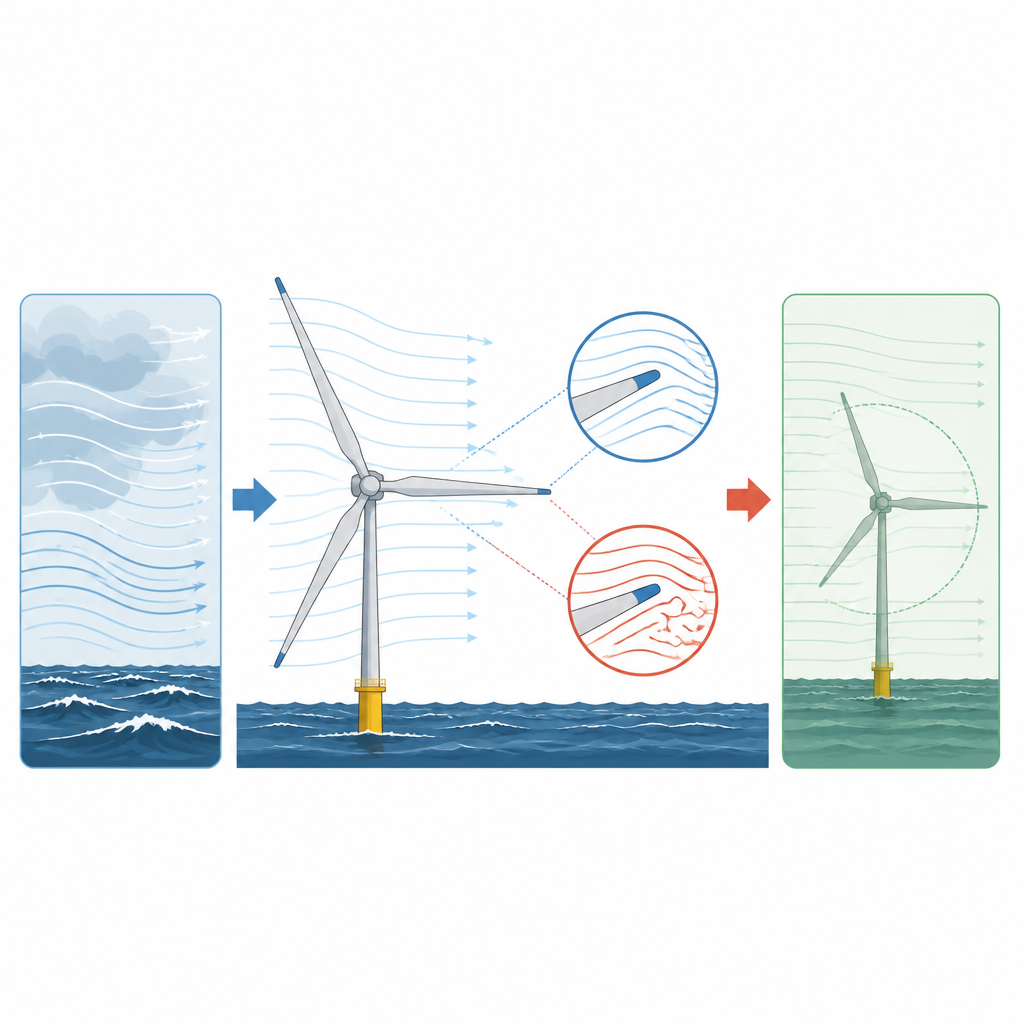
When wind meets near sound speed
As blades grow longer, their tips sweep huge circles through the air. Even in moderate winds the tips of the 22 megawatt reference turbine studied here travel at more than 100 meters per second, roughly a third of the speed of sound. Although the incoming wind itself is still far below that limit, the shape of the blade forces the air to speed up as it flows over the curved surface. Near the tip, and especially when the blade is pitched to shed power in strong storms, this local speed up can be so strong that small patches of air actually reach and exceed the speed of sound. This mixed regime, with mostly slower flow but small pockets of very fast flow, is known as transonic and is familiar from the history of high speed aircraft.
Learning from aircraft without copying them
In aviation, early encounters with transonic flight caused violent shaking and even structural failures before engineers learned how to design wings to cope with shock waves and rapid pressure changes. Modern airliners are built and tested specifically for those conditions. Wind turbine blades, by contrast, are thick, highly curved and optimised for very different tasks. They are not currently designed with transonic effects in mind, and the most risky conditions for turbines involve lower incoming air speeds combined with unusual blade angles that have barely been studied in wind tunnels or simulations. The authors argue that this knowledge gap means we cannot yet be sure that repeated exposure to transonic patches near the blade tips is harmless for turbine structures or long term performance.
Finding where the risk appears
The researchers first analysed a typical blade section using standard airfoil tools to map out when local air speeds on the surface would cross into the transonic range. They then used a detailed simulation package to follow the changing wind conditions and blade motions along the entire span of a 22 megawatt offshore turbine. Real wind is gusty and turbulent, and the machine itself flexes and responds only slowly. When all of this unsteady behaviour is taken into account, the outer ten percent of the blade is predicted to spend noticeable fractions of time in transonic conditions whenever the site wind speed rises above about 20 meters per second. Even though the average operating point looks safe, brief excursions into the risky zone occur again and again during normal operation.
A new safe mode for giant turbines
Rather than waiting for problems to show up in the field, the authors propose a control strategy they call a transonic safe mode. The idea is simple: treat any operating combination of blade pitch and rotational speed that would lead to transonic patches as off limits, and search instead for nearby combinations that keep the flow comfortably slower while still meeting design goals. Using the 22 megawatt turbine as a test case, they show that by modestly reducing tip speed and slightly adjusting blade pitch at high winds, the machine can either hold the same power level at the cost of higher torque, or keep torque within limits while sacrificing some power. In both examples the tip flow stays fully below the transonic threshold.
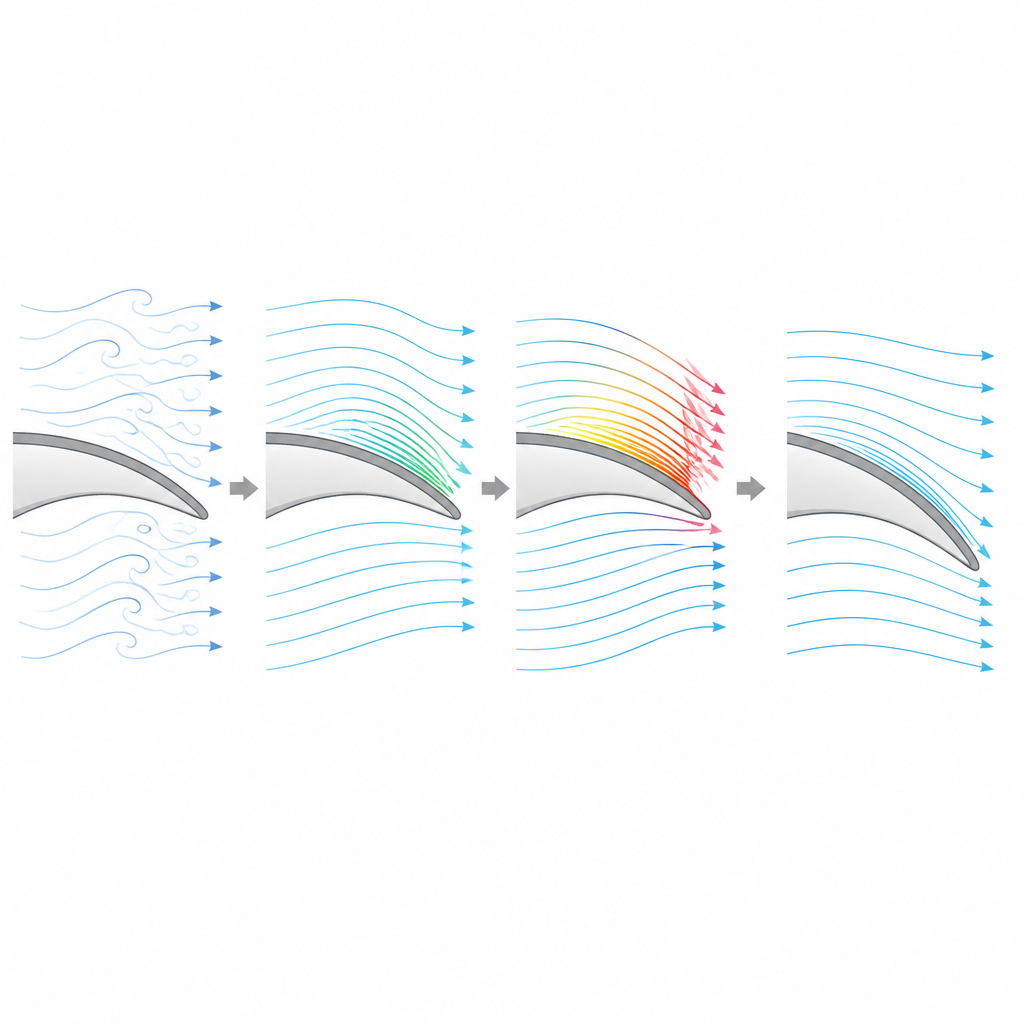
What this means for future wind power
The study does not claim that transonic flow will automatically damage large turbines, but it makes clear that the risk can no longer be ignored as machines grow and their tips run faster. By providing a practical way to map when and where transonic patches appear, and to design operating rules that avoid them, the transonic safe mode gives manufacturers and operators a tool to manage uncertainty while research catches up. In plain terms, it is a way to run tomorrow’s giant offshore turbines a little more gently at the highest winds so that they can deliver reliable clean power for decades, even as engineers continue to study how near sound speed airflow really affects their blades.
Citation: De Tavernier, D.A.M., Zaaijer, M.B. & von Terzi, D.A. The transonic safe mode as an enabler of next-generation wind turbines. Commun Eng 5, 87 (2026). https://doi.org/10.1038/s44172-026-00656-x
Keywords: offshore wind turbines, blade tip speed, transonic flow, turbine control, renewable energy engineering