Clear Sky Science · en
PdNeuRAM: forming-free, multi-bit Pd/HfO2 ReRAM for energy-efficient neuromorphic computing
Smarter Chips for a World of Smart Devices
From voice assistants to self-driving cars, modern gadgets rely on computers that are fast yet power hungry. As we pack more intelligence into phones, sensors, and robots, today’s processors struggle to keep up without draining batteries or overheating. This study explores a new kind of tiny electronic memory element that behaves a bit like a brain synapse, aiming to make future artificial intelligence hardware far more energy efficient.

Why Brain Inspired Computing Needs New Hardware
Many modern AI systems run on a concept called computing in memory, where information is stored and processed in the same physical spot. This cuts down on the time and energy spent shuttling data back and forth. A leading candidate for these memory cells is resistive random access memory, or ReRAM, which can remember different resistance levels even when the power is off. However, most ReRAM devices need an initial high voltage “forming” step to punch conductive paths through the material. That step wastes energy, stresses the device, and complicates manufacturing, limiting its usefulness in large, low power AI chips.
Designing a Tiny Switch Without a Harsh Start
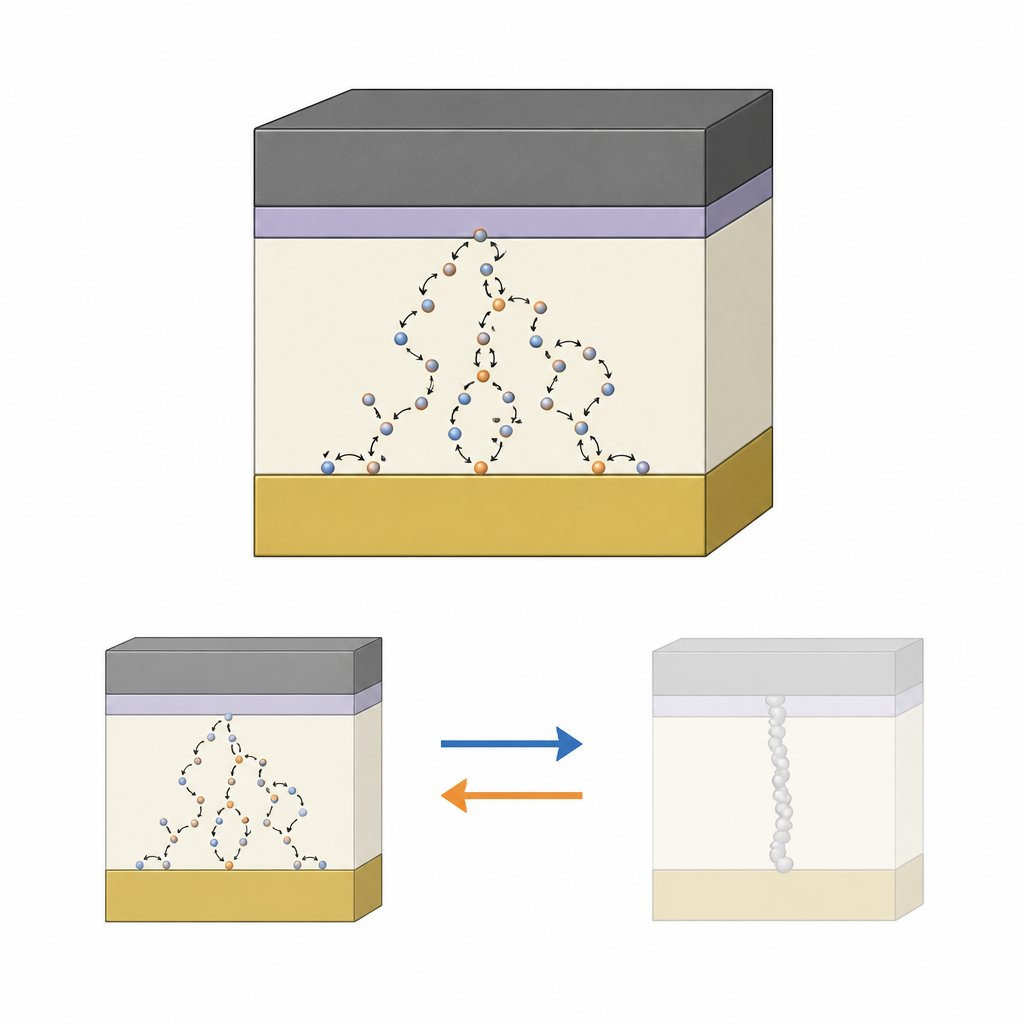
The researchers developed a new ReRAM cell they call PdNeuRAM, built from an ultrathin layer of hafnium oxide sandwiched between layers of palladium and titanium. Careful microscopy showed that palladium atoms slip slightly into the oxide at the interface, where they attract oxygen atoms and leave behind many small defects. Instead of needing a violent electrical forming step to create a single thick conductive filament, this engineered interface naturally hosts a dense network of gentle, shallow defect sites. As a result, the device can switch between resistance states at much lower voltages and without the harsh pre treatment that typical ReRAM requires.
Tuning Many Shades of Conductance
Electrical tests revealed that these PdNeuRAM cells can smoothly adjust their resistance across multiple levels rather than just flipping between simple “on” and “off” states. By changing the size and timing of the electrical pulses, the team could reliably program at least eight distinct resistance levels in a single cell. These levels stayed stable over tens of thousands of read operations and switching cycles. Analysis of how current flows suggested that, at lower strengths, the device conducts through a spread out network of shallow traps, while stronger programming pulses gradually thicken the conductive paths, expanding the usable range of resistance without losing smooth control.
From Single Devices to Spiking Neural Networks
To see how this new cell behaves in a realistic setting, the team modeled crossbar arrays of PdNeuRAM and compared them with more conventional platinum based ReRAM. They used these arrays as synapses in two spiking neural networks that recognize patterns from event based vision datasets, including moving handwritten digits and human gestures. In these networks, information is carried by brief electrical spikes rather than continuous signals, more like real neurons. The researchers mapped each digital weight in the network onto several multi level ReRAM cells and then simulated how much energy was needed to write and read those weights during learning and recognition.
Saving Energy Without Sacrificing Accuracy
The spiking neural networks built with PdNeuRAM achieved accuracies similar to those using the earlier platinum based devices, correctly identifying most digits and gestures in the test sets. However, thanks to their higher natural resistance and forming free operation, the palladium based cells used significantly less energy. Across an entire network, the energy needed to program synaptic weights dropped by about 43 percent, while the energy required to read them during inference fell by about 38 percent. This reduction arises because the gentle, distributed defect network in PdNeuRAM avoids thick, highly conductive filaments, limiting unnecessary current during both write and read operations.
What This Means for Everyday Technology
In simple terms, the study shows how subtle changes at the atomic scale can turn a demanding memory element into a gentle, finely tunable electronic synapse. By reshaping how oxygen and metal atoms arrange themselves at a few billionths of a meter thick, the team created a device that no longer needs an energy heavy “kick start,” yet still offers many stable resistance levels for brain like computing. If scaled up and refined, such forming free, multi level ReRAM cells could help power future AI hardware that fits inside tiny sensors, mobile gadgets, and edge devices while using far less energy than today’s chips.
Citation: Hua, E., Spyrou, T., Ahmadi, M. et al. PdNeuRAM: forming-free, multi-bit Pd/HfO2 ReRAM for energy-efficient neuromorphic computing. Commun Eng 5, 97 (2026). https://doi.org/10.1038/s44172-026-00650-3
Keywords: neuromorphic computing, ReRAM, hafnium oxide, spiking neural networks, low power AI hardware