Clear Sky Science · en
Thalamus: a real-time system for synchronized, closed-loop multimodal behavioral and electrophysiological data capture
Why tracking brain and body together matters
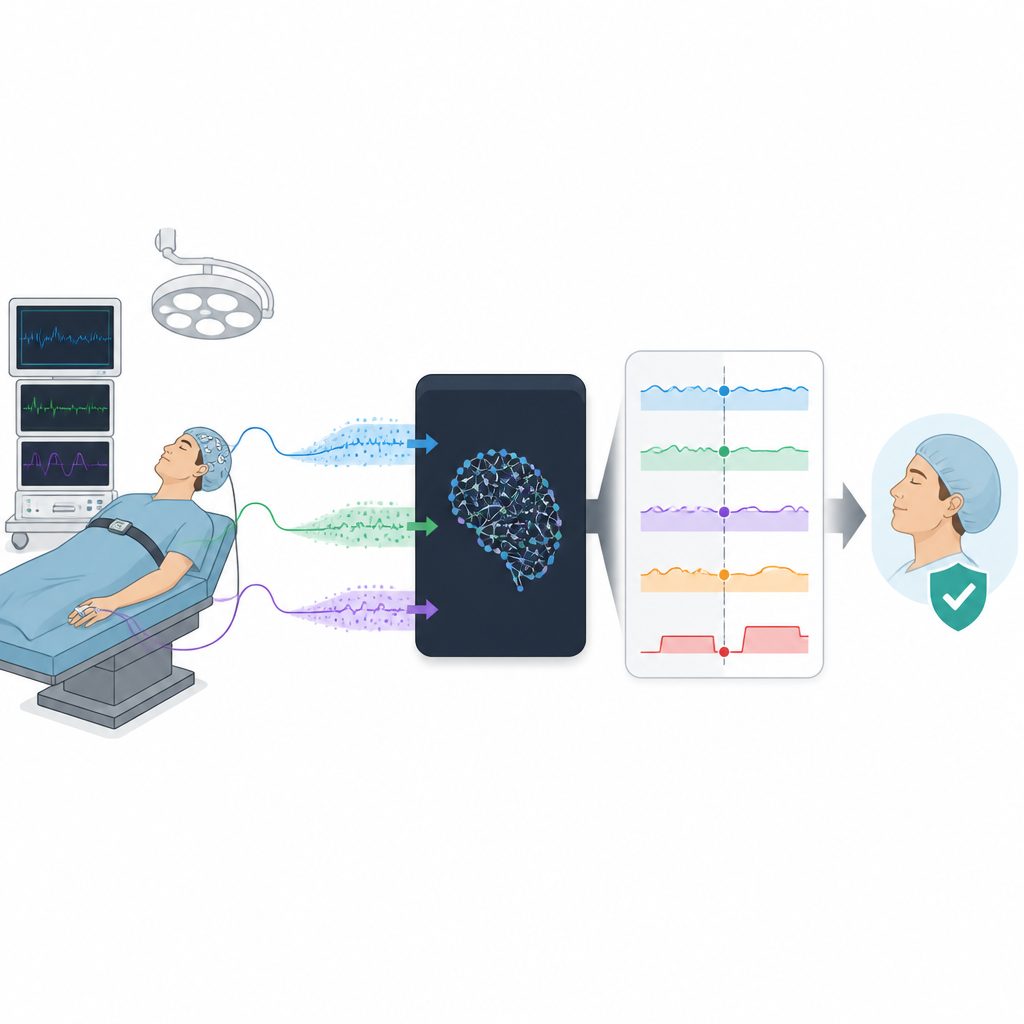
Modern brain surgery and brain–computer interfaces depend on seeing what the brain and body are doing at the same time and with great precision. Yet in a busy operating room, different machines watch the brain, muscles, heart, and movement separately, often without a shared clock. This article introduces Thalamus, an open software system that pulls all these signals together in real time, helping doctors and researchers better understand how brain activity links to behavior and how to safely test new therapies.
A single hub for many signals
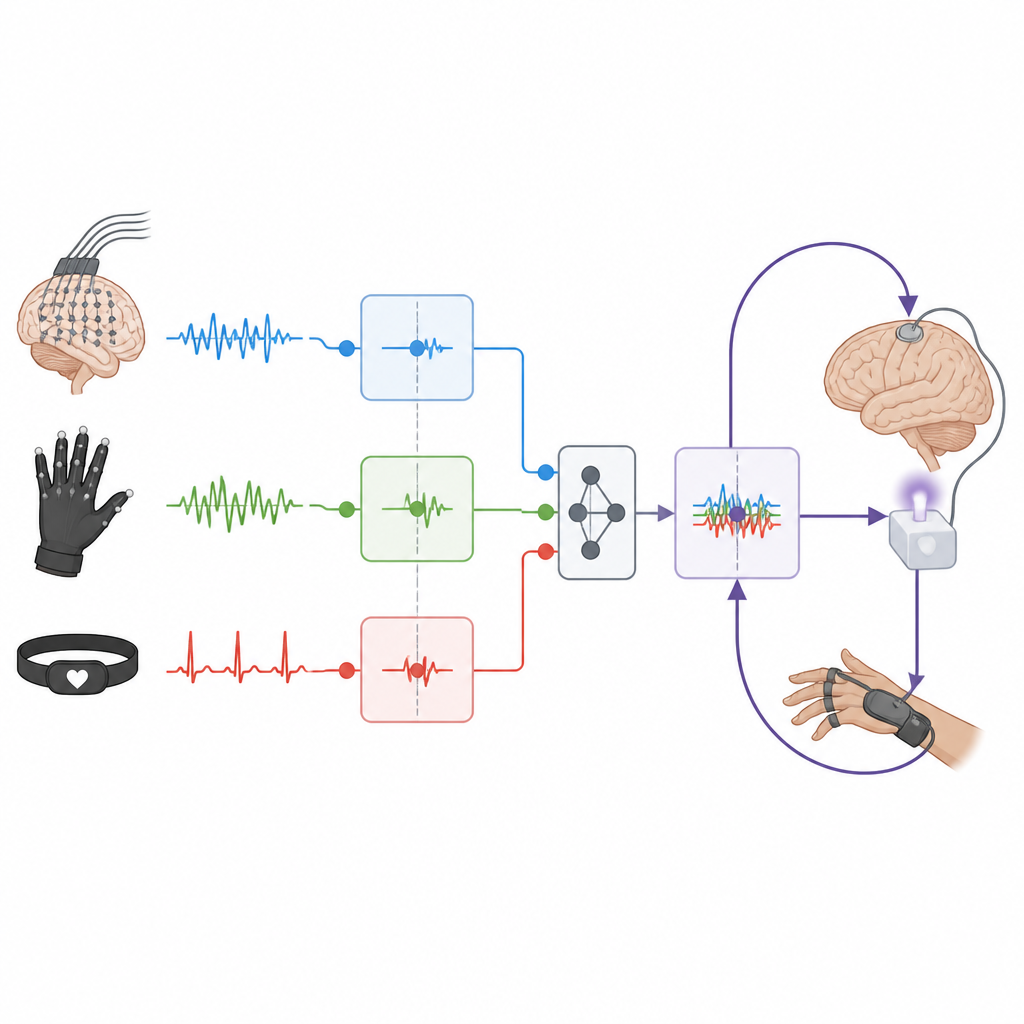
Thalamus is designed as a central hub that can listen to many kinds of sensors already found in hospitals, such as brain electrodes, motion capture gloves, cameras, and heart monitors. Instead of treating each device as an island, Thalamus time stamps every stream as it arrives so that brain waves, hand movements, and other readings can be lined up down to fractions of a millisecond. This synchronized view is especially valuable during short and delicate neurosurgical procedures, where there is little room or time for extra hardware.
How the system is built
To keep up with the heavy data flow, Thalamus uses a two-layer design. A user-friendly Python layer runs the control panel and experiment screen seen by the researcher and patient. A faster C++ layer handles the demanding work of grabbing data from devices, moving it through a chain of processing steps, and saving it. These steps are organized into modular “nodes,” each of which can acquire, transform, or store data. Researchers can mix and match nodes to connect new sensors, compute simple measures such as signal power, or trigger other devices, all while keeping the system stable and responsive.
Real-time feedback and safety
A key goal of Thalamus is to close the loop between sensing and acting. The software can watch incoming signals, carry out calculations in real time, and then send timely feedback, such as driving a virtual hand or triggering brain stimulation hardware. The authors measured how long these loops take using a series of bench tests. They show that Thalamus can detect a change and respond in well under a millisecond inside the software, and on the order of one millisecond when including common data acquisition cards. Careful use of modern communication tools helps the system detect errors, avoid losing data, and recover nearly all information even if a computer process is suddenly stopped.
Proving accuracy in the lab and operating room
The team checked that Thalamus keeps different data streams aligned by building simple test circuits and combining them with motion capture gloves and cameras. When a button was released, the rise in voltage, the recorded finger motion, and the change in light from an LED all matched within a few thousandths of a second. They also stressed the system by increasing video frame rates and computing detailed brain signal summaries, finding that timing remained tight even as the workload grew. Finally, they brought Thalamus into the operating room for patients undergoing deep-brain stimulation surgery. There, the software recorded fine-grained hand movements along with signals from electrodes in a deep brain region tied to movement, revealing the expected drop in certain rhythmic brain activity while the patients moved their hands.
What this means for patient care and research
From a lay perspective, Thalamus acts like a highly precise conductor, keeping many medical “instruments” in sync so that complex brain and body interactions can be seen clearly instead of guessed after the fact. Because it builds on existing hospital equipment, is open-source, and has been tested both on the bench and in real surgeries, Thalamus lowers the barrier to running rich, data-driven experiments in clinical settings. Over time, such synchronized views of brain signals and behavior could support more personalized brain–computer interfaces and therapies, making it easier to tune treatments to each individual without adding risk or burden in the operating room.
Citation: Haggerty, J., Qureshi, Q., Gabriel, E.D. et al. Thalamus: a real-time system for synchronized, closed-loop multimodal behavioral and electrophysiological data capture. Commun Eng 5, 93 (2026). https://doi.org/10.1038/s44172-026-00646-z
Keywords: multimodal neuroscience, brain computer interface, neurosurgery data capture, real time neural recording, closed loop neuromodulation