Clear Sky Science · en
Achieving wideband wavefront manipulation in asymmetric media by phase-engineered metasurfaces with near-unity transmission
Seeing into Hidden Worlds
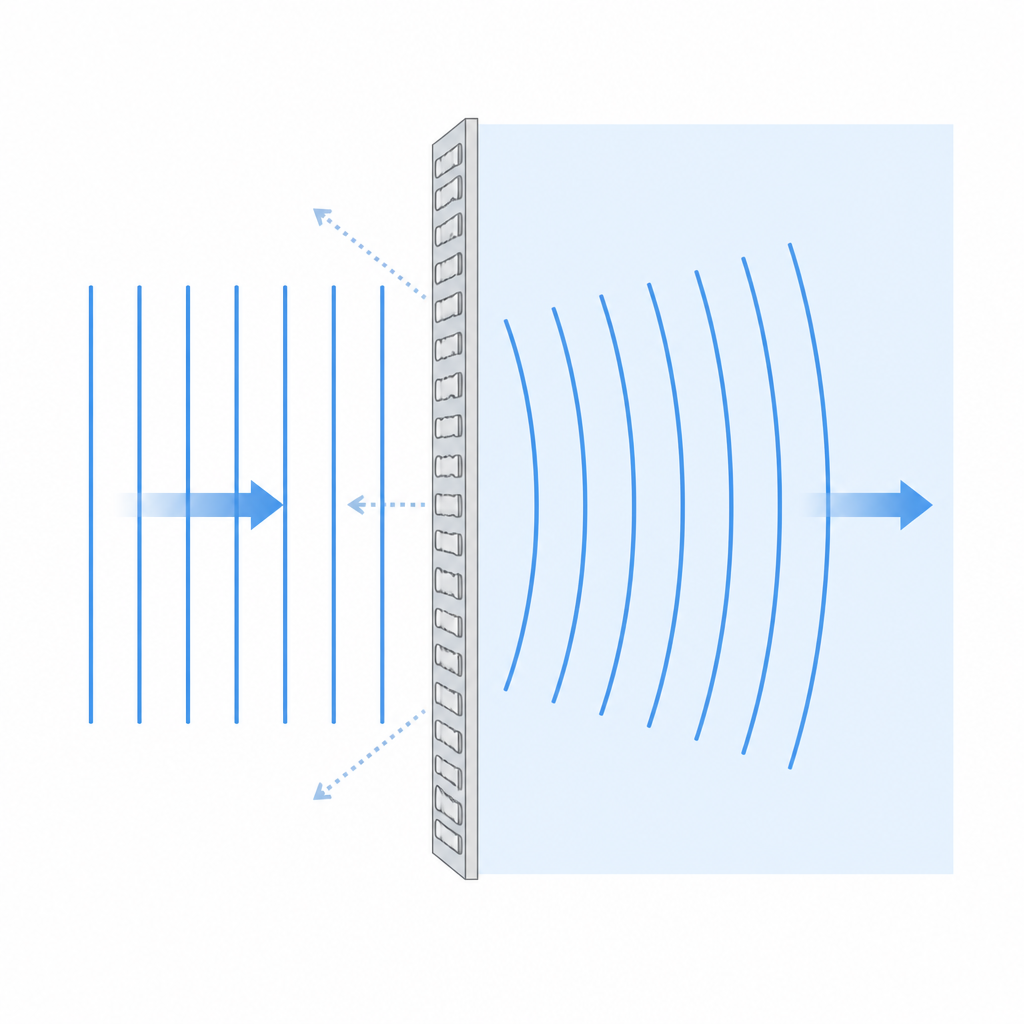
From inspecting aging bridges to peering inside the human body, many technologies rely on electromagnetic waves passing cleanly from one material into another. Yet whenever waves cross a sharp boundary—for example, from air into concrete, water, or tissue—much of their energy bounces back. This wasteful reflection blurs images, weakens wireless links, and narrows the range of frequencies that devices can use. The paper introduces a new ultra-thin engineered surface that lets a broad band of waves slip across such boundaries with very little loss, while also steering and focusing them with high precision.
A Thin Surface that Tames Reflections
When waves hit a boundary between different materials, the sudden change in electrical properties creates a strong mismatch, like a badly tuned audio cable between devices. Traditional solutions add bulky layers or rely on narrowband resonant structures that only work well over a small slice of frequencies. The authors instead design a special “metasurface,” a flat patterned layer built from tiny repeating units much smaller than the wavelength. Each unit gently reshapes the passing wave so that, taken together, the entire surface both matches the boundary and sculpts the outgoing beam. This allows waves to cross from air into a denser medium while being bent or focused as desired, with minimal reflection.
Balancing Two Paths for Shaping Waves
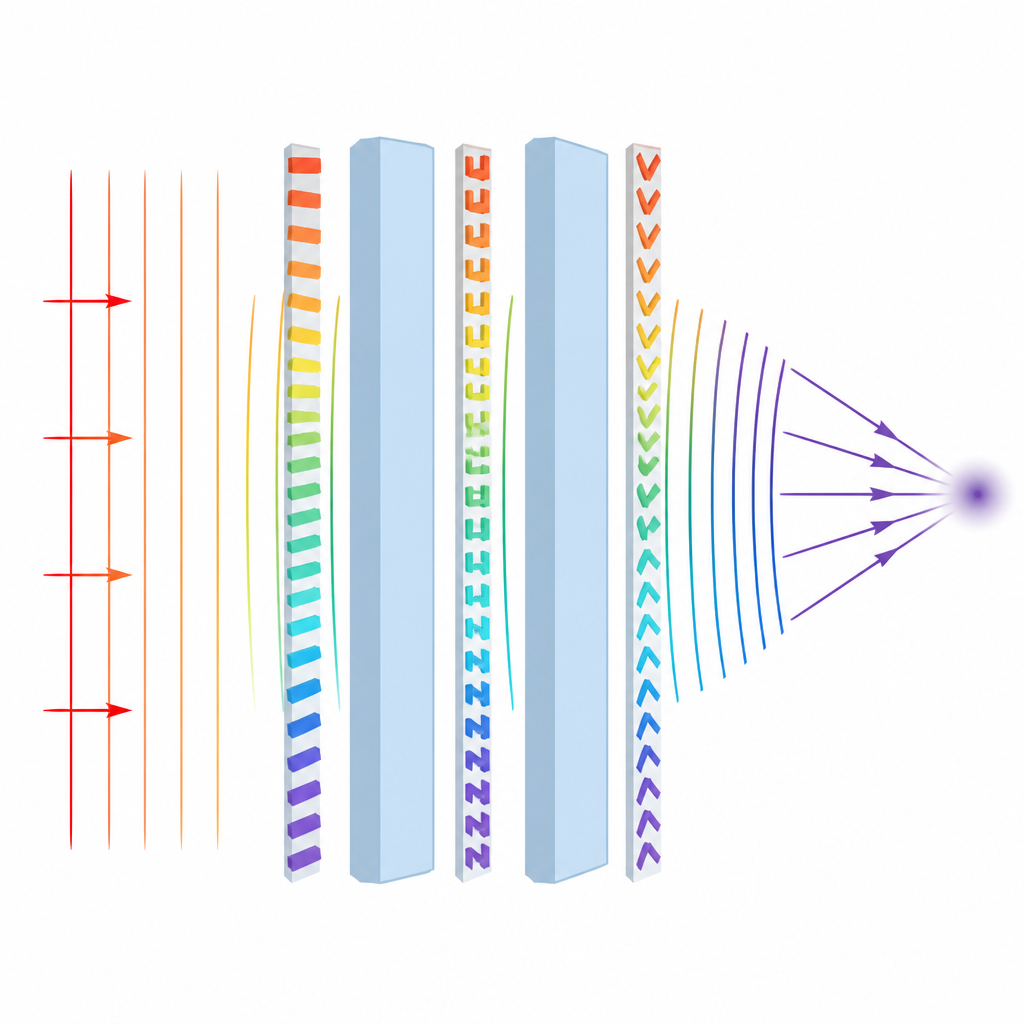
The core innovation is how each tiny building block of the metasurface controls the wave. Earlier designs leaned heavily on sharp metal resonances, similar to pushing a swing at just the right rhythm. That approach gives strong control but only within a narrow frequency window. The new design spreads the job between metal patterns and the transparent spacers that sit between them. The metal layers provide fine-tuned interaction with the wave, while the spacers act as simple corridors that add extra delay as the wave travels through. By carefully choosing the thickness and material of these spacers, the authors ensure the right total delay and direction over a much wider range of frequencies.
From Narrowband to Wideband Control
To show why the spacer thickness matters, the team compares two versions of their gradient metasurface. The first is very thin and relies strongly on metal resonances. It can steer waves, but only in a very narrow frequency band. The second is slightly thicker and uses the spacers as an extra control knob. In this version, the metal layers operate in a milder regime, while the spacers provide most of the phase shift. Simulations reveal that this balance dramatically widens the frequency band where the surface both transmits almost all the energy and sweeps smoothly through the full range of phase shifts needed to steer and focus the outgoing beam.
Steering and Focusing Across a Boundary
The researchers then arrange these building blocks into larger repeating cells that impose a gentle phase slope along the surface. According to a generalized version of Snell’s law, this slope dictates how much the transmitted beam deflects. By choosing different sequences of units, they create surfaces that bend waves at plus or minus specific angles or that focus energy to a tight spot inside the second medium. Laboratory tests in the X-band (around 8 to 12 gigahertz) confirm that their prototypes can steer beams by about 30 degrees and form sharp focal regions, all while keeping reflections very low over more than 13 percent of the band—an unusually broad range for such asymmetric setups.
New Tools for Imaging and Wireless Links
Finally, the authors combine several steering patterns into composite surfaces that create multiple beams or enhanced focusing, acting like flat convex or concave lenses pressed against a boundary. These devices offer much stronger concentration of energy than a bare surface or a single simple metasurface, and they work across a useful spread of frequencies. Because the design method is grounded in general electrical network ideas, it can be scaled to other bands, including those used in radar, medical imaging, underground sensing, and high-speed wireless links. In simple terms, the study shows how a carefully layered ultra-thin surface can let waves cross difficult boundaries with little reflection while aiming and sharpening them, opening new possibilities for clearer images and more efficient communication through complex materials.
Citation: Li, X., Hao, T., Yu, R. et al. Achieving wideband wavefront manipulation in asymmetric media by phase-engineered metasurfaces with near-unity transmission. Commun Eng 5, 94 (2026). https://doi.org/10.1038/s44172-026-00645-0
Keywords: metasurface, wavefront control, impedance matching, beam steering, electromagnetic imaging