Clear Sky Science · en
Synapse-inspired energy networks: a neuromorphic approach to microgrid protection without communication links
Why protecting small power grids matters
As neighborhoods add solar panels, batteries, and local generators, they increasingly rely on small power networks called microgrids. These systems can keep lights on during storms and reduce strain on large power plants, but they are also harder to protect from electrical faults and cyberattacks. This paper explores a new way to safeguard microgrids by borrowing ideas from how brain cells communicate, allowing each energy unit to make its own ultra-fast decisions without depending on fragile communication links.
Limits of today’s protection tools
Traditional protection devices expect very large fault currents and a fairly stable grid layout. In modern microgrids, inverters limit current for safety and efficiency, and lines are often reconfigured as solar arrays or batteries connect and disconnect. This makes it hard to tell a dangerous fault from a normal change in power use. Newer schemes try to fix this with high-speed communication, synchronized sensors, or complex logic, but that introduces delays, data loss risks, and cyber vulnerabilities. Other approaches, such as travelling wave methods, work well on big transmission lines but struggle in low-voltage, tightly meshed microgrids where signals are weaker and reflections are messy.
Borrowing ideas from the brain
The authors propose a different strategy inspired by biological neurons. In their design, every distributed energy resource in a microgrid behaves like a simple brain cell called a leaky integrate-and-fire neuron. Each unit watches its local voltage, current, and power, and combines their deviations into a single disturbance index. When this index is small, the virtual neuron stays mostly quiet. As the disturbance grows, the time between its electrical “spikes” shortens. Stronger or closer faults cause the neuron to spike sooner, much like how a nerve cell fires more quickly in response to a strong stimulus. A built-in adaptive threshold shifts with operating conditions so that routine load changes do not trigger unnecessary spikes.
Letting the first spike decide
Instead of sending detailed measurements to a central brain, all units simply watch for spikes. The protection rule is straightforward: the device whose neuron spikes first is assumed to be closest to the fault and trips its local circuit breaker. This First-To-Spike rule mirrors how travelling wave systems use the earliest arriving signal to locate a problem, but here it works without GPS, wide-area communication, or specialized high-frequency sensors. Because each unit acts only on its own measurements and timing, the scheme is inherently decentralized and far less exposed to communication failures or cyberattacks. 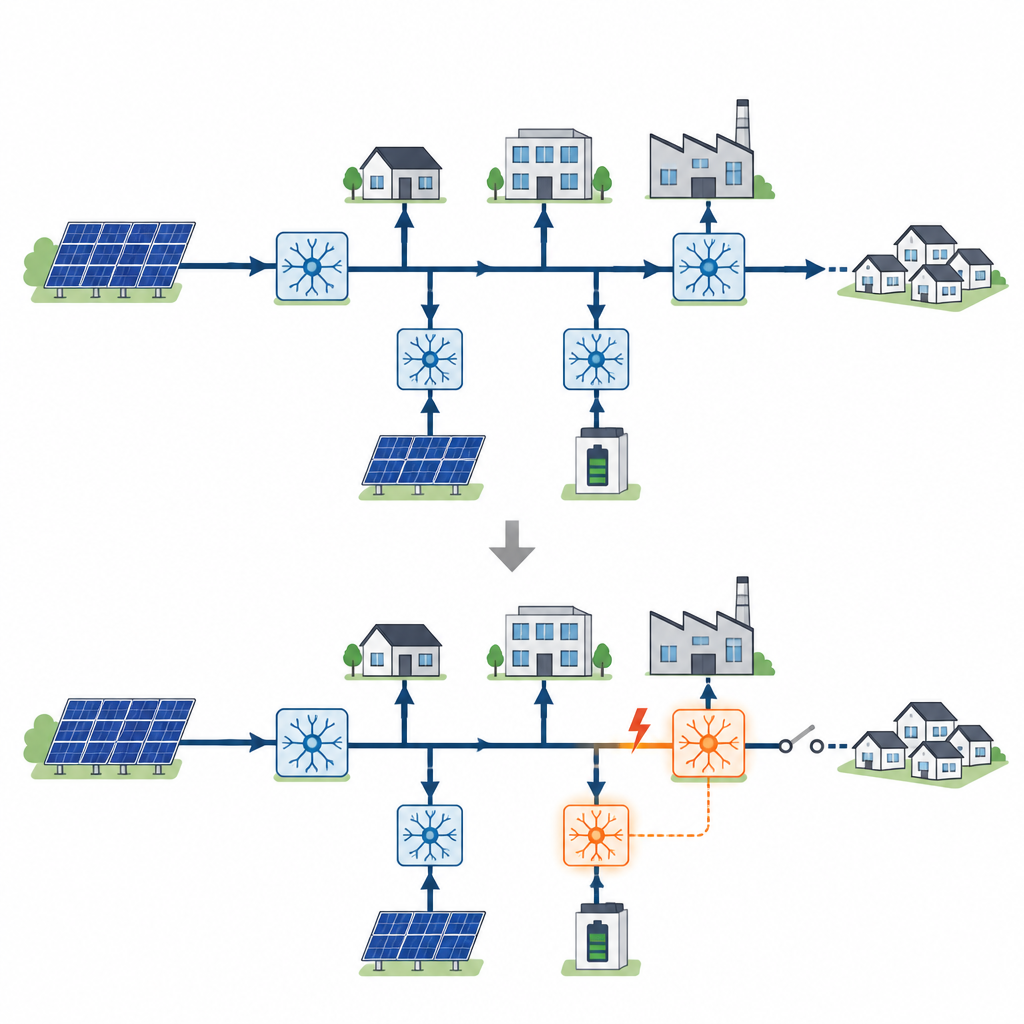
How the new protection behaves in practice
The team tested their approach in detailed computer models of ring and meshed microgrids, and then on real-time hardware. They simulated single-line faults, line-to-line faults, three-phase faults, and large load changes across many line lengths and fault resistances. The system typically detected and cleared faults within 10 to 58 milliseconds, much faster than conventional microgrid relays that often take 200 to 450 milliseconds, and even faster than travelling wave systems reported at around 60 milliseconds. Stronger faults and faults on shorter lines consistently produced earlier spikes and quicker breaker trips, naturally reproducing the “stronger fault, faster action” behavior of classic protection curves. At the same time, the adaptive threshold kept the neurons quiet during even sizeable load swings, yielding detection accuracy above 98 percent and spatial selectivity above 97 percent in more than 300 simulated fault cases. 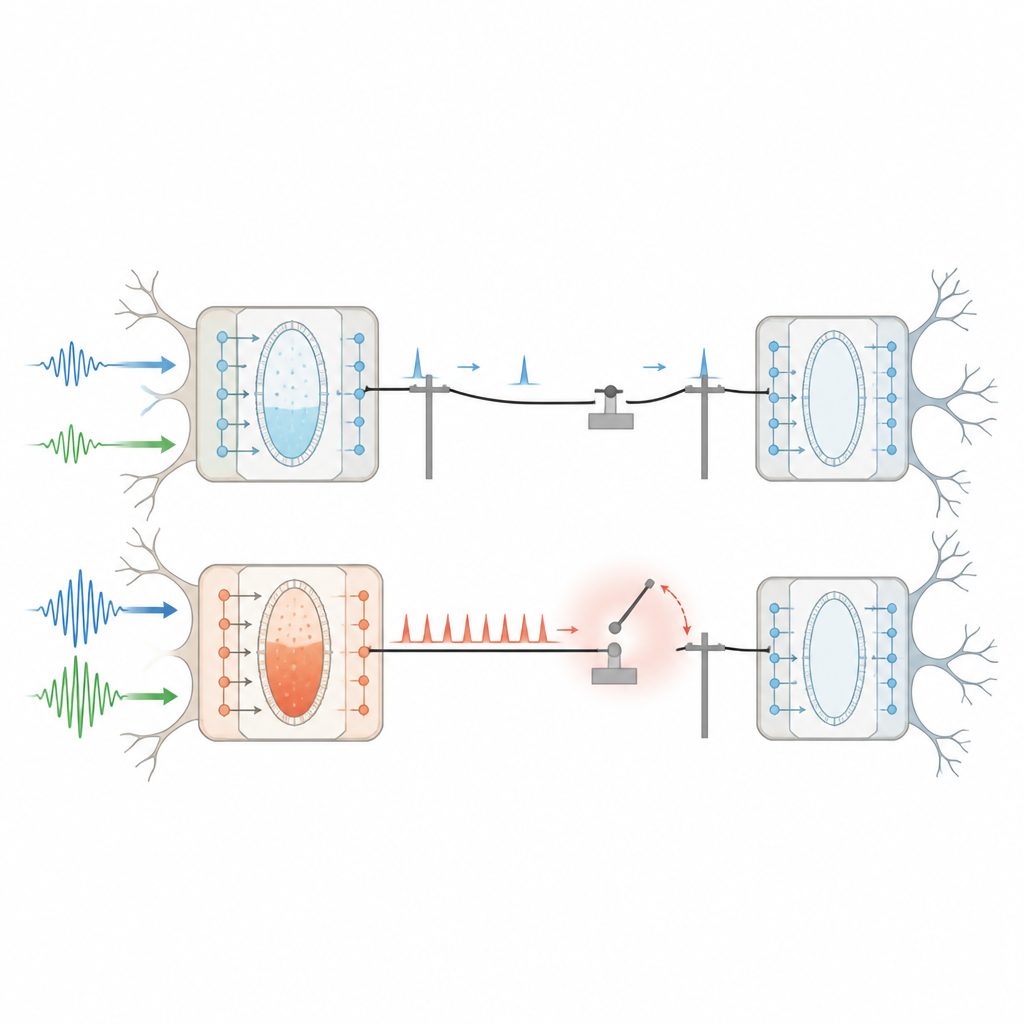
Why this approach could scale with future grids
Because each energy unit needs only local measurements and a lightweight spiking model, the method is energy-efficient and easy to scale. During normal operation, almost no spikes are produced, and computation happens only around rare fault events. New solar or battery units can join the microgrid without reprogramming a central controller, since they simply act as new neurons that obey the same First-To-Spike rule. The authors note some remaining challenges, such as very high-resistance faults that create only weak disturbances and crowded networks where many units see similar conditions, but they argue these can be handled with further tuning and added filtering.
What this means for everyday power users
To a non-specialist, the core message is that the authors have shown how microgrids can protect themselves by thinking more like a brain than a traditional machine. Each solar inverter or battery unit listens carefully to its local environment, fires spikes only when something truly unusual happens, and lets the first responder isolate the problem almost instantly. This neuromorphic strategy delivers fast, selective protection without relying on vulnerable communication networks, offering a path toward safer, more resilient, and more flexible local power systems as renewable energy continues to spread.
Citation: Prabhakar, S., Panigrahi, B.K., Blaabjerg, F. et al. Synapse-inspired energy networks: a neuromorphic approach to microgrid protection without communication links. Commun Eng 5, 90 (2026). https://doi.org/10.1038/s44172-026-00643-2
Keywords: microgrid protection, neuromorphic energy, spiking neural networks, distributed energy resources, fault detection