Clear Sky Science · en
Realization of blue-emitting CsPb(Br1-xClx)3 nanocrystals via simultaneous halide exchange and defect passivation using dopamine hydrochloride
Brighter blue light from tiny crystals
Blue light is essential for displays, lighting, and lasers, but making tiny light-emitting crystals that shine bright blue while staying stable has been surprisingly difficult. This study shows how a familiar brain chemical, in a salt form, can help tune these nanocrystals to emit vivid blue light and protect them from falling apart, opening new paths toward better screens and light sources.
Why blue light is hard to get right
Modern displays and lighting increasingly rely on nanocrystals that can be tuned to glow in different colors. Green and red versions already work well, but blue ones tend to be dim or quickly lose their color. The problem comes from two main issues: the atoms that set the color can separate into different regions, and tiny flaws on the crystal surface act like leaks where light energy is lost as heat instead of being emitted.
Using a dual-purpose helper molecule
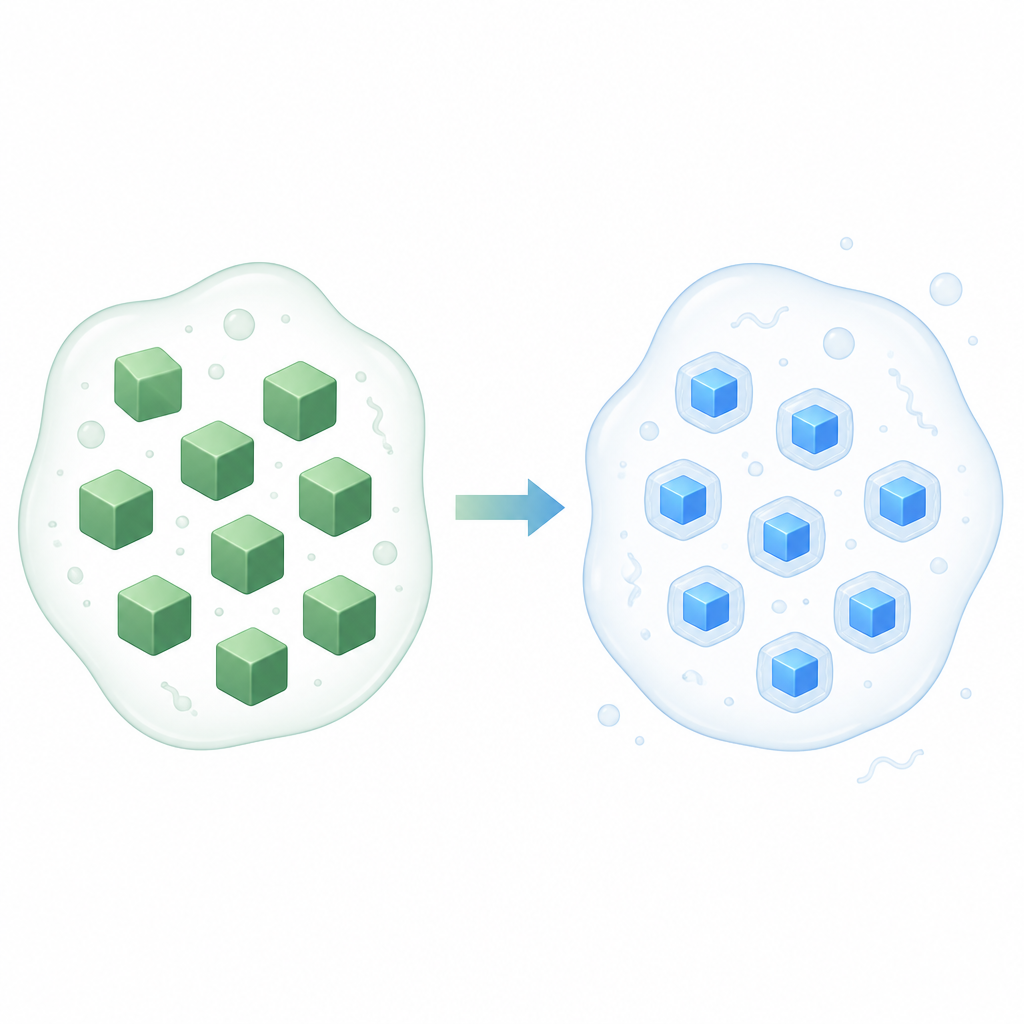
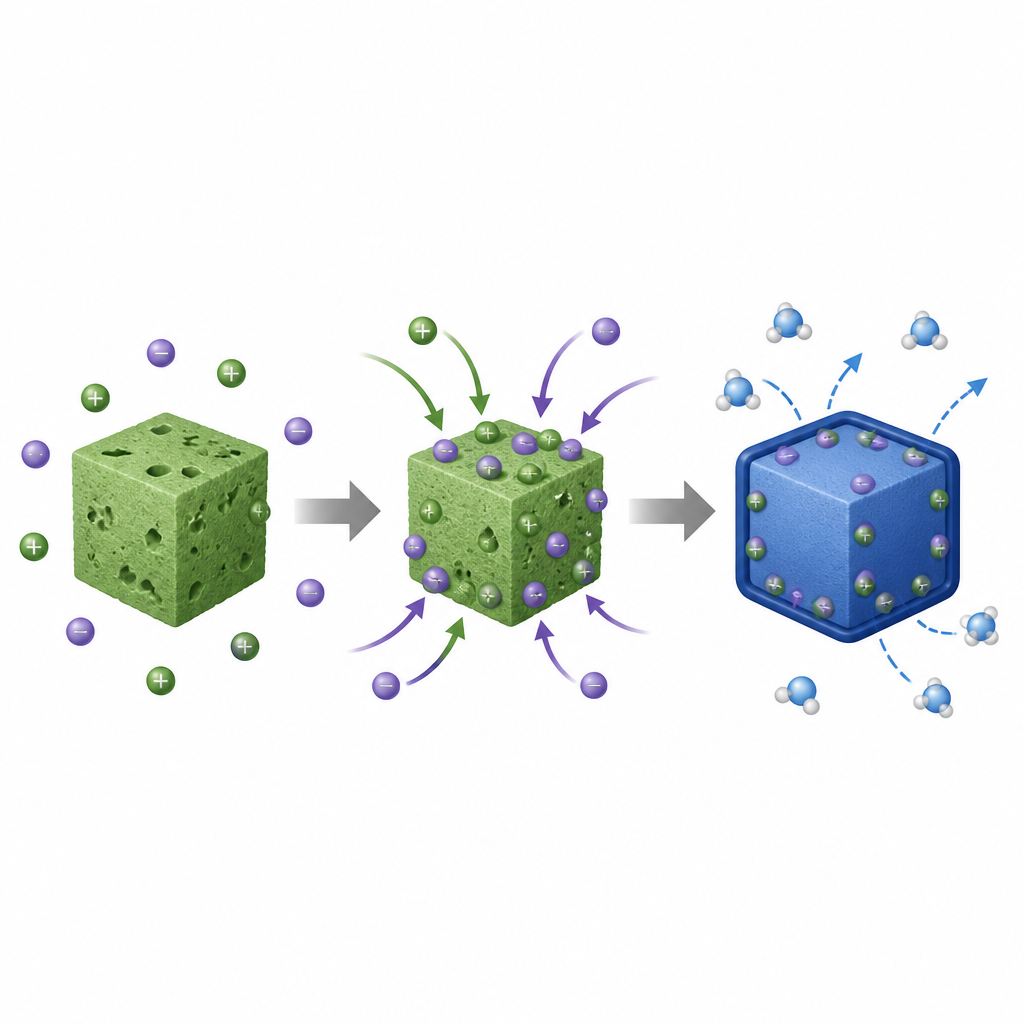
The researchers worked with cesium lead halide nanocrystals, a family of materials whose color can be adjusted by swapping bromide atoms for smaller chloride atoms. Instead of using harsh chemicals, they added dopamine hydrochloride, a powder made of a dopamine molecule paired with a chloride ion. In liquid, the chloride can slip into the crystal and replace bromide, pushing the color from greenish toward blue, while the dopamine part sticks to the crystal surface, covering up light-leaking defects.
Balancing color tuning and defect healing
By carefully controlling how long the nanocrystals were stirred with dopamine hydrochloride, the team watched the light they emitted shift from about 512 nanometers (green) to 478 nanometers (blue). At first, the brightness dropped sharply, because early in the treatment many new defects formed before the surface was fully covered. As time went on, more dopamine bound to the surface, healing these flaws and restoring brightness. After two hours of treatment, the crystals were not only blue but also more efficient, converting about three-quarters of absorbed light into emitted light.
How pH steers the chemistry
The surrounding liquid acted a bit like a steering wheel for the chemistry. In slightly acidic conditions, dopamine hydrochloride did not break apart very well, so few chloride ions were available to change the color, and dopamine did not join together into a protective coating. The crystals showed only a small shift in color. Under slightly basic conditions, however, more chloride was released and dopamine molecules linked into a thin layer called polydopamine that wrapped around the crystals. This led to a much larger color shift toward blue and created a protective shell.
Keeping the crystals safe from water
Water is usually bad news for these materials, quickly dimming their glow. The untreated nanocrystals lost most of their brightness within a few hours in a moist environment. In contrast, the blue-emitting crystals treated with dopamine hydrochloride kept more than half of their original light output over the same time, and their color stayed steady. The polydopamine shell helped block moisture and also kept the chloride evenly distributed, preventing the color from drifting.
What this means for future devices
In simple terms, the study shows that a single additive can both tune nanocrystals to emit blue light and patch the flaws that normally drain their brightness, while also wrapping them in a moisture-resistant coat. This approach could make it easier to build more reliable blue pixels and light sources using perovskite nanocrystals, bringing laboratory demonstrations a step closer to practical, long-lasting devices.
Citation: Kim, D., Park, J.S., Yim, SY. et al. Realization of blue-emitting CsPb(Br1-xClx)3 nanocrystals via simultaneous halide exchange and defect passivation using dopamine hydrochloride. Commun Eng 5, 88 (2026). https://doi.org/10.1038/s44172-026-00640-5
Keywords: blue perovskite nanocrystals, dopamine hydrochloride, halide exchange, defect passivation, structural stability