Clear Sky Science · en
Long-term on-leaf monitoring of plant electrophysiology with printed adhesive gel bioelectrodes
Listening to Plants
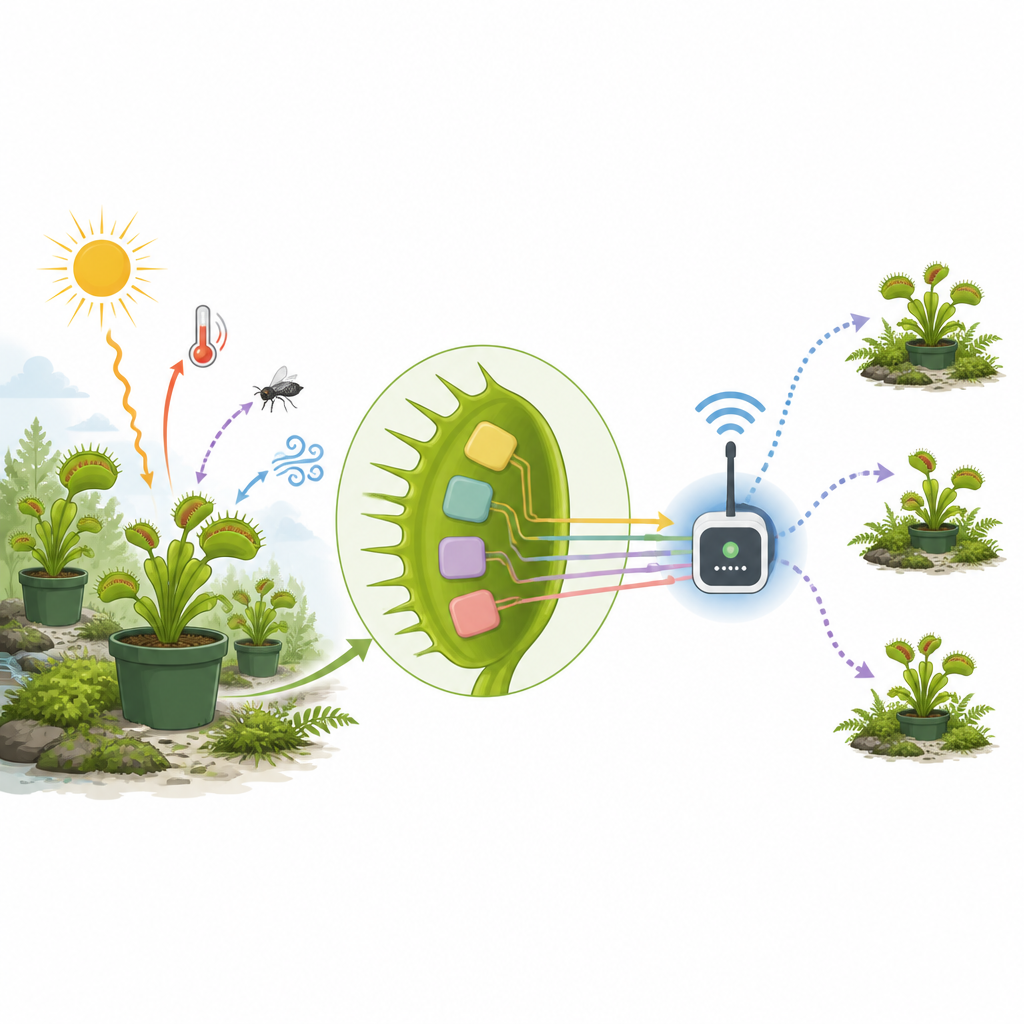
Imagine if living plants could act as quiet sentinels, reporting on insects, heat, cold, and daily light cycles simply by "speaking" through tiny electrical pulses. This study shows how Venus flytraps fitted with soft, sticker like gel pads can do exactly that, turning a familiar carnivorous plant into a natural sensor that links the green world to everyday electronics.
Why Plants Send Tiny Electrical Signals
Plants are not silent. Inside their leaves, small electrical bursts ripple from cell to cell whenever they are touched, wounded, chilled, or exposed to changing light. In the Venus flytrap, these signals are especially dramatic. When a bug brushes its trigger hairs twice within about 20 seconds, the plant generates a pair of electrical pulses that cause the trap to snap shut. Because this response is so reliable, the flytrap is an ideal model for turning plant signals into useful information about the surrounding environment.
The Problem with Bulky Metal Contacts
Until now, reading these signals over days or weeks has been difficult. Conventional metal wire contacts, similar to medical electrodes, sit awkwardly on the outside of the leaf. They do not stick well, often lose contact when the plant moves, and can damage the tissue over time. In this study, the researchers compared these rigid silver chloride wires to new soft gel pads and found that the older style contacts led to browning, dead patches on the leaves and a steady loss in signal quality, especially as humidity and temperature changed.
Soft Stickers that Bond with the Leaf
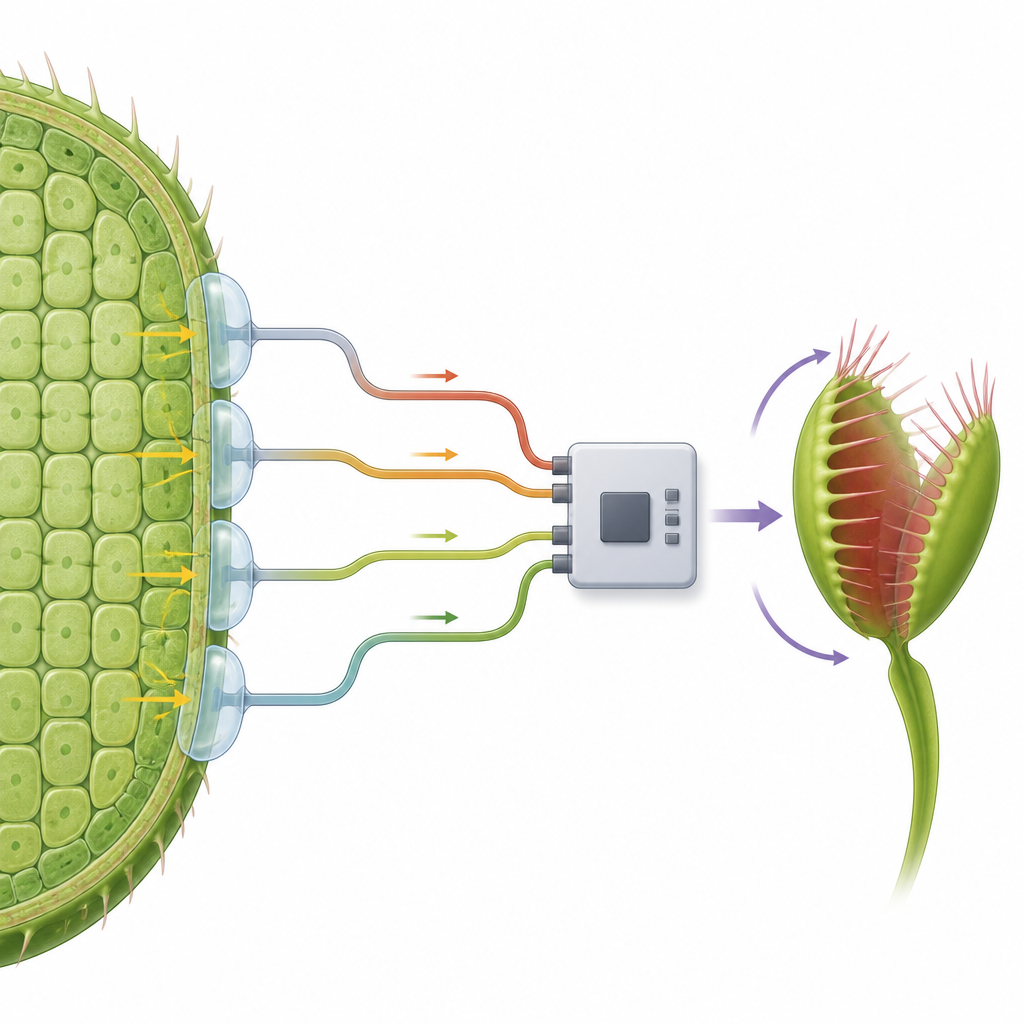
The team developed a thin, jelly like pad that gently adheres to the inside of the Venus flytrap’s trap, right next to the trigger hairs. Inside the gel is a printed strip of a flexible conducting plastic, backed by a harmless adhesive made from methyl cellulose. Mechanical tests showed that the pads stick more strongly than the leaf’s own tissue and can endure stretching and repeated motion without peeling off. Electrical tests revealed that, unlike metal wires, the gel pads keep a stable, low resistance connection for at least five days, even as light, temperature, and humidity change, allowing the plant’s signals to be monitored continuously.
Hearing and Talking to the Plant
With the gel pads in place, the researchers recorded the flytrap’s natural electrical pulses when hairs were touched by hand, by crickets walking in an enclosure, and during cooling in a freezer. The soft contacts picked up larger and cleaner signals than rigid wires and continued to work when removed and reattached over 14 days. The team also showed that they could “talk back” to the plant: when they applied carefully shaped electrical pulses through the same pads, the traps snapped shut just as if prey had arrived. By linking several pads to inexpensive wireless circuit boards, one plant’s electrical activity could be detected, sent over a distance, and used to trigger another plant to close its trap, creating a simple plant to plant communication link.
Plants as Living Environmental Sensors
For a non specialist, the main outcome is that soft, printed gel pads can reliably listen to and gently stimulate a living plant for days without harming it. In the Venus flytrap, this means that a plant can reveal when an insect has been caught or when temperatures have dipped, and it can even be triggered to move on command using small, battery powered circuits. Scaled beyond flytraps, similar gentle contacts could turn ordinary crops or wild plants into living sensor nodes that report on drought, pests, and climate patterns, blending natural sensing abilities with modern electronics.
Citation: Crichton, C.A., Sharpe, T., López-Pozo, M. et al. Long-term on-leaf monitoring of plant electrophysiology with printed adhesive gel bioelectrodes. Commun Eng 5, 86 (2026). https://doi.org/10.1038/s44172-026-00638-z
Keywords: plant electrophysiology, Venus flytrap, bioelectronic sensors, hydrogel electrodes, environmental monitoring