Clear Sky Science · en
Non-contact electroelastic modulation of conventional media leveraging two-way electromagnetic induction
Why stopping vibrations without touching matters
From airplanes and trains to delicate lab instruments and satellites, many vital machines are made of metal structures that shake and vibrate. Engineers can tame these vibrations by attaching special devices or reshaping the structure itself, but doing so can be difficult, risky, or impossible once the system is already in service. This paper introduces a new way to calm and steer vibrations in ordinary metal parts without ever touching them, using a clever blend of magnets, coils, and electronics that sit just above the surface.
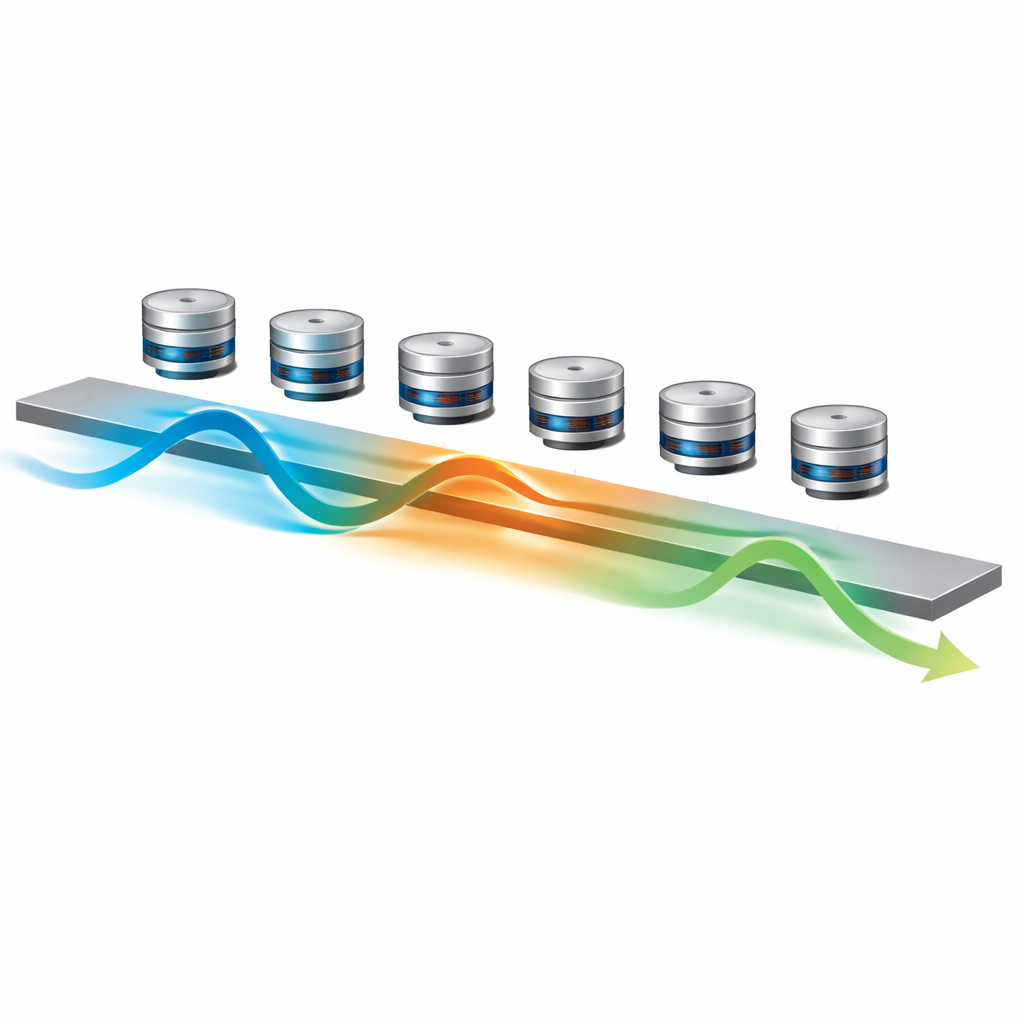
A hovering add-on for restless metal
The authors present a "wave-altering non-contact design," or WAND, that acts like a detachable silencer for bending waves traveling through metal beams and panels. Each WAND unit is a compact module containing a strong permanent magnet and a copper coil, held a small distance above a conductive surface such as aluminum. When the metal vibrates, it moves within the magnet’s field and stirs up swirling electric currents—called eddy currents—inside the metal. These currents interact with the coil through electromagnetic induction, allowing energy to shuttle back and forth between the mechanical motion of the structure and an electrical resonator built from the coil and an electronic circuit. Crucially, no glue, bolts, or welded parts are needed: the units simply hover at a fixed gap, so the host structure itself remains unchanged.
Turning vibrations into a tunable electrical echo
Inside each WAND, the coil is connected to a tunable circuit that behaves like a classic mass-and-spring system, but in electrical form. By adjusting the apparent capacitance and resistance using analog electronics, the researchers can set this electrical “spring” to ring at a chosen frequency, much like tuning a musical instrument. When the vibration frequency in the metal matches this electrical resonance, the energy transfer between the structure and the circuit becomes especially strong. The coil current then produces magnetic forces that push back on the vibrating metal, but out of phase, so that some of the incoming wave energy is trapped and re-emitted in a way that cancels motion rather than amplifying it. To overcome real-world losses in the coil and circuitry, the team uses specially designed analog components that effectively reduce internal resistance without resorting to full digital feedback control.
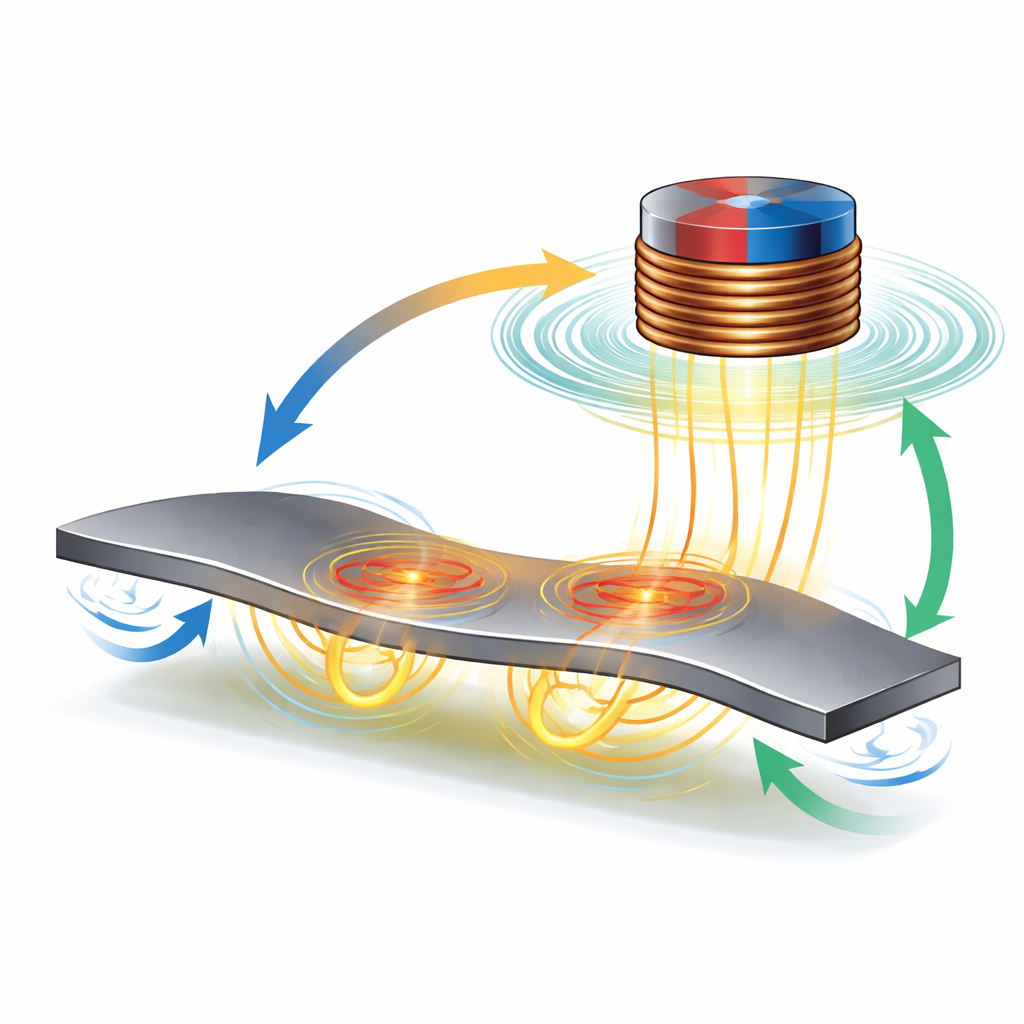
Blocking waves and calming resonances
To show what WAND can do, the authors build a one-dimensional “metamaterial” by lining up seven identical units above a long, thin aluminum beam. They first tune the electrical resonance of the coils to specific target frequencies and then send bending waves down the beam. Using a scanning laser to measure motion, they find that in a narrow band around each tuned frequency, the wave is strongly reduced after passing beneath the array, forming what is known as a band gap. In their experiments, transmission drops by about 9–10 decibels at the target frequencies—roughly a threefold cut in vibration amplitude—purely through non-contact interaction. In a second demonstration, a single WAND is placed near the free end of a cantilevered beam and tuned to one of its natural vibration modes. With careful electrical adjustment, the sharp resonance peak of that mode is flattened, showing that the device can act as a remote, frequency-specific vibration damper.
Limits, trade-offs, and paths to improvement
The study also clarifies where the approach works best and where it struggles. Because the mechanism relies on changing magnetic flux, it becomes more effective at higher frequencies, and it benefits from lightweight, flexible, and highly conductive host materials such as aluminum. However, the band gaps created so far are relatively narrow and modest in depth, as eddy current coupling is not extremely strong and electrical losses remain significant. The distance between the resonators and the surface must be carefully controlled, and there are practical limits on magnet strength and circuit performance. The authors suggest that stronger magnets, improved coil designs, better-conducting structures, and optimized placement patterns could all boost performance and widen the useful frequency range, especially if units with slightly different tunings are combined to merge multiple narrow gaps into broader vibration-free zones.
What this means for future quiet and smart structures
In everyday terms, this research shows how we might one day quiet noisy, vibrating metal structures or steer mechanical waves inside them simply by snapping on small, reusable modules that never need to be permanently attached. The WAND concept preserves the original properties of the host while adding a reconfigurable “acoustic skin” that can be tuned by turning electronic knobs rather than redesigning hardware. Although current results focus on modest, narrowly targeted suppression in laboratory beams, the underlying idea opens a door to next-generation smart structures and devices—ranging from adaptive vibration control and structural health monitoring to wave-based sensing and even energy harvesting—all achieved through contactless, reversible, and electrically adjustable add-ons.
Citation: Dupont, J., Christenson, R. & Tang, J. Non-contact electroelastic modulation of conventional media leveraging two-way electromagnetic induction. Commun Eng 5, 69 (2026). https://doi.org/10.1038/s44172-026-00630-7
Keywords: non-contact vibration control, eddy current resonator, electromagnetic metamaterial, elastic wave band gap, tunable structural damping