Clear Sky Science · en
3D-printed concrete with in-process embedded fiber-reinforced polymer grid reinforcement
Building Homes with Giant 3D Printers
Imagine houses printed the way your home printer lays down ink—only the “ink” is wet concrete squeezed out in thick ribbons. This vision of robotic, low-waste construction is close to reality, but one big hurdle remains: today’s 3D-printed concrete can be surprisingly fragile. This study explores a new way to quietly slip strong, lightweight grids into the concrete as it is printed, aiming to make future printed walls and floors tougher, safer, and longer lasting.
A New Way to Strengthen Printed Concrete
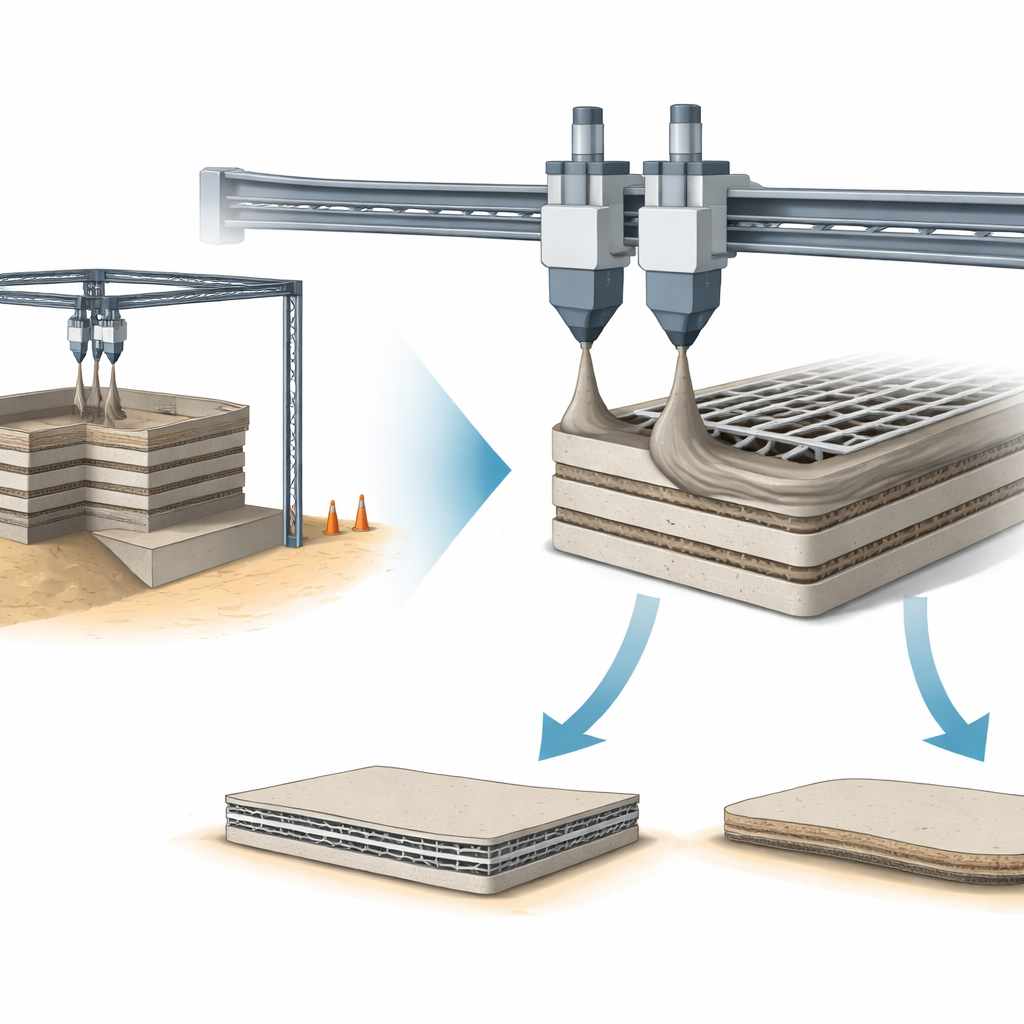
Traditional concrete buildings hide steel bars inside to resist bending and cracking. With 3D-printed concrete, which is built up layer by layer without molds, slipping in such bars is difficult and often requires manual work that undercuts the promise of full automation. The authors propose a different strategy: using flexible fiber-reinforced polymer (FRP) grids—thin, mesh-like strips made from high‑strength fibers in a plastic binder—and feeding them into the structure during printing. Their key advance is a dual-nozzle system that prints concrete and FRP grid at the same time. One nozzle extrudes the concrete filament, while a second, slightly lower nozzle lays the flexible grid so that it becomes sandwiched between successive concrete layers as the printer moves.
How the Dual-Nozzle System Works
The new device mounts an FRP storage reel and a guiding track directly onto a commercial 3D concrete printer. As the print head travels, concrete exits the front nozzle while the grid is pulled from its reel, steered around corners, and fed through a rear nozzle into the fresh concrete. Gravity and the weight of new layers press the grid into place. Because the track and FRP nozzle are modular and detachable, grids of different widths can be used without redesigning the whole machine. The researchers also use “functionally graded” concrete plates, with tougher fiber‑rich concrete on the tension side and geopolymer concrete on top, echoing how nature tailors material where it is most needed.
Putting the Printed Plates to the Test
To see whether in-process grids really help, the team printed a series of plate-like elements and subjected them to three-point bending tests, in which a plate is supported at its ends and pressed in the middle until it fails. Plates reinforced with FRP grids carried about 41% more load than plain plates and could deflect more than five times as much before failure, meaning they bent without suddenly snapping. The best-performing layout used grids in multiple rows and columns, but the study also found that a single, wider grid strip could be as effective as several narrow ones with the same total amount of reinforcement. Pull-out tests—where a piece of grid is tugged out of a concrete block—showed that the bond between grid and concrete is moderate but not optimal, and that only some of the grid yarns actually slide, limiting how efficiently forces are shared.
The Hidden Cost of Voids Between Layers
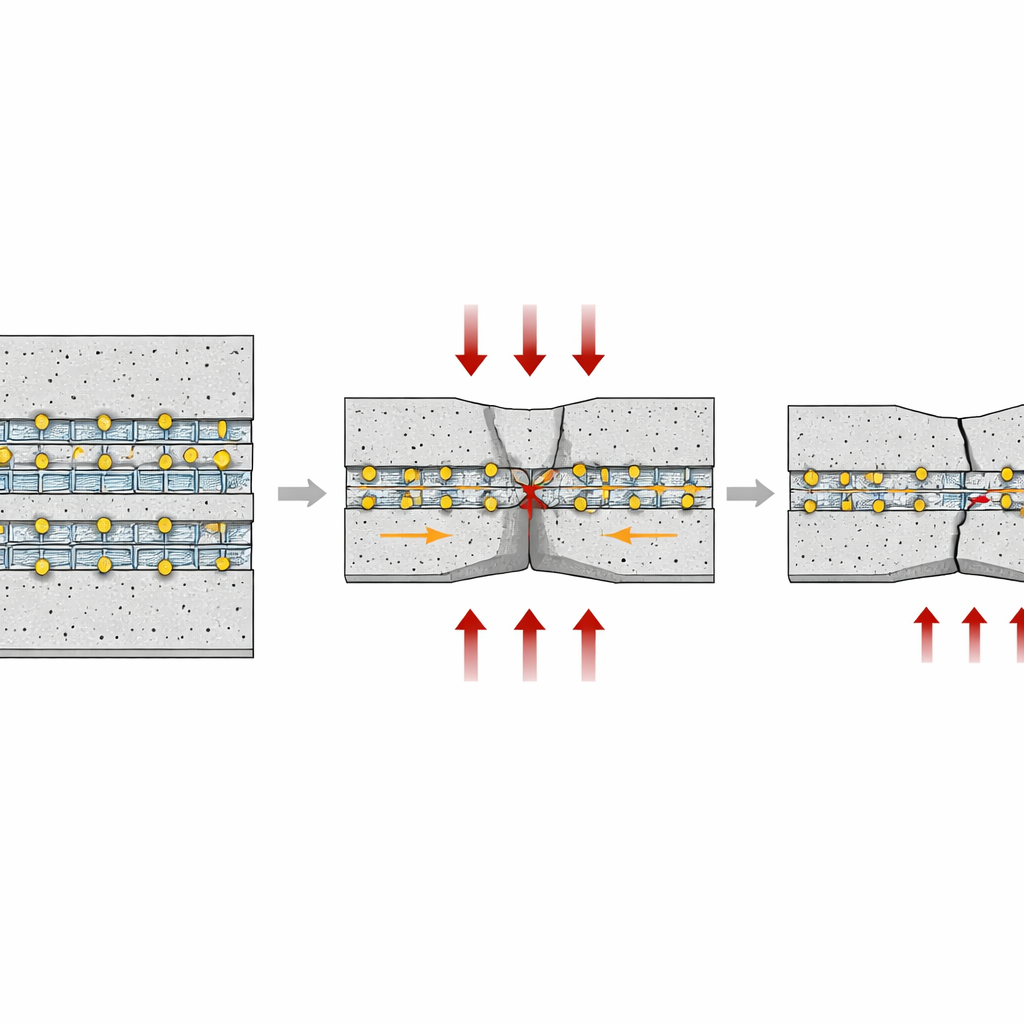
The story is not entirely positive. Because the grid is laid between layers, it creates small gaps and reduces direct contact from one concrete layer to the next. Splitting tests that deliberately pull layers apart showed that this interlayer strength dropped by roughly one-third to nearly one-half when grids were added. High‑resolution imaging with micro–computed tomography and pore measurements with mercury intrusion revealed why: the interfaces around the grids contain more and larger voids, especially elongated pores over one millimeter long. These weak zones change how cracks move through the material, encouraging a single dominant crack rather than many fine ones, and make it harder for the grid to fully “lock” into the concrete.
What This Means for Future Printed Buildings
For non-specialists, the takeaway is that the new dual-nozzle printer successfully proves a key idea: strong, lightweight reinforcement can be woven directly into 3D-printed concrete as it is built, boosting how much load a component can carry and how far it can bend before breaking. At the same time, it exposes the next engineering challenges—improving how the grid bonds internally and across layers, and reducing the tiny air pockets that form around it. Solving these issues could move 3D-printed concrete closer to becoming a mainstream, fully automated way to build durable homes, bridges, and other infrastructure.
Citation: Sun, HQ., Xie, SS., Zeng, JJ. et al. 3D-printed concrete with in-process embedded fiber-reinforced polymer grid reinforcement. Commun Eng 5, 72 (2026). https://doi.org/10.1038/s44172-026-00628-1
Keywords: 3D-printed concrete, FRP grid reinforcement, additive construction, functionally graded concrete, interlayer bonding