Clear Sky Science · en
Laser-powder bed fusion printed CrMnFeCoNi high entropy alloys engineered for acoustic insulation
Quieter Machines Made from Loud Metals
Metals are usually great at carrying sound and vibration, which is bad news if you want a quiet car, aircraft, factory line, or medical scanner that still relies on strong metal parts. This study shows how a special class of metals, combined with 3D printing, can turn that problem on its head: by baking tiny, random flaws directly into the metal, the researchers create compact blocks that strongly block ultrasound while staying as tough as high‑grade steel.
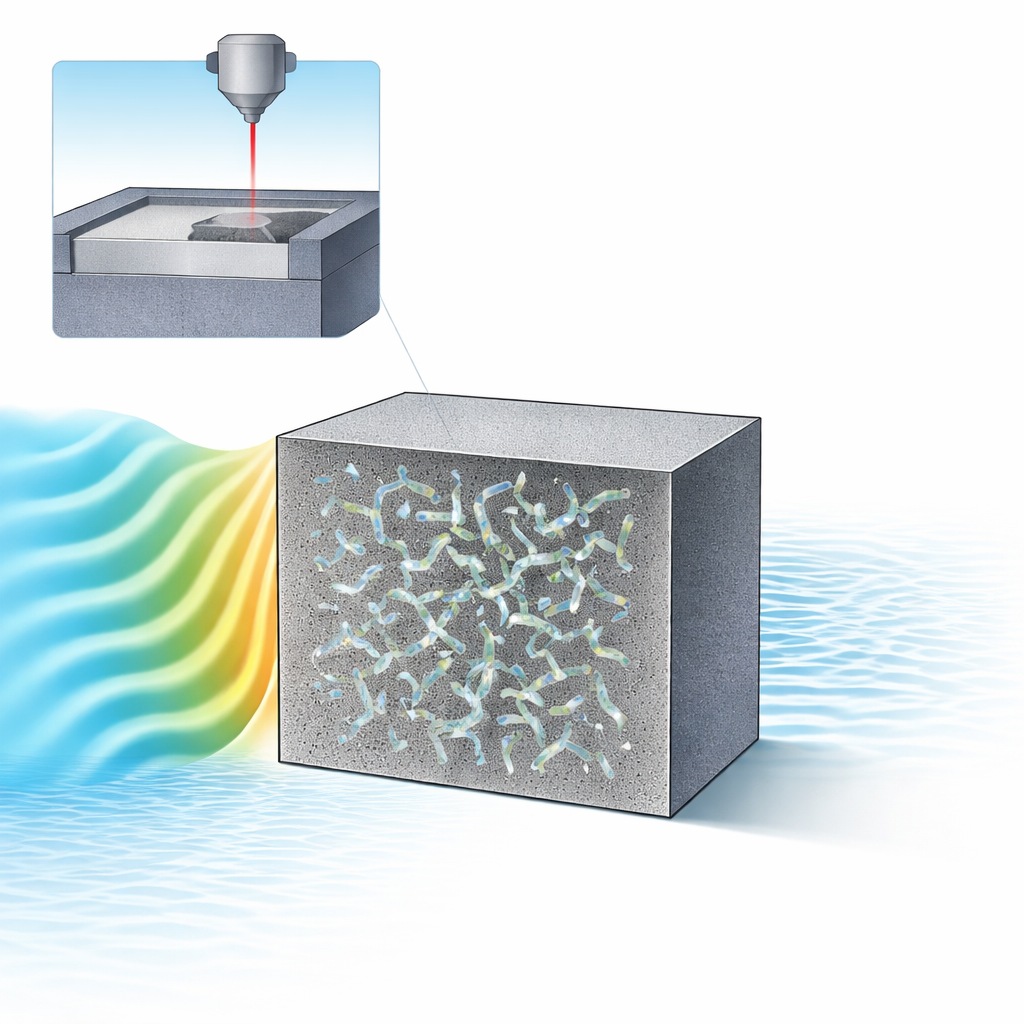
Turning a Super Alloy into a Sound Shield
The team works with a so‑called high‑entropy alloy, a metal made from roughly equal parts of chromium, manganese, iron, cobalt, and nickel, with a pinch of silicon. Instead of starting from a perfect, dense block, they use laser powder bed fusion, a metal 3D‑printing method that naturally leaves behind small internal voids when the settings are pushed away from the “ideal.” Rather than treating these voids as unwanted defects, the researchers deliberately exploit them. The printed samples are about the size of a sugar cube and contain more than 25% internal void space, yet still behave as solid structural pieces that can be handled, machined, and tested like ordinary metal parts.
How Random Voids Trap Sound
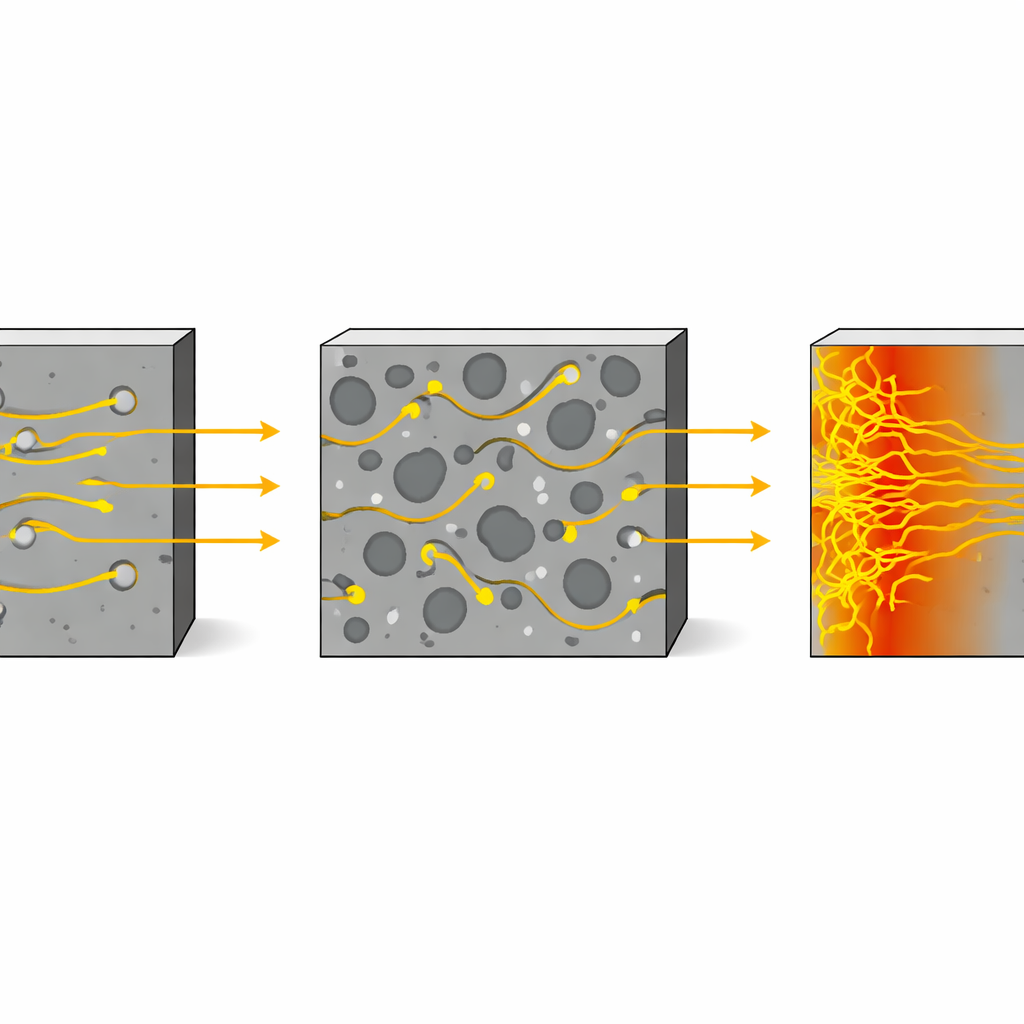
To understand how these hidden voids stop sound, the authors model ultrasound waves passing through four different plate designs: a fully solid metal, a solid metal with a plastic damping layer, a plate patterned with a neat grid of holes (a phononic crystal), and a plate containing randomly sized and positioned voids that mimic the printed alloy. In the regular structures, sound either passes through or is blocked only for a narrow frequency band. In the random‑void sample, however, the waves are repeatedly bounced around by the many mismatched regions between solid metal and empty space. This random back‑and‑forth scattering causes different pieces of the wave to interfere with one another, so that the overall signal dies off almost exponentially within just a few millimeters—a hallmark of a phenomenon known as Anderson localization.
Matching Simulations with Real Metal Blocks
The researchers do not just rely on computer models: they carefully print and measure both “sound” (densely printed) and “defective” (void‑rich) versions of the alloy. Microscopes and elemental scans show that, apart from the voids, the alloy’s grains and composition are fairly uniform, so the main source of disorder is the void network itself. Ultrasound tests in water reveal that a 10 mm‑thick defective sample can reduce transmitted sound intensity by about 65 decibels compared with nearly lossless water—a cut of more than a thousand‑fold in amplitude. Importantly, this strong reduction holds across a broad frequency range around 8–10 MHz, not just at a single tuned pitch, making the material suitable for real‑world broadband ultrasound insulation.
Quiet Metals That Stay Strong
One might expect that filling a metal with so many voids would make it weak and brittle. Surprisingly, mechanical tests show that these high‑entropy alloy samples keep impressive strength and hardness. Even with roughly 28% void fraction, the microhardness is about 10% higher than common stainless steel 316, and the yield and ultimate strengths exceed those of typical structural steels. In other words, the alloy can act as both a load‑bearing component and a built‑in sound shield, eliminating the need to bolt on extra rubber layers, foams, or complex hole patterns that usually compromise reliability or invite corrosion.
What This Means for Future Quiet Technology
This work demonstrates a new way to engineer quiet metals: instead of adding soft coatings or drilling deliberate hole patterns, manufacturers can use metal 3D printing to sculpt internal randomness at the right scale to trap sound. Because the effect depends mainly on the void architecture and the alloy’s naturally high sound attenuation, the approach can, in principle, be adapted to other alloys and scaled for different ultrasound frequencies by changing sample thickness. The result is a path toward compact, robust structural parts that both carry mechanical loads and quietly block or shape ultrasonic waves in applications ranging from industrial inspection and underwater devices to medical imaging and therapy tools.
Citation: Jin, Y., Kumar, J., Palaniappan, S. et al. Laser-powder bed fusion printed CrMnFeCoNi high entropy alloys engineered for acoustic insulation. Commun Eng 5, 85 (2026). https://doi.org/10.1038/s44172-026-00624-5
Keywords: acoustic insulation, high entropy alloys, 3D printed metals, ultrasound control, wave localization