Clear Sky Science · en
X-ray fluorescence spectroscopy for rapid identification of cathode chemistry in lithium-ion battery recycling
Why Old Batteries Still Matter
From smartphones to electric cars, lithium-ion batteries quietly power our lives—and they are piling up at the end of their lives. Inside each battery, the cathode holds valuable metals like nickel, cobalt and manganese that we want to recover instead of mining anew. But recyclers first need to know exactly what kind of cathode is inside each sealed cell, and current methods are slow, messy, or require taking batteries apart. This study explores a fast, non-destructive way to “see” through battery casings using X-ray fluorescence, offering a potential game-changer for large-scale battery recycling.
Looking Inside Without Opening
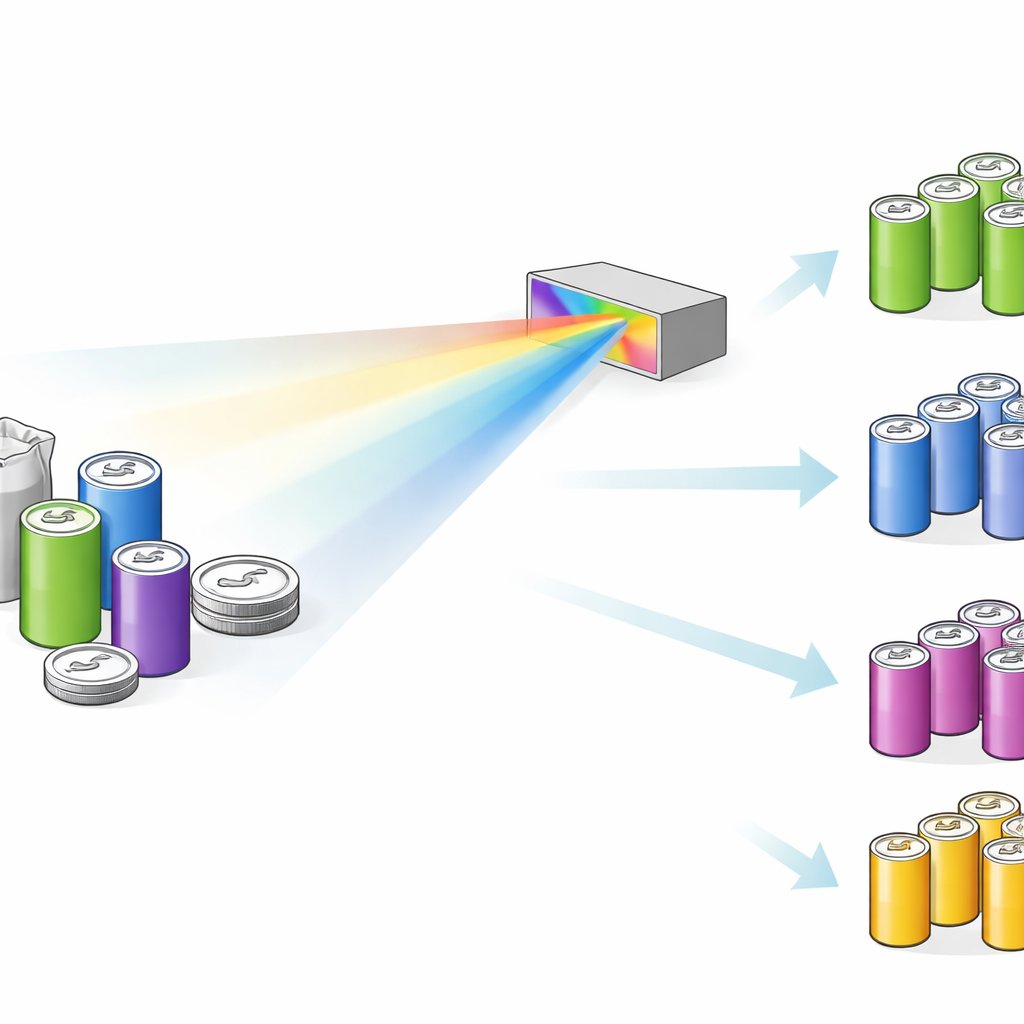
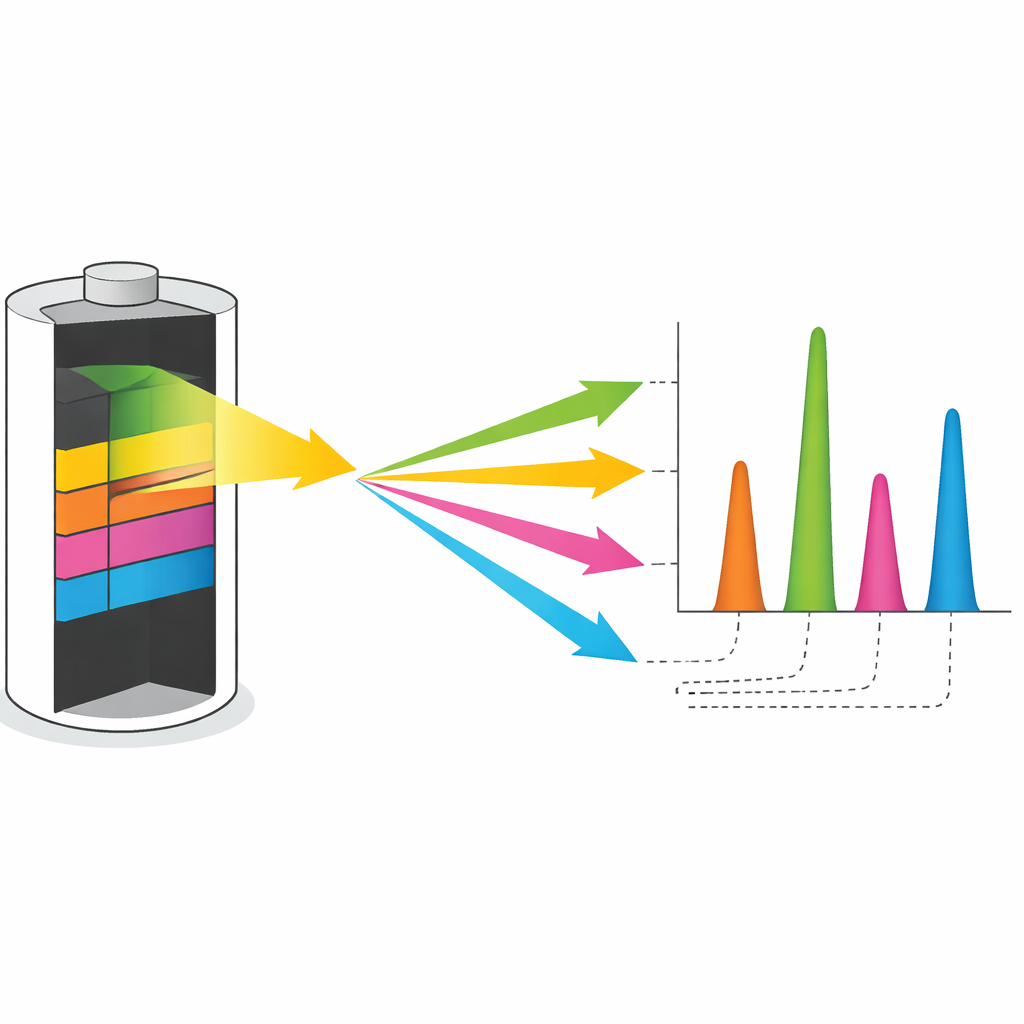
The researchers turned to X-ray fluorescence (XRF), a technique in which high-energy X-rays strike a material and cause its atoms to emit their own characteristic X-ray signals. Those signals act like elemental fingerprints, revealing which metals are present. Crucially, XRF can often probe through the metal or foil packaging of a battery without opening it. In this work, the team used a benchtop XRF machine operating at 50 kilovolts to scan 108 used lithium-ion batteries of different shapes—coin cells, cylindrical cells and flat pouch cells—collected from a French recycling center.
From Raw Signals to Clear Groups
Simply measuring X-ray signals is not enough; the spectra are complex and influenced by both the cathode and the outer casing. To untangle this, the team used statistical tools that look for patterns across many batteries at once. They focused on the strengths of signals from five key metals—aluminum, manganese, iron, cobalt and nickel—that help distinguish common cathode types. Using principal component analysis and hierarchical clustering, they grouped the 108 batteries into five clusters that reflected both their physical formats and their underlying chemistries.
Checking What the Groups Really Mean
To confirm what each group actually contained, the researchers carefully opened three representative batteries from each cluster. They examined the cathode powders with electron microscopy, X-ray diffraction and a more sensitive chemical technique called ICP-OES. These destructive tests revealed which cathode materials were really present: coin cells mainly used lithium–manganese dioxide; some pouch cells were based on lithium cobalt oxide; others and most cylindrical cells relied on mixtures of nickel-, manganese- and cobalt-rich oxides. Importantly, when they trained a classification model on the high-quality XRF data and then tested it on very short, 5-second scans, the model still correctly assigned all test batteries to the right groups with very high confidence.
When Packaging Helps—or Hides—the View
The study also shows that battery housings are not just obstacles; they can be clues. Thin aluminum-laminated pouch casings let more of the cathode’s X-ray signal escape, making it easier to read the true chemistry. Thick stainless-steel casings on coin and cylindrical cells, by contrast, strongly absorb and overshadow cathode signals, so the XRF spectrum is dominated by the steel itself. Yet even in these cases, the chemical makeup of the casing and plastic sleeves—such as the presence of chlorine or titanium-based pigments—tended to correlate with particular cathode families in the sample set. This means the system can sometimes use outer packaging as a proxy when direct cathode signals are weak, while still recognizing that such correlations may not hold everywhere.
Faster Sorting for a Circular Battery Economy
Overall, the work demonstrates that XRF combined with smart data analysis can sort spent batteries by cathode type in seconds, without disassembly, at least for the range of commercial cells studied. Pouch cells with pure cobalt-based cathodes, for example, can be picked out directly—valuable for channeling cobalt-rich batteries into specialized recovery streams. While the method cannot perfectly identify every possible design and struggles with very thick steel casings, it offers a practical foundation for automated, real-time sorting lines. By quickly directing different battery chemistries into tailored recycling processes, this approach could help recover more critical metals, cut processing costs and reduce the environmental footprint of our growing appetite for rechargeable power.
Citation: Ren, F., Vidal, V., Campos, A. et al. X-ray fluorescence spectroscopy for rapid identification of cathode chemistry in lithium-ion battery recycling. Commun Eng 5, 67 (2026). https://doi.org/10.1038/s44172-026-00618-3
Keywords: lithium-ion battery recycling, cathode identification, X-ray fluorescence, critical metals recovery, battery sorting technology