Clear Sky Science · en
A wireless power transfer system for leadless endovascular electrocorticography
Why powering brain implants without wires matters
Brain-computer interfaces and long-term brain monitors are moving from science fiction toward everyday medicine. One promising approach uses tiny metal scaffolds, called stents, that can be placed inside blood vessels in the brain to record and possibly stimulate neural activity without opening the skull. But today’s systems still rely on long wires that run from the brain, through blood vessels, down to an electronic unit in the chest. Those wires pose surgical risks, can fail over time, and make the whole setup less appealing for patients. This paper describes a new way to send power to such stent-based brain implants without any long wires, using only hidden components under the scalp and a small external unit worn on the head.
A new way to feed energy into the brain
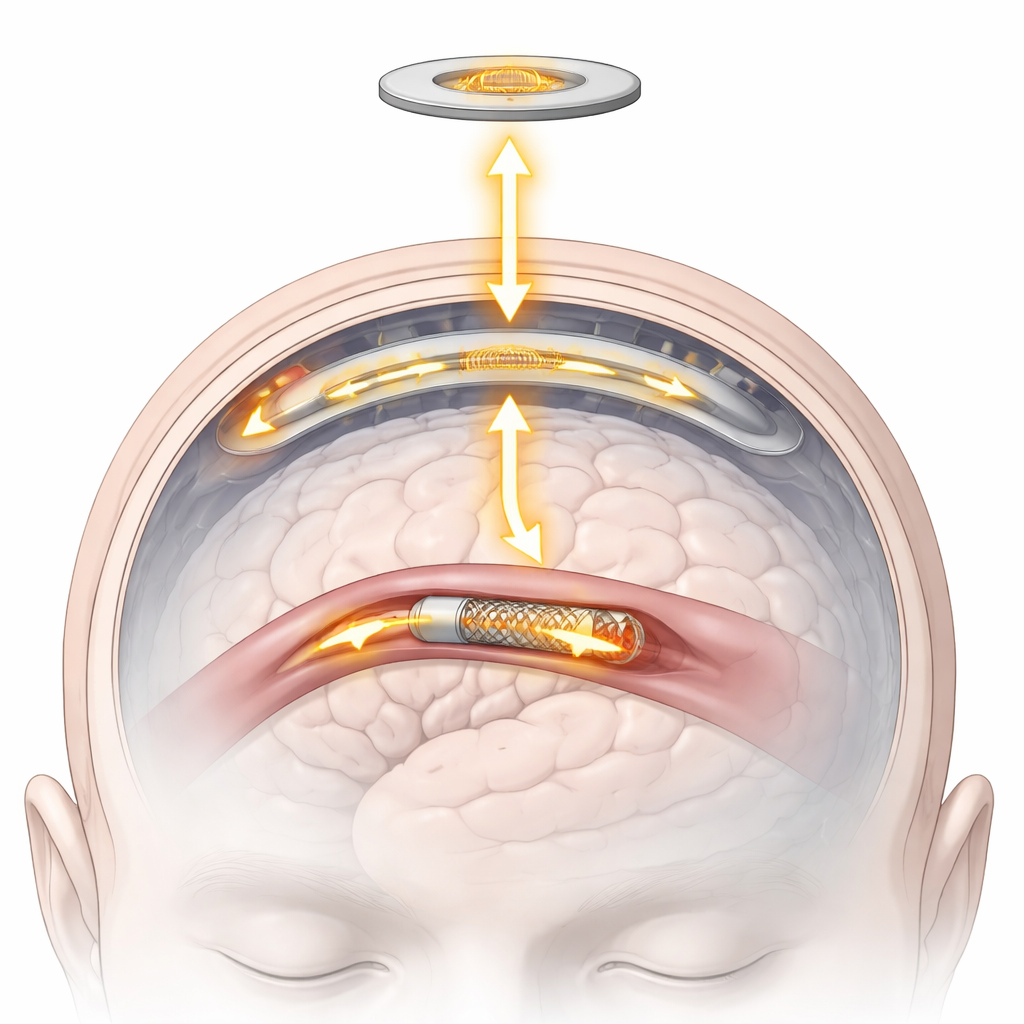
The authors propose a power system that works with an ordinary clinical stent rather than a custom-made device. The system has three parts: an external head-worn module with a coil, a paper-thin relay strip tucked under the scalp and above the skull, and the stent deep inside a vein that runs along the brain’s surface. The external coil sends energy through a magnetic field to a matching coil in the relay. The relay then hands that energy off as an electric field through the skull and surrounding tissues to the stent. Crucially, the stent itself is used as the receiving element, so no extra hardware needs to be crammed into the already tight blood vessel.
Turning magnetic fields into electric fields
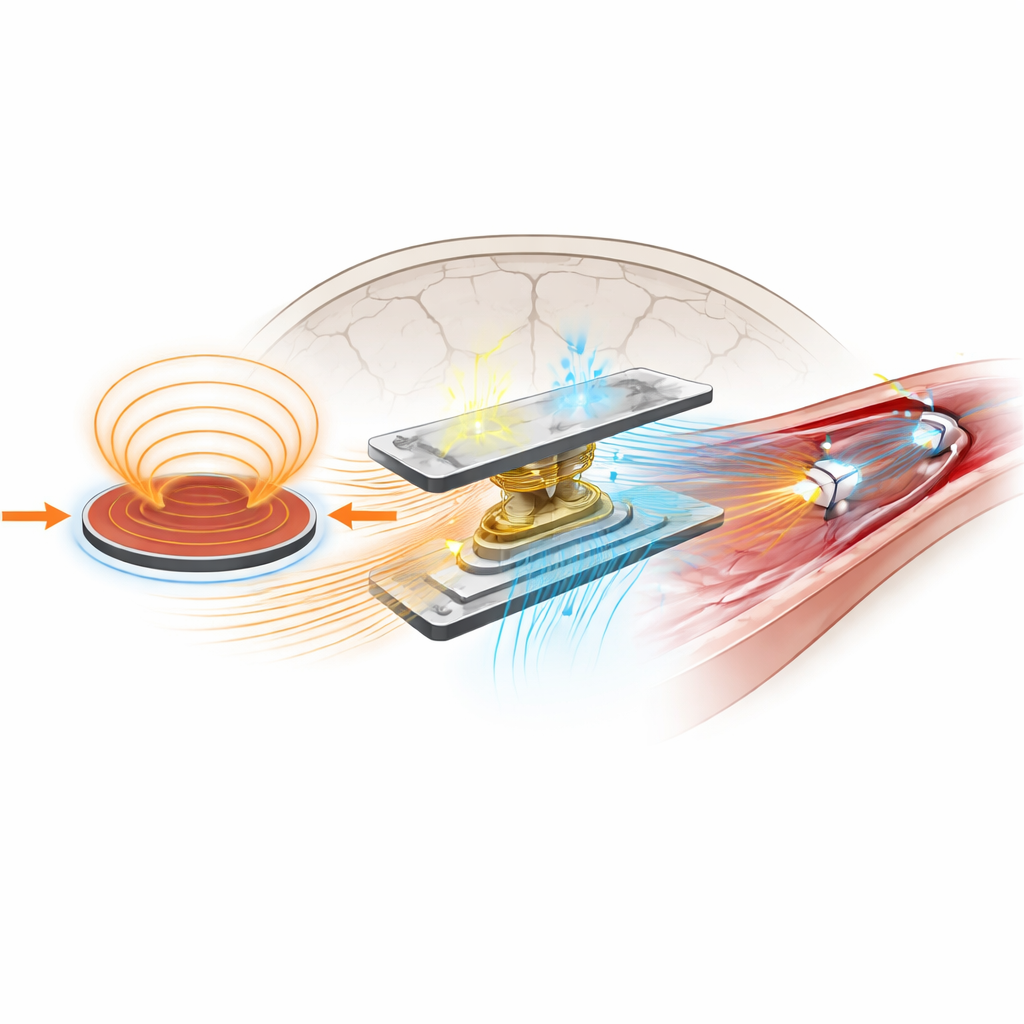
At the heart of the design is the under-skin relay that converts one style of wireless transfer into another. On the outer side, the relay’s flat coil captures power by magnetic coupling, similar to a wireless phone charger. On the inner side, two long, thin metal plates in the relay act like the two sides of a capacitor. They set up an electric field that passes through bone, membranes, and fluid to reach two separated sections of the stent. Simple electronic parts—just diodes and capacitors—can then straighten this alternating energy into steady power for sensors, communication circuits, and optional stimulation electronics inside or next to the stent. Because the relay is passive and extremely thin, it can be placed under the scalp with minimal disruption and no moving parts.
Putting the system to the test
To see if this scheme works in realistic conditions, the team built a test bed using real animal bone, blood vessels, and saline solution to mimic the layers of the human head. They carefully varied stent length, the spacing between stent sections, plate size, plate spacing, depth of the stent below the bone, and operating frequency, carrying out hundreds of measurements to find the best combination. They found two useful frequency ranges, with the most practical one around 40–50 megahertz. With optimised dimensions, they could send more than 45 milliwatts of power to the stent while keeping the overall direct-current efficiency at about 7 percent—currently the highest reported for an unmodified stent in the brain. Computer models using detailed human head anatomy closely matched these bench results, confirming that the measurements were not just quirks of the lab setup.
Checking safety inside the head
Any wireless system that sends energy into the body must meet strict safety limits for heating and exposure. The researchers used advanced finite-element simulations to calculate how much of the transmitted energy would be absorbed by tissues, a quantity known as specific absorption rate (SAR), and how much local temperature would rise over time. With input powers high enough to deliver roughly 45 milliwatts to the stent, the peak and averaged SAR values in skin, bone, and brain stayed well below international safety thresholds. Temperature simulations over several hours of continuous operation showed only tiny increases—on the order of a few tenths of a degree Celsius—concentrated mainly in the scalp region near the relay and external coil, with no warming at the implant itself.
What this could mean for future brain technology
This work shows that it is technically and safely possible to power a brain stent implant entirely without long wires or customised stent designs. The proposed architecture can supply enough power for high-quality brain signal recording and even on-demand stimulation, all while keeping hardware under the scalp thin and passive and allowing the external unit to rest loosely on the head. Although the detailed physics of how the magnetic and electric fields interact near the relay still need deeper theoretical study, the combination of experiments and simulations provides strong evidence that the approach is sound. If manufacturing challenges for the ultra-thin relay can be solved and in vivo tests confirm durability, this method could underpin a new generation of fully wireless, minimally invasive neuroprosthetic systems that are easier to implant, more comfortable to live with, and more acceptable to patients.
Citation: Xu, Z., Truong, N.D., Ahnood, A. et al. A wireless power transfer system for leadless endovascular electrocorticography. Commun Eng 5, 73 (2026). https://doi.org/10.1038/s44172-026-00617-4
Keywords: wireless power transfer, brain stent, neuroprosthetics, endovascular implants, electrocorticography