Clear Sky Science · en
Triphasic synthesis of MXenes with uniform and controlled halogen terminations
Why this new material recipe matters
Electronics, batteries, and even wireless devices all rely on how easily electrons can move through materials. A promising class of ultra-thin materials called MXenes already conduct electricity extremely well and can be tailored for many uses, from energy storage to shielding electronics from interference. But until now, chemists have struggled to control the outermost atomic layer of these materials, which acts like the “traffic rules” for electrons. This paper presents a new way to grow MXenes with precisely arranged halogen atoms on their surfaces, dramatically boosting their electrical performance and opening doors to more reliable, tunable devices.
Peeling metals into atom-thin sheets
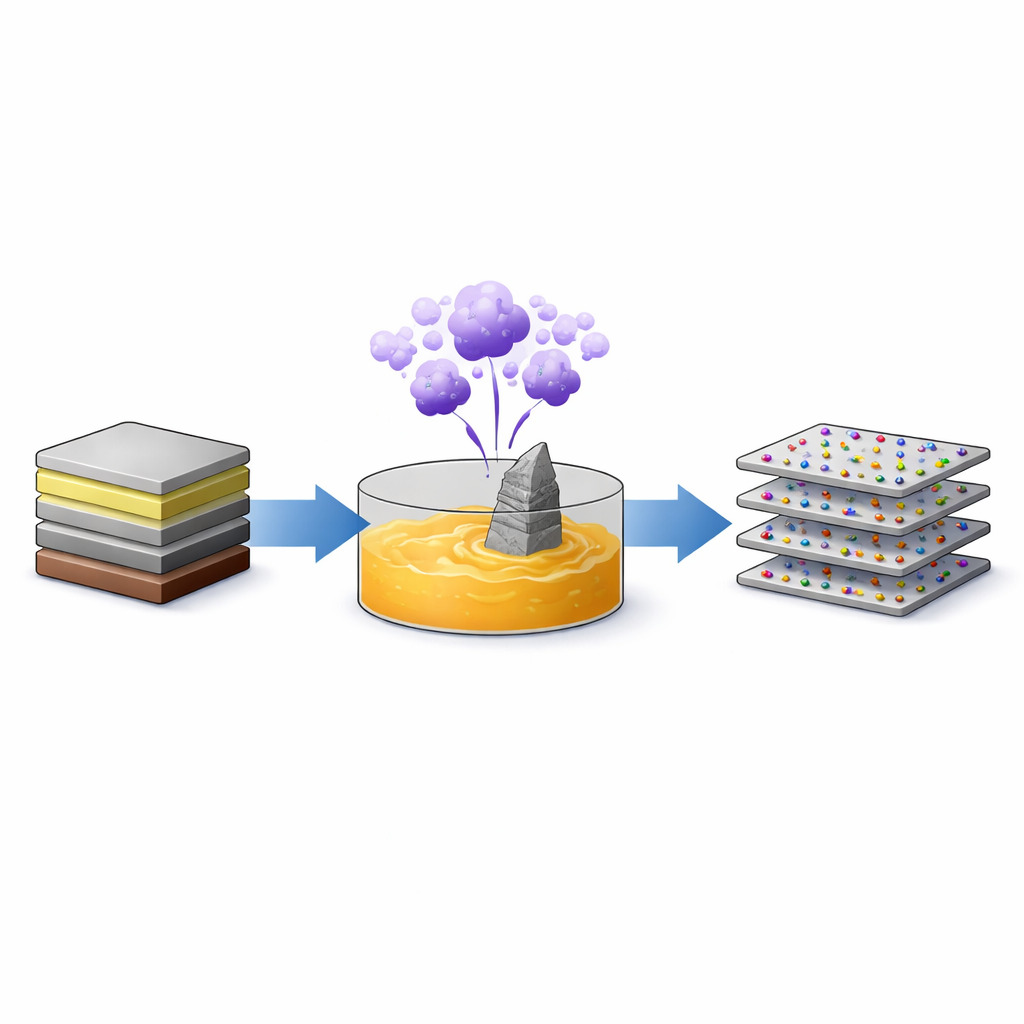
MXenes are made by carving out certain layers from a parent material called a MAX phase, which consists of transition metals bonded with carbon or nitrogen, plus a removable “A” layer such as aluminum or silicon. When the A-layer is etched away, what remains is a stack of metallic, atom-thin sheets rich in free electrons, making MXenes excellent conductors. However, the exposed metal atoms on the sheet surfaces do not stay bare; they are quickly capped by small chemical groups, known as surface terminations. These terminations crucially tune how electrons move both within each sheet and between neighboring flakes in a film. Conventional synthesis methods, usually based on strong liquid acids, leave a random mix of oxygen, hydroxyl, and fluorine or chlorine on the surface, creating disorder that traps and scatters electrons.
A three-phase recipe for cleaner surfaces
The authors introduce a new “gas–liquid–solid” (GLS) etching approach that gives far better control over what ends up on the MXene surface. In this setup, a MAX crystal sits in contact with a molten potassium halide salt while iodine vapor fills the surrounding space, forming three interacting phases. The molten salt dissolves the iodine and creates reactive inter-halogen species that gently remove the A-layer while simultaneously delivering halogen ions (chlorine, bromine, or iodine) to cap the exposed metal atoms. After the reaction, simple ethanol washing removes the by-products and leftover salts without harsh oxidizing agents. This process avoids unwanted oxygen terminations and preserves the structural integrity of the MXene sheets, yielding atomically ordered, halogen-only surfaces.
Turning disorder into smooth electron highways
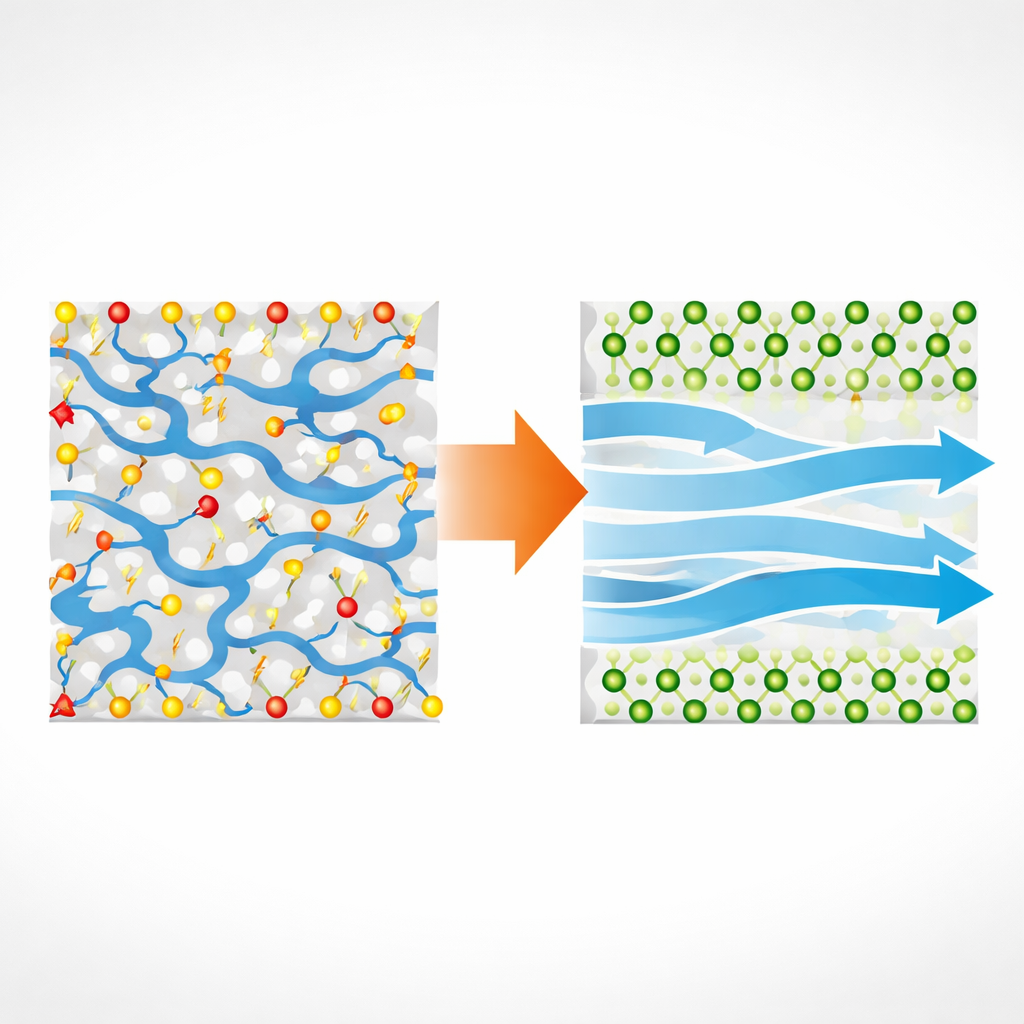
Using titanium carbide MXene (Ti3C2) as a model, the team shows they can produce versions capped uniformly with chlorine, bromine, or iodine. Advanced structural probes, including atomic-resolution mass spectrometry and electron microscopy, reveal that the halogen atoms form single, clean layers on both sides of the MXene, with almost no impurities between sheets. Electrical tests show the payoff of this atomic tidiness. A chlorine-terminated Ti3C2 exhibits about 160 times higher bulk electrical conductivity and roughly 13 times higher terahertz-frequency conductivity than a comparable MXene made by older methods that carry a mixed chlorine/oxygen surface. Time-resolved terahertz measurements further indicate that charge carriers move more freely and are less likely to be trapped, while computer simulations visualize smoother electron pathways across the uniformly terminated lattice.
Mixing and matching surface atoms on demand
Beyond single-halogen coatings, the GLS method allows finely controlled mixtures of different halogens on the same MXene surface. By blending different molten salts, the researchers create dual and even triple combinations of chlorine, bromine, and iodine terminations, and they tune their ratios with simple changes in recipe. Calculations suggest that such mixed-termination surfaces can be not only stable but in some cases more energetically favorable than single-halogen ones. Because the surface chemistry of MXenes strongly influences not only conductivity but also how they interact with light, electromagnetic waves, and other molecules, this level of control becomes a powerful handle to customize materials for specific functions, such as targeted electromagnetic wave absorption bands.
What this means for future technologies
In essence, this work shows that carefully arranging just one atomic layer on the outside of MXenes can turn them from merely good conductors into exceptionally efficient electron highways. The GLS method provides a general, scalable route to produce MXenes with clean and customizable halogen coatings, improving conductivity, stability in air, and tunability for future modifications. For non-specialists, the key message is that chemists have found a way to “rewire” the outer skin of these ultrathin materials with unprecedented precision, bringing us closer to designer components for next-generation electronics, sensors, and energy devices.
Citation: Li, D., Zheng, W., Ghorbani-Asl, M. et al. Triphasic synthesis of MXenes with uniform and controlled halogen terminations. Nat. Synth 5, 516–526 (2026). https://doi.org/10.1038/s44160-025-00970-w
Keywords: MXenes, surface terminations, halogen chemistry, electrical conductivity, two-dimensional materials