Clear Sky Science · en
Meta-analytic microbiome target discovery for immune checkpoint inhibitor response in advanced melanoma
Why gut bugs matter for skin cancer treatment
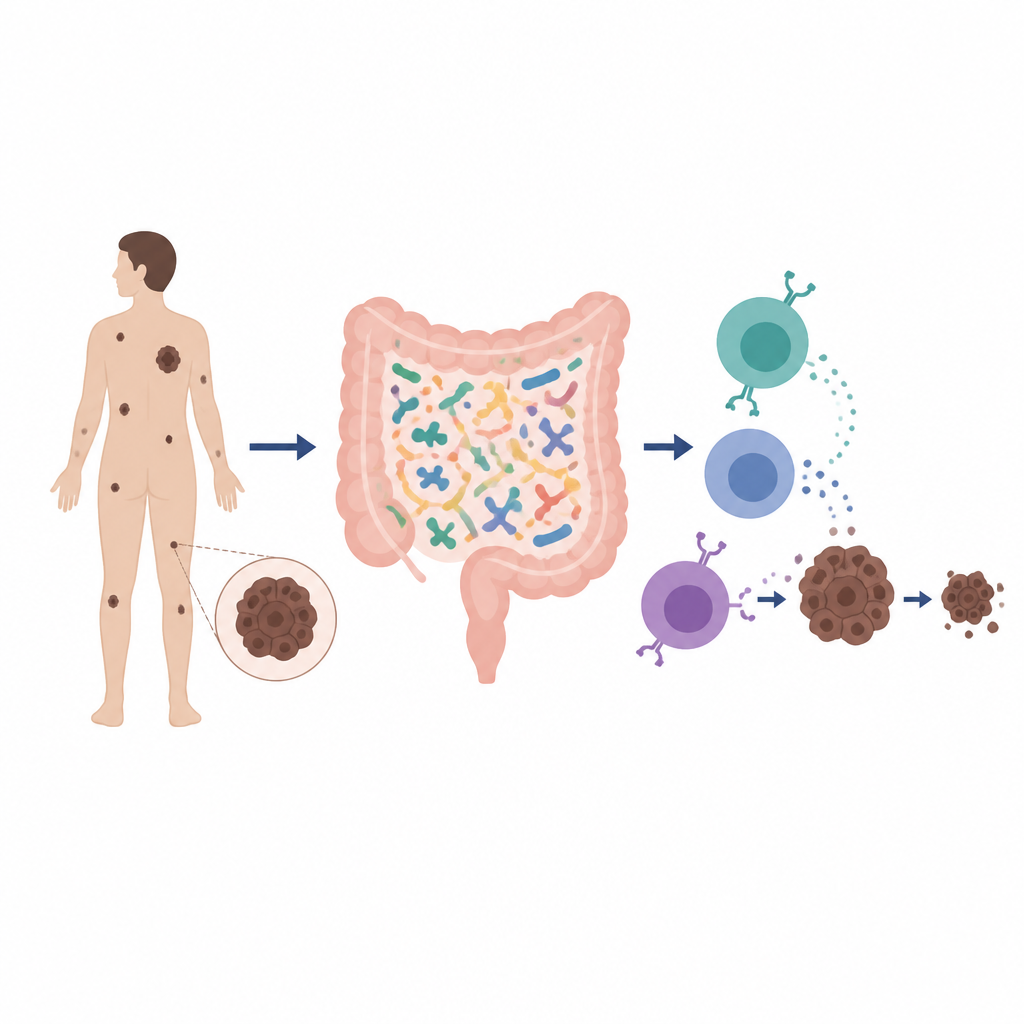
For people with advanced melanoma, modern immunotherapy drugs can sometimes make tumors shrink dramatically and stay controlled for years, but many patients see little benefit. This study dives into an unexpected player that may help explain these mixed results: the trillions of bacteria living in our intestines. By pooling data from many previous trials, the researchers ask whether certain gut microbes and the chemical processes they carry out are linked to who responds to immune checkpoint inhibitors and who does not.
Bringing many studies under one roof
Different research groups have reported different “good” and “bad” gut bacteria for melanoma immunotherapy, making it hard to see the big picture. To tackle this, the authors went back to the raw stool DNA data from 15 patient groups around the world, covering 484 people and more than 760 samples. Some patients received immune checkpoint inhibitors alone, while others also received fecal microbiota transplants, in which stool from a donor is used to reset the gut community. All the samples were reanalyzed using the same software tools so that species, metabolic pathways and gene clusters could be compared fairly across studies.
Untangling technical noise from real biology
Because each original trial used its own DNA extraction kits and lab procedures, the team first checked how much this “batch effect” distorted the view of the gut community. They measured how similar or different samples looked across studies and then applied statistical corrections to reduce artificial differences. This step cut the study-to-study variation by more than half while keeping underlying biological patterns, making it more likely that any links they found between microbes and treatment response reflect real biology rather than lab quirks.
No single magic microbe
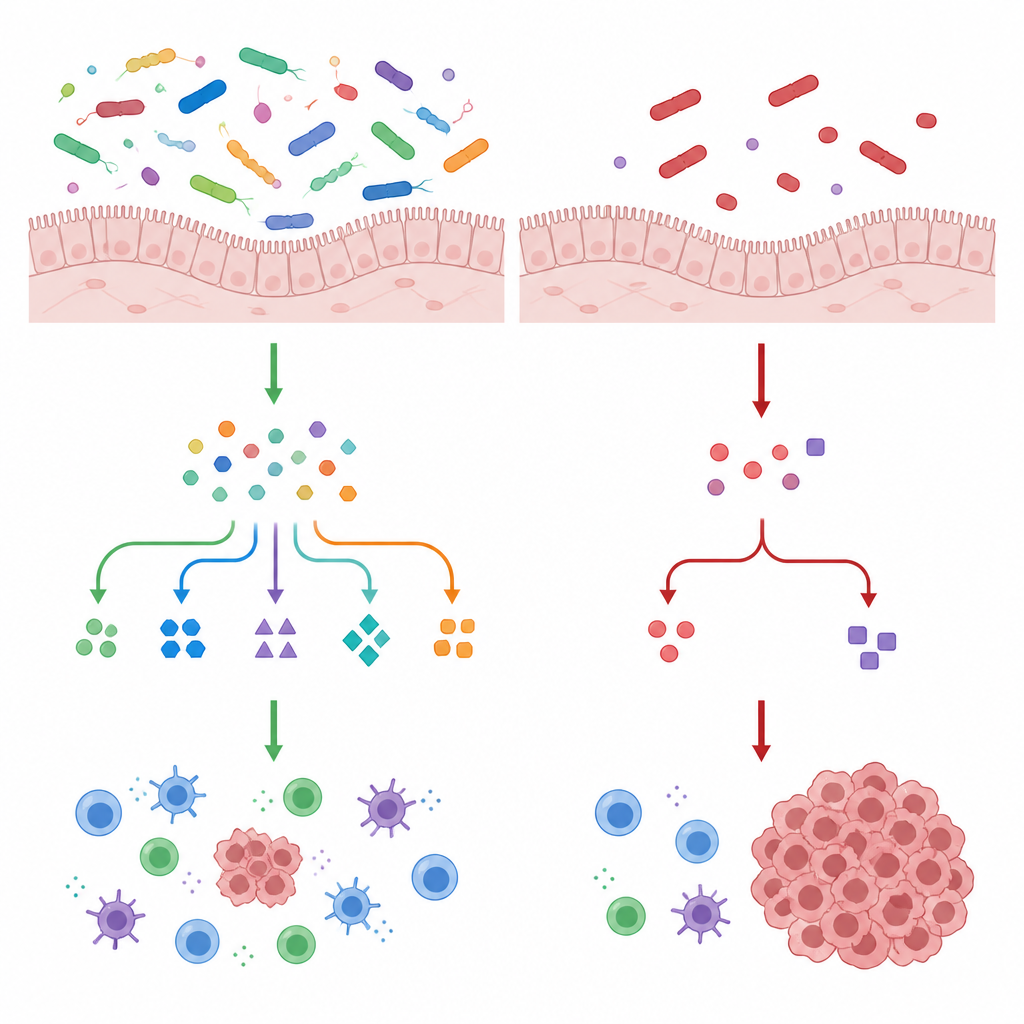
When the researchers compared patients who benefited from immune checkpoint inhibitors with those who did not, a clear message emerged: there is no single universally helpful or harmful bacterium. In patients treated with immunotherapy alone, those who responded tended to harbor more species that produce short-chain fatty acids, small molecules known to support gut health and influence immune cells. Non-responders more often carried microbes tied to disrupted gut communities. In contrast, for patients who also received fecal transplants, entirely different sets of bacteria stood out, and some species that were helpful in one treatment setting appeared linked to poorer outcomes in the other. This suggests that the impact of a microbe depends strongly on the surrounding community and the therapy used.
Looking inside the chemistry of the gut
Beyond naming species, the study examined what the gut community is capable of doing. By tracking metabolic pathways, the authors found that in immunotherapy-only patients, responders had gut microbes geared more toward building amino acids, the building blocks of proteins, while non-responders favored breaking certain amino acids and related compounds down. In the groups that received fecal transplants plus immunotherapy, response instead went along with pathways for recycling DNA building blocks, while non-response linked to pathways involved in sugar breakdown, vitamin K production and complex sugar coatings on bacterial surfaces. They also identified clusters of genes that may produce antimicrobial compounds or surface capsules, hinting that battles between microbes and the way bacteria present themselves to the immune system could shape treatment outcomes.
How well do these patterns predict response
The team tested whether gut profiles could be used to predict treatment success across different patient groups. Using machine learning models that combined species, pathways and gene clusters, they trained predictors on some studies and tested them on others. While these models performed better than chance, their accuracy was only modest, meaning that gut data alone cannot yet reliably forecast how an individual will respond. Still, certain bacterial groups, metabolic programs and gene clusters kept resurfacing in the models, pointing to a core set of microbiome features that are consistently tied to outcomes across studies.
What this means for patients and future care
The authors conclude that there is no universal “good” or “bad” gut bacterium for melanoma immunotherapy. Instead, whole communities of microbes and the chemical jobs they perform seem to matter, and their influence changes depending on whether patients receive immune checkpoint inhibitors alone or together with fecal transplants. These harmonized results provide a refined shortlist of bacterial groups and metabolic functions for future lab experiments and clinical trials, with the long-term goal of designing microbiome-aware strategies that can safely tilt the odds of successful immunotherapy in favor of more patients.
Citation: Zhang, X., Mallick, H. & Rahnavard, A. Meta-analytic microbiome target discovery for immune checkpoint inhibitor response in advanced melanoma. Commun Med 6, 298 (2026). https://doi.org/10.1038/s43856-026-01612-8
Keywords: melanoma, gut microbiome, immunotherapy, fecal microbiota transplant, cancer metabolism