Clear Sky Science · en
Smartphone-derived joint angular velocities in sit-to-stand motion provide a spatiotemporal marker for symptomatic knee osteoarthritis
Turning a Simple Chair Test into a Knee Checkup
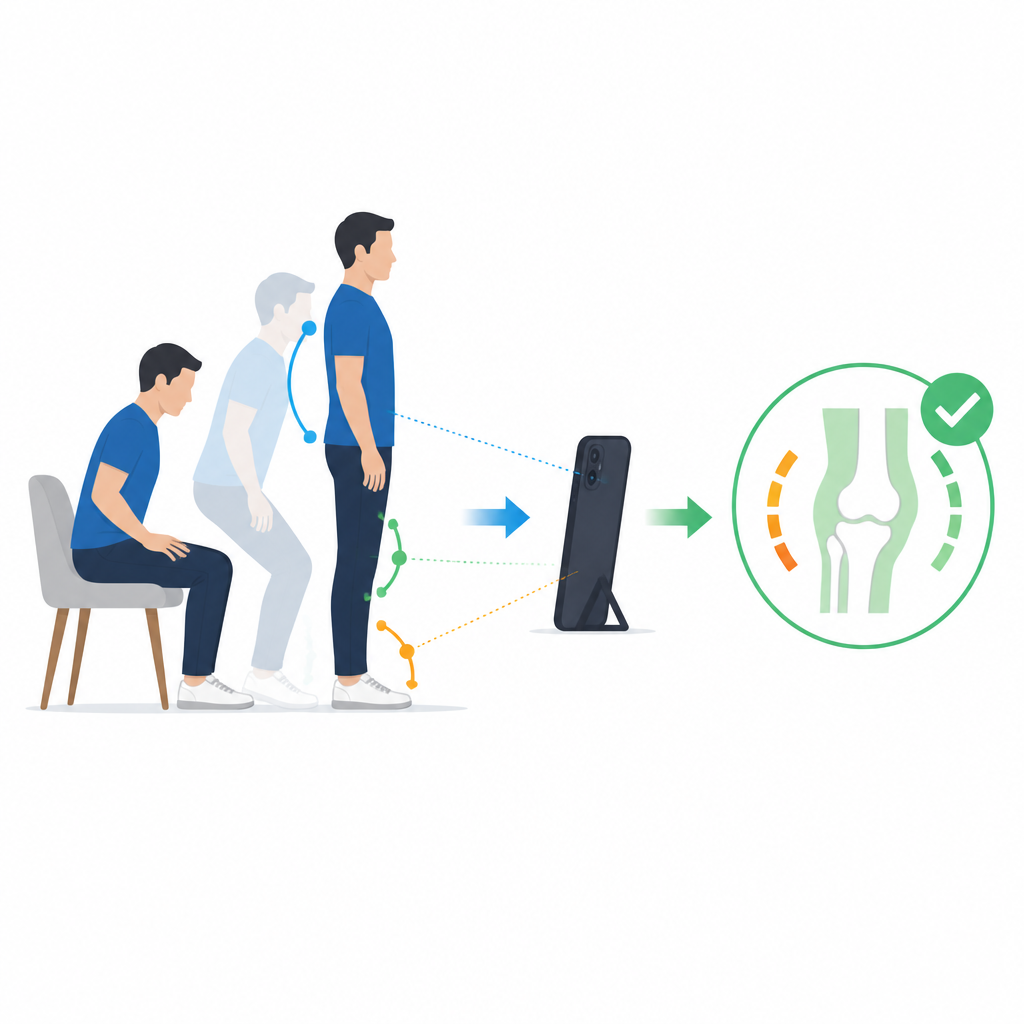
Standing up from a chair is something most of us do dozens of times a day, often without a second thought. For people with knee osteoarthritis, however, this everyday motion can be painful and difficult. This study shows that an ordinary smartphone can turn a simple sit-to-stand movement into a window on knee health, offering a low cost way to spot joint problems and monitor how they change over time.
Why Knee Trouble Is Hard to Spot Early
Knee osteoarthritis is a leading cause of disability in older adults, making even routine activities such as standing up and walking a challenge. Doctors usually judge knee function by watching how a person moves or by using questionnaires about pain and stiffness. In research labs, expensive motion capture systems with markers and multiple cameras can measure movement in great detail, but they are not practical for clinics, homes, or community centers. As a result, many people live with knee damage that is not measured objectively until it is quite advanced.
Using a Phone Camera to Read Joint Motion
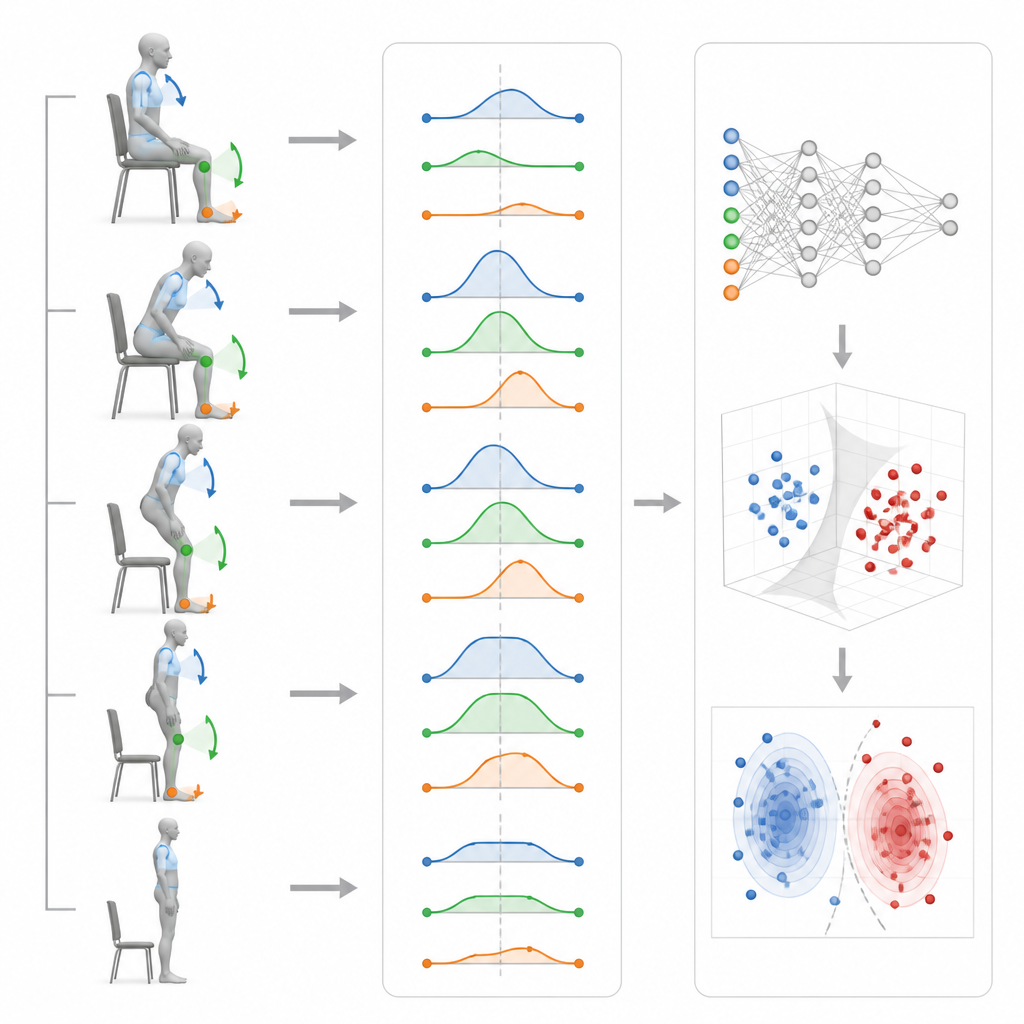
The researchers asked 309 adults, most in their 60s, to repeatedly stand up from and sit down on a standardized chair while being filmed in profile with a smartphone. Using an artificial intelligence system, they tracked key points on the body to calculate how much the trunk, knee, and ankle bent and how quickly these angles changed over time. They then built a deep learning model, called STS Dynamics Net, that learned patterns in these joint speeds and angles to estimate the chance that a person had symptomatic knee osteoarthritis. The model produced a single score, the STS D Index, between zero and one for each person.
Joint Speed as a New Warning Signal
The study found that how fast the joints move during the sit-to-stand motion carries important information about knee health. Models that used both angles and their speeds detected symptomatic knee osteoarthritis more accurately than simple measures such as how many times someone could stand up in 30 seconds or how far they leaned forward. The phone based approach performed nearly as well as a laboratory grade three dimensional motion capture system. People whose movements the model rated as more likely to reflect osteoarthritis also tended to report worse stiffness and difficulty with daily tasks on a standard symptom survey.
What the Motion Patterns Reveal about Muscles
To better understand what the phone based measurements reflect inside the body, the team scanned the thigh muscles of a smaller group of volunteers using MRI. They found that people with less muscle and more fat within their thigh muscles tended to move their trunk faster during key phases of the sit-to-stand task. This suggests that when the muscles around the knee are weak or of poorer quality, people compensate by swinging their trunk more rapidly to rise from a chair, shifting some of the effort away from the knee joint itself. The model also revealed altered timing and coordination between the trunk, knee, and ankle in people with osteoarthritis, hinting at broader changes in movement control.
From Lab Tool to Everyday Health Check
In simple terms, the study shows that a standard smartphone can pick up subtle differences in how people stand up and sit down that relate to painful knee osteoarthritis and thigh muscle health. By turning joint speeds and angles into a single risk score, the method could enable easy, home based checks of knee function, support remote follow up after treatment, and help identify people who might benefit from strengthening programs or further medical assessment. While the work still needs to be tested in larger and more diverse groups, it points toward a future where a quick chair test in front of a phone camera becomes a routine part of looking after aging joints.
Citation: Chan, L.C., Yan, J., Zhang, Y.C. et al. Smartphone-derived joint angular velocities in sit-to-stand motion provide a spatiotemporal marker for symptomatic knee osteoarthritis. Commun Med 6, 286 (2026). https://doi.org/10.1038/s43856-026-01537-2
Keywords: knee osteoarthritis, smartphone motion analysis, sit to stand test, joint angular velocity, muscle weakness