Clear Sky Science · en
Thalamic organization differentially contributes to clinical conditions in epilepsy
Why a deep brain hub matters in epilepsy
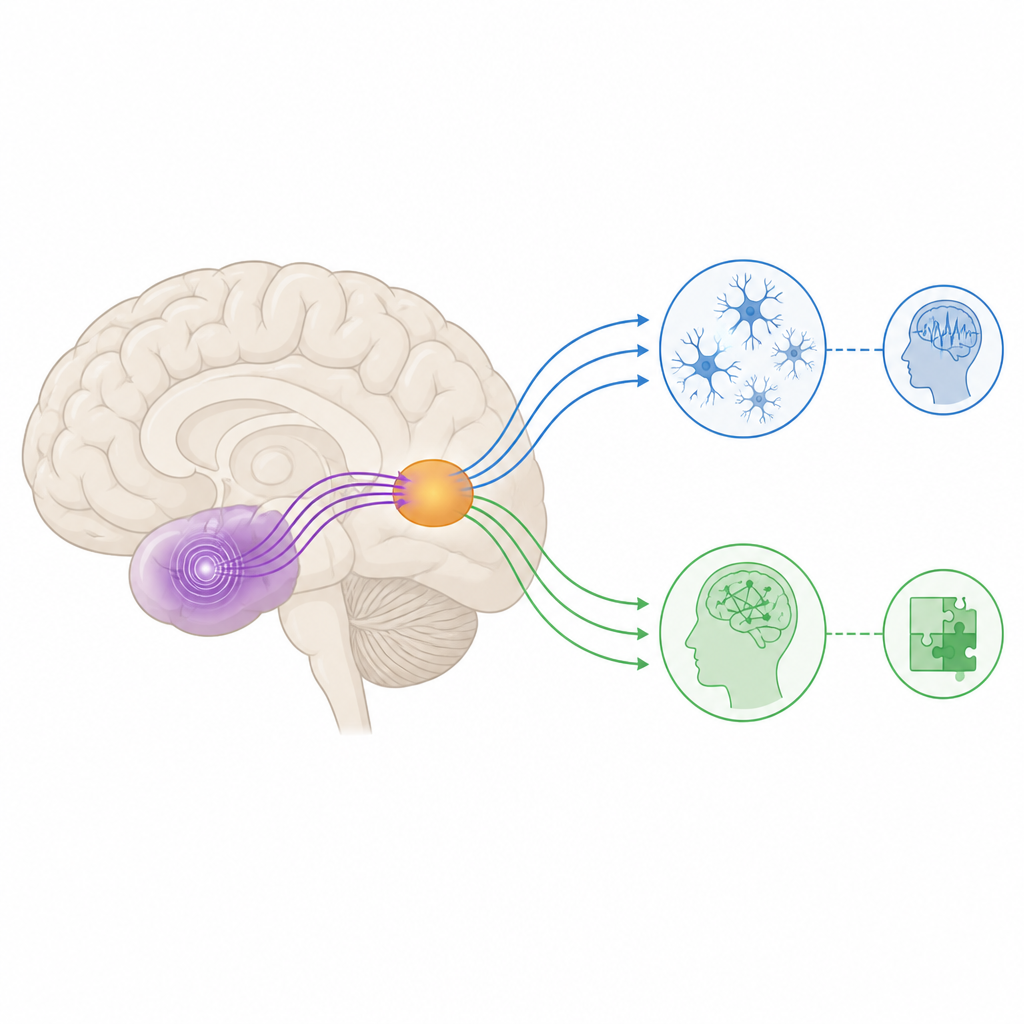
People with temporal lobe epilepsy often face two big uncertainties: will surgery stop their seizures, and how will it affect their memory and language? This study looks beyond the obvious trouble spot in the temporal lobe to a deeper relay station called the thalamus. By following patients before and after surgery, the researchers show that this small structure quietly shapes both seizure control and thinking skills, suggesting new ways to plan and judge epilepsy treatment.
Looking at the whole brain, not just the scar
The team studied adults with drug resistant temporal lobe epilepsy treated at two medical centers, along with healthy volunteers of similar age and education. All participants underwent detailed MRI scans, including resting brain activity and structure, and many patients also completed memory, language, and thinking tests before and after surgery. Instead of focusing on a single symptom, the researchers grouped six common clinical features of temporal lobe epilepsy, such as seizure type, underlying brain damage, side of seizure onset, changes after surgery, and seizure outcome, and then asked which brain regions best explained differences across all of these conditions.
The thalamus stands out from the crowd
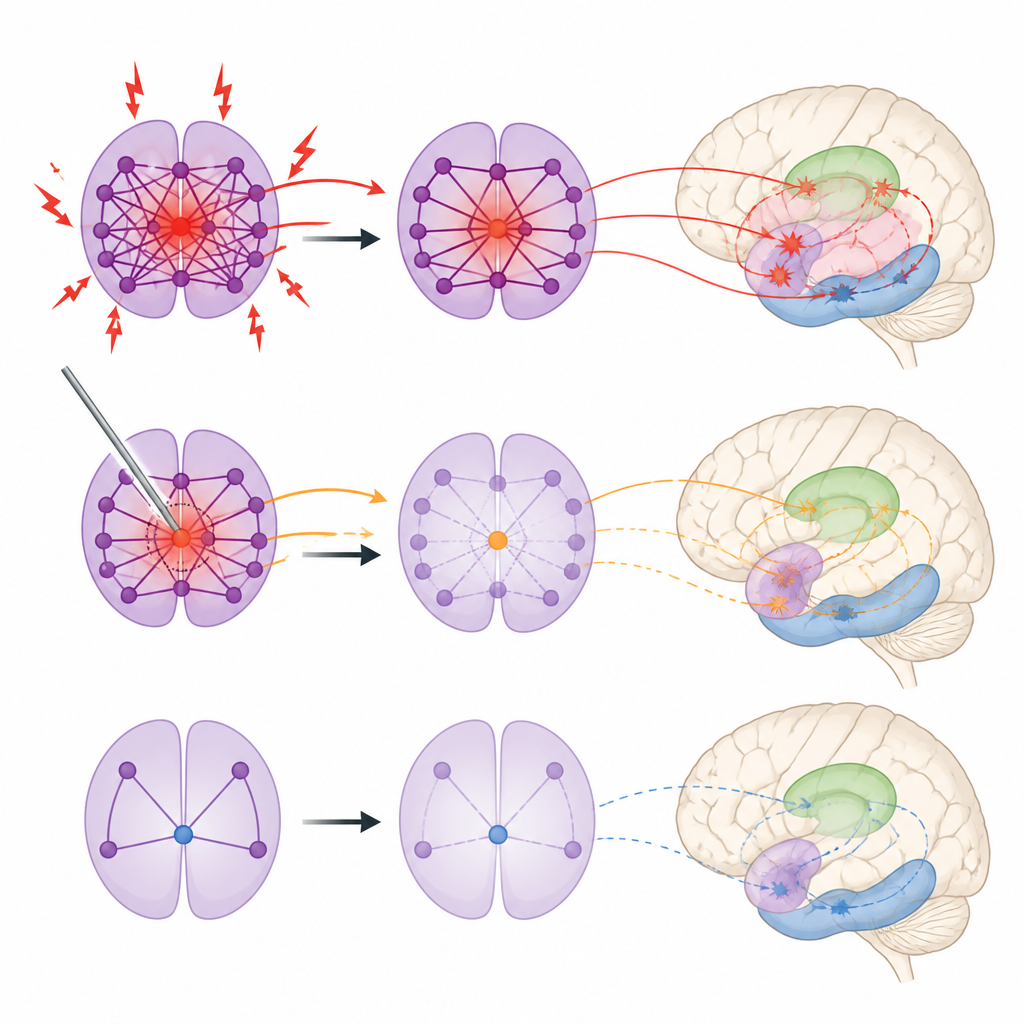
When the authors compared local activity, tissue volume, and wiring properties across more than one hundred brain regions, the thalamus repeatedly rose to the top. The thalamus sits deep in the brain and connects the temporal lobe with widespread networks that support movement, sensation, and higher thinking. In this study, the thalamus on the same side as the seizure focus showed the strongest and most frequent links to multiple clinical measures. Before surgery, patients had unusually synchronized activity in both thalami compared with healthy people. After surgery, the thalamus on the operated side showed stronger background activity but a loss of gray matter, while the opposite side showed reduced coordination of activity. These patterns were confirmed in an independent group of patients, reinforcing that they were not a fluke of a single hospital or scanner.
Deep connections predict seizure control
The researchers then asked which thalamic features were tied to whether seizures stopped after surgery. They found that how the thalamus was wired before the operation mattered more than how it changed afterward. Patients who continued to have seizures tended to show a more heavily connected thalamus that was better able to influence activity across the brain networks, a pattern the authors interpret as a sign of a more widespread seizure system. Machine learning models that combined several thalamic connection measures could distinguish good from poor seizure outcomes better than any single measure alone, suggesting that these scans may one day help doctors estimate surgical benefit for individual patients.
A trade off between seizure relief and thinking skills
Seizure control is not the only goal of surgery; preserving memory and language is equally important. In this study, many patients showed declines in word learning, remembering lists, naming pictures, and word fluency after surgery. The team found that features of the thalamus again played a key role, but in a stage dependent way. Before surgery, patients whose thalamus on the affected side had healthier tissue and stronger low level activity tended to maintain better memory and language afterward. In contrast, when this same thalamus became more active and lost volume after surgery, those changes were linked to steeper drops in thinking performance. Notably, structural and activity changes in the thalamus were related to cognition, while its long range wiring patterns were more closely tied to seizure control.
What this means for people with epilepsy
For patients and clinicians, these findings suggest that the thalamus is more than a passive relay station; it is a central hub that shapes both how well seizures can be controlled and how thinking skills fare after surgery. Measuring thalamic structure, activity, and connectivity before an operation may help refine expectations about who is likely to become seizure free and who is at higher risk for memory or language problems. In the long run, tailoring surgical plans and follow up care with the thalamus in mind could support more personalized and balanced treatment decisions in temporal lobe epilepsy.
Citation: Zhang, Q., Javidi, S.S., Ankeeta, A. et al. Thalamic organization differentially contributes to clinical conditions in epilepsy. Commun Med 6, 281 (2026). https://doi.org/10.1038/s43856-026-01530-9
Keywords: temporal lobe epilepsy, thalamus, epilepsy surgery, brain networks, cognitive outcome