Clear Sky Science · en
Patient-specific alterations in blood plasma cfRNA profiles enable accurate classification of cancer patients and controls
Reading Cancer Clues in a Simple Blood Sample
Cancer often hides deep inside the body, but tiny fragments of genetic material continuously leak from our cells into the bloodstream. This study asks a straightforward question with big implications: can we reliably detect cancer by reading these floating RNA fragments in blood, without having to touch the tumor itself? By following how the researchers tackled this problem across multiple cancers and patient groups, readers can glimpse how future blood tests might spot cancer earlier and more personally than today’s tools.
What Cell-Free RNA Can Reveal About Health
Our blood plasma carries cell-free RNA (cfRNA)—short-lived messages that reflect what many tissues in the body are doing at a given moment. Unlike DNA, which is relatively static, RNA changes as cells respond to disease, treatment, or stress. The team analyzed cfRNA from over 600 samples spanning 25 cancer types, several independent cancer cohorts, and multiple control groups, including people with non-cancer illnesses. They used high-throughput sequencing to capture tens of thousands of messenger RNAs in each sample, then compared patterns between patients and individuals without known malignancies. This broad design allowed them to look for both universal cancer signals and changes tied to specific tumor types.
Many Cancers, Many Different RNA Patterns
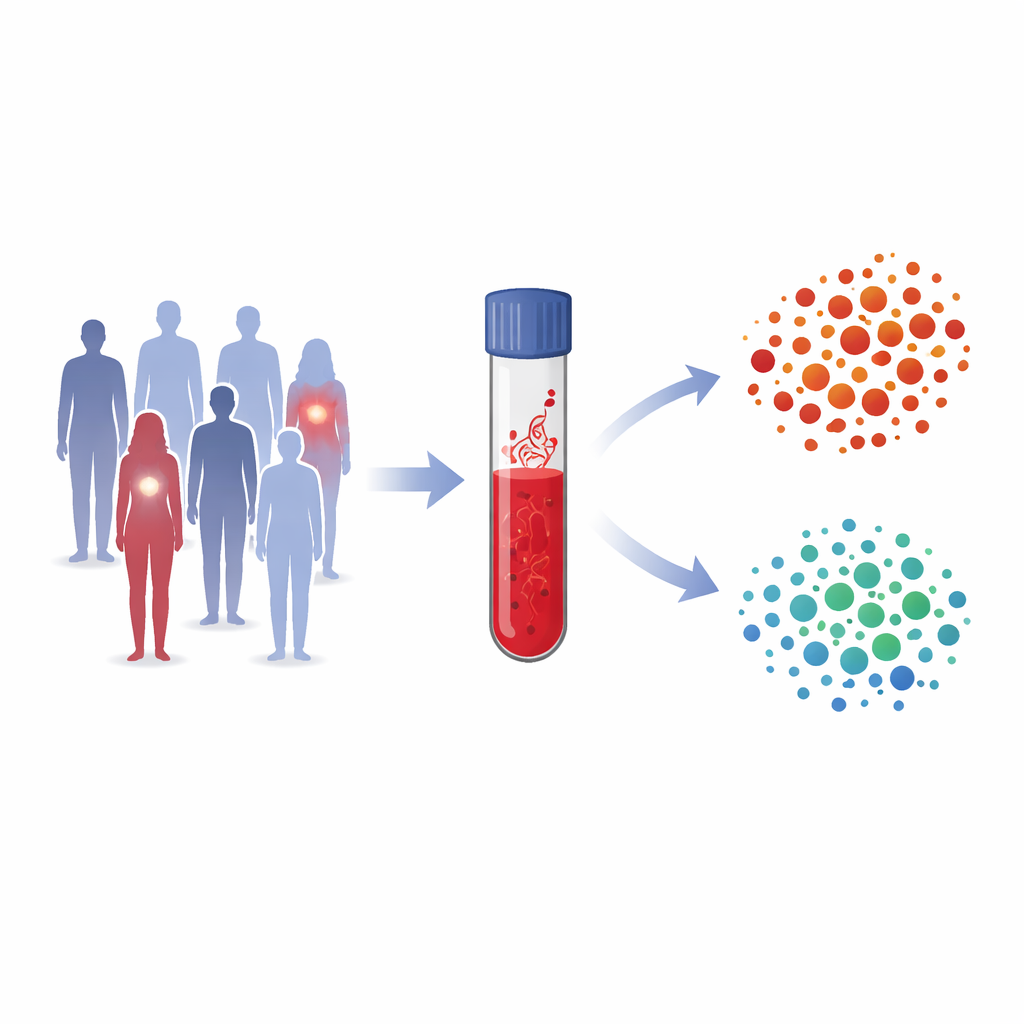
When the researchers compared groups of cancer patients to healthy controls, they did see clear differences in cfRNA profiles. For every cancer type, some RNAs were more abundant and others less so, suggesting that cancer disrupts the body’s RNA landscape. Blood cancers such as acute myeloid leukemia, and liver tumors in particular, left strong footprints: leukemia samples showed fusion transcripts known to occur only in tumor cells, and liver cancer samples carried liver-specific RNA signatures. But for most solid tumors, the signals were far more diluted and mixed with background contributions from healthy organs and blood cells. Even within the same cancer type, the exact RNAs that differed from controls changed widely between cohorts and individual patients.
A Systemic Immune Signal, Not Just Tumor Echoes
By probing which biological pathways and cell types were reflected in cfRNA, the study found that many shared changes were systemic rather than strictly tumor-derived. Across most cancers, immune-related RNAs and blood-cell markers were consistently lower, hinting at the widespread immune disturbances seen in people with advanced disease. Other pathways associated with tissue remodeling, blood vessel growth, and cell movement tended to be higher, echoing known hallmarks of cancer progression and metastasis. Still, the overlap in specific RNAs between independent cohorts was modest, underscoring how difficult it is to build a single universal gene list that robustly separates all cancer patients from all controls.
Zooming In on Each Patient’s Outlier Genes
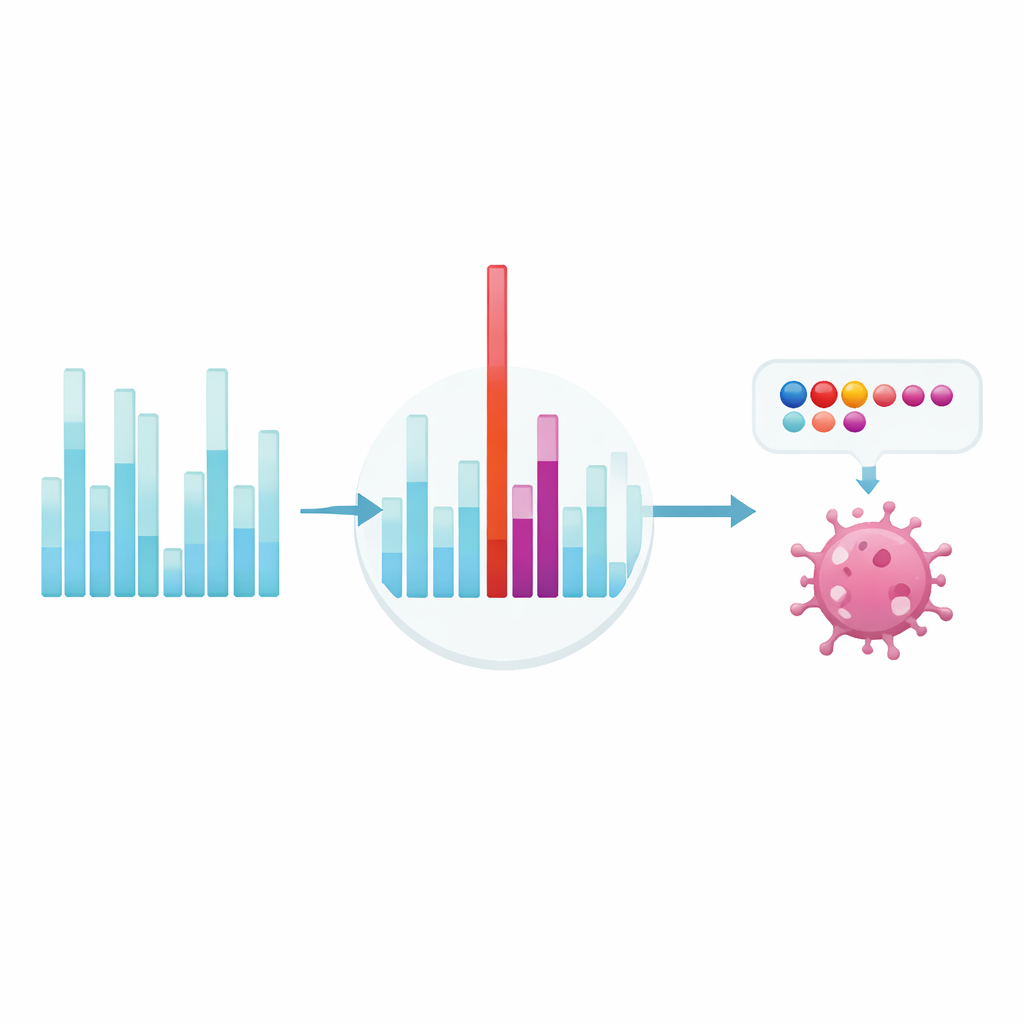
Faced with this heterogeneity, the authors flipped the usual logic. Instead of asking, “Which RNAs differ on average between cancer and control groups?”, they asked, “For this one person, which RNAs look unusually high or low compared with a large reference group of healthy samples?” For each individual, they calculated how far every RNA’s level sat from the normal range and flagged extreme outliers—those more than three standard deviations away—as “tail genes.” A simple count of these tail genes turned out to be surprisingly powerful: cancer patients consistently had more such outliers than healthy donors. Many of these genes would not have appeared in traditional group-level analyses, revealing rare but meaningful disruptions that are unique to a subset of patients.
Using Tail Genes as a Cancer Flag
The researchers then selected a subset of tail genes that were statistically linked to cancer status, calling them “biomarker tail genes.” Using only the number of these biomarker tail genes per sample, they built very simple classifiers that labeled samples as cancer or control. In multiple independent cohorts—including prostate cancer, lymphomas, and even bladder cancer detected from urine—this approach showed high accuracy, often with strong sensitivity and specificity. For prostate cancer, a fixed threshold in one large plasma cohort correctly classified all patients and all healthy male controls in an internal validation set. Tests in people with non-cancer illnesses showed some false positives, especially in serious inflammatory conditions, but the vast majority of non-malignant cases were correctly recognized as non-cancer, and benign prostate enlargement did not trigger a cancer-like pattern.
What This Means for Future Cancer Blood Tests
To a lay reader, the key message is that rather than hunting for a single “cancer gene signature” that fits everyone, this study suggests a different strategy: measure how much an individual’s RNA pattern breaks away from what is normal in a large, well-characterized healthy population. The more strongly deviating RNAs a sample contains, the more likely it is that cancer is present. This patient-centered, deviation-based view appears to handle the messy reality that cancers and people are highly diverse. While the work is still at an early stage and will require larger, standardized, multi-center studies before clinical use, it points toward a future where a routine blood or urine test might quietly tally up a person’s tail genes and flag those whose molecular patterns warrant closer examination.
Citation: Morlion, A., Decruyenaere, P., Schoofs, K. et al. Patient-specific alterations in blood plasma cfRNA profiles enable accurate classification of cancer patients and controls. Commun Med 6, 230 (2026). https://doi.org/10.1038/s43856-026-01507-8
Keywords: cell-free RNA, liquid biopsy, cancer detection, blood biomarkers, personalized oncology