Clear Sky Science · en
Epidemiological impacts of nonpharmaceutical interventions are modulated by immunity exposure trade offs
Why everyday precautions still matter
The pandemic taught many people about masks, ventilation, and keeping distance, but as emergency rules fade, a big question remains: do these precautions still help in the long run, once a virus like SARS-CoV-2 has become a regular visitor? This paper explores how everyday protections and vaccination interact with our immune systems over time, and asks whether lowering the amount of virus we breathe in can permanently cut down infections, even when the virus is very contagious. 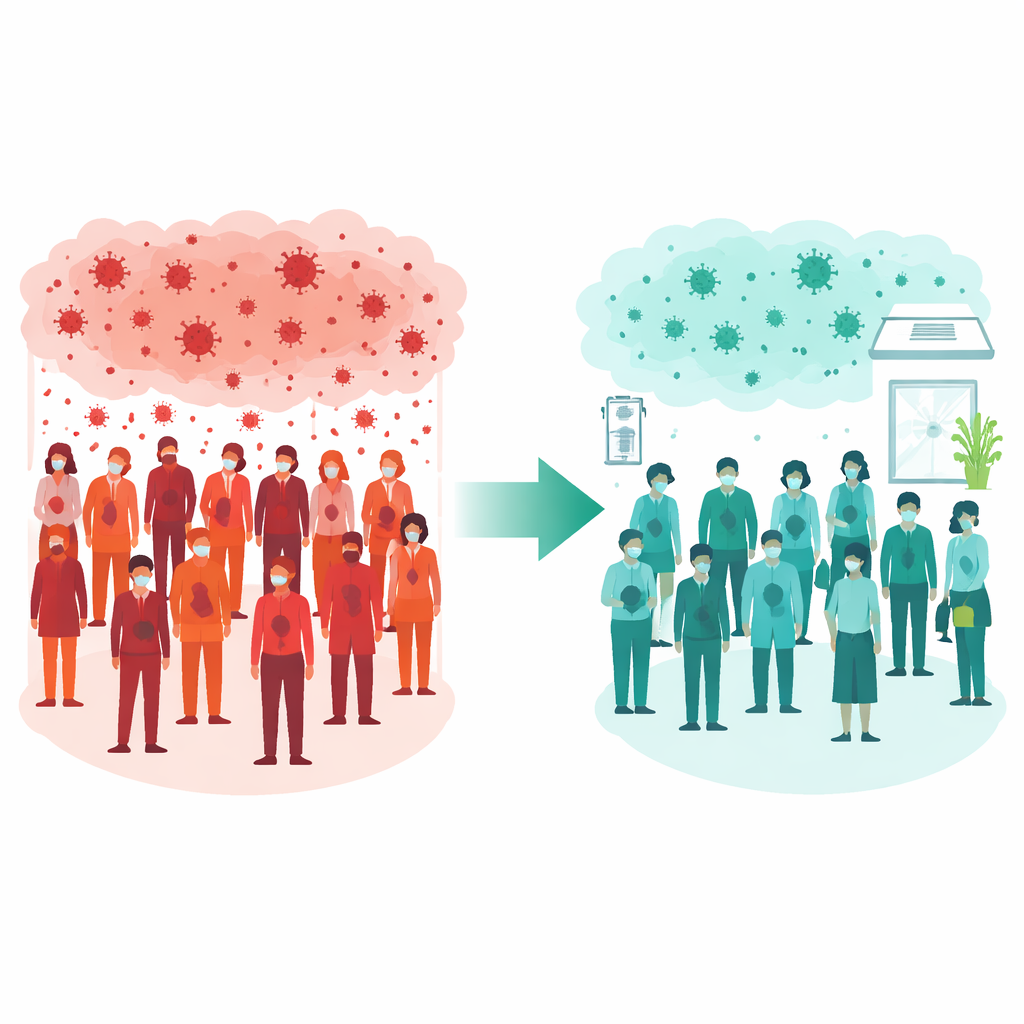
How infection risk depends on dose
The authors build on new evidence that people who have some immunity—either from past infection or vaccination—are not simply “protected” or “unprotected.” Instead, their chance of getting sick again depends on how much virus they encounter. High doses can punch through their defenses and cause infection, while low doses may be safely handled by the immune system. This “dose-dependent” risk is different from the older view, where people were either fully immune for a while or just as vulnerable as before, and it opens the door to extra benefits from measures that trim exposure without stopping it completely.
A simple model of a complex system
To study these ideas, the researchers use a mathematical model that tracks several groups in a population: people who have never been infected or vaccinated, those in a first infection, those fully protected right after recovery or vaccination, people whose protection has waned to a partial level, and those in later ("secondary") infections. Non-drug measures like masking or cleaner indoor air are represented as a reduction in how easily the virus moves from person to person. Crucially, in the model, this reduction in exposure can also change what happens to people with partial immunity—for example, how likely they are to be reinfected, how long they stay infectious, and how easily they pass the virus on.
What happens when exposure goes down
Using this framework, the team explores what the long-term “steady state” of infections looks like under different conditions. Earlier work suggested that for very contagious viruses, cutting transmission with nonpharmaceutical interventions (NPIs) mostly helps in the short term and has little effect once the virus settles into an endemic pattern. Here, when dose-dependence is included, the story changes. Even in high-transmission settings, long-term use of NPIs can lead to much lower infection levels, because lower exposure both reduces the chance that partially immune people are reinfected and, in some scenarios, shortens or softens those repeat infections. The stronger the link between lower exposure and better immune control, the larger the benefit.
Vaccines and better immunity over time
The model also examines how vaccines fit into this picture. Standard vaccines that give only short-lived protection against infection still help by shrinking the pool of people who can become infected. But vaccines that offer longer-lasting and broader protection—against many variants—have an outsized effect. When such vaccines are combined with steady NPI use, the model suggests that infection levels can fall dramatically and, in some cases, local elimination becomes possible. The benefits grow even more if lower exposure not only makes reinfection less likely, but also causes shorter or less contagious repeat infections among those who do get sick. 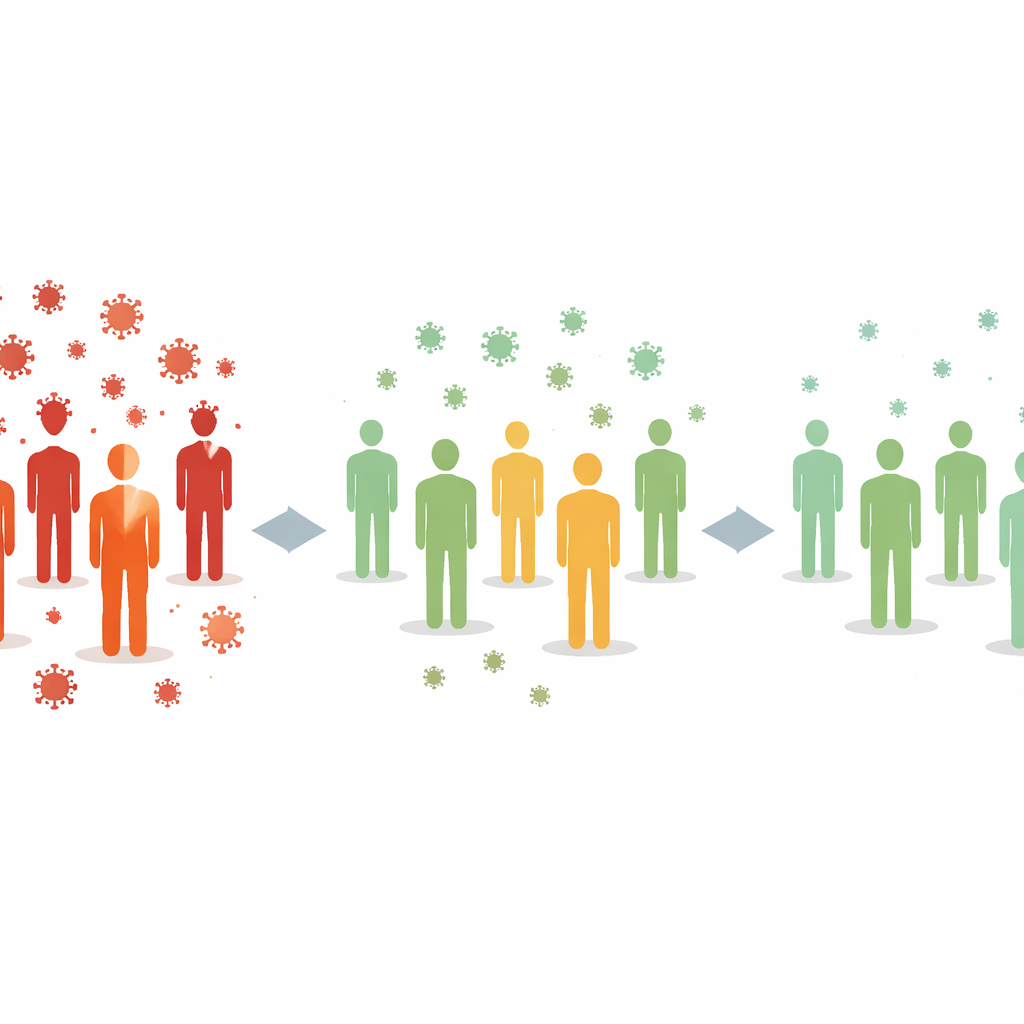
What it means for future public health
For a layperson, the main message is that everyday protections and vaccines do more than just delay infection waves; they can reshape the long-term balance between viruses and our immune systems. If the chance and severity of reinfections truly depend on how much virus people encounter, then cleaner air, better masks, and other exposure-reducing steps can permanently lower the overall burden of disease, especially when paired with widely used, durable vaccines. The authors argue that to turn this insight into precise guidance, we now need careful studies that measure how exposure levels, immunity, and repeat infections interact in real life.
Citation: Saad-Roy, C.M., Nielsen, B.F., Lind, M.L. et al. Epidemiological impacts of nonpharmaceutical interventions are modulated by immunity exposure trade offs. Commun Med 6, 262 (2026). https://doi.org/10.1038/s43856-026-01492-y
Keywords: nonpharmaceutical interventions, dose-dependent infection, COVID-19 immunity, endemic transmission, vaccination strategies