Clear Sky Science · en
Synergistic elastase and papain injury drives abdominal aortic aneurysm formation and rupture in mice
When a Hidden Bulge Becomes Deadly
Deep in the abdomen, the body’s main highway for blood can slowly balloon outward without causing any pain. This condition, called an abdominal aortic aneurysm, may go unnoticed for years but can suddenly burst, leading to massive internal bleeding and often death. Doctors know some of the risk factors—age, smoking, and high blood pressure—but still lack drugs that can reliably stop these dangerous bulges from growing or rupturing. The study in this paper introduces a refined mouse model that closely mimics how these aneurysms form and rupture in people, providing a powerful new testing ground for future treatments.
Why Scientists Need Better Animal Models
To understand and treat aneurysms, researchers rely heavily on laboratory animals, especially mice. Existing mouse models can make the aorta enlarge, but they often miss key hallmarks of the human disease: the correct location in the vessel, realistic growth over time, formation of internal blood clots, and, crucially, frequent ruptures. Some models create damage only where a chemical touches the vessel wall, while others cause tears higher up in the chest rather than in the lower abdominal segment where most human aneurysms occur. These mismatches can help explain why drugs that look promising in animals have repeatedly failed to protect patients. The authors set out to build a model that reproduces the anatomy, biology, and danger of human aneurysms far more faithfully.
Combining Forces to Damage the Artery
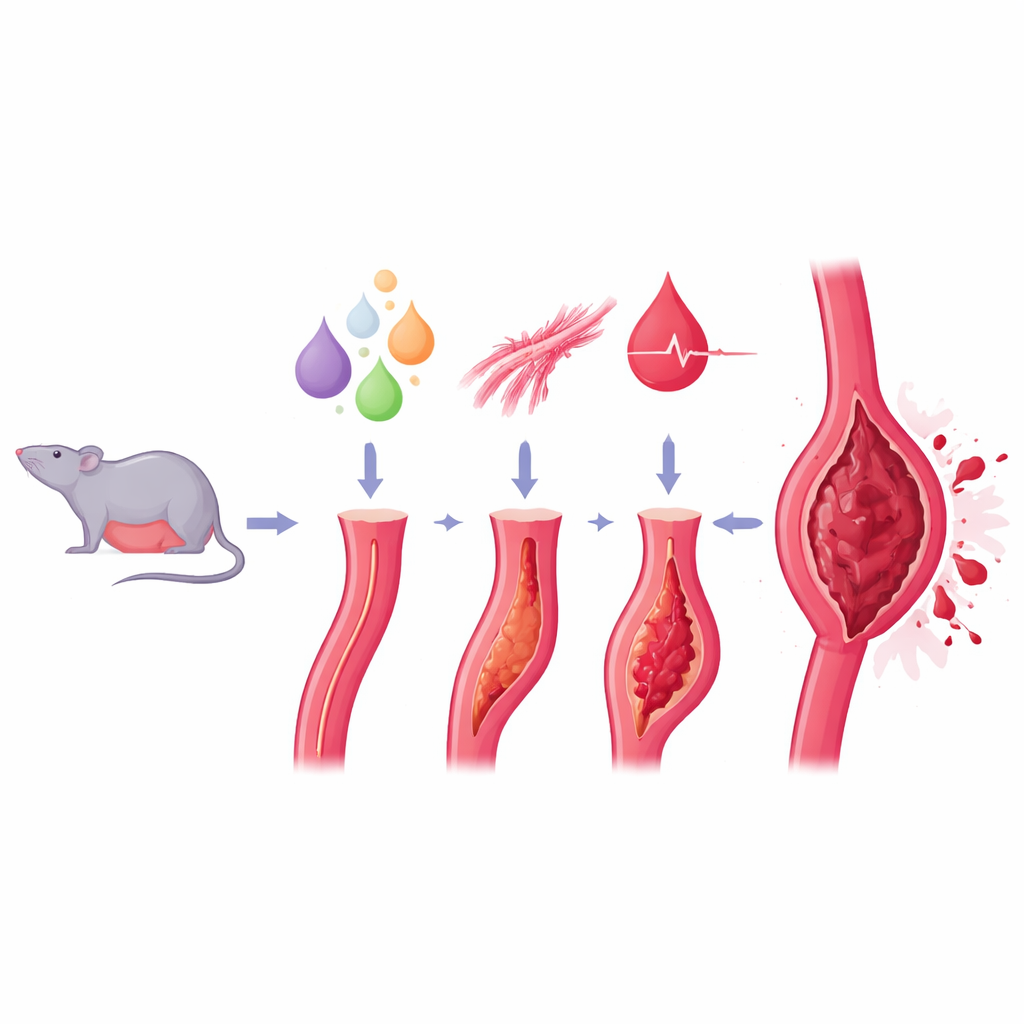
The team focused on four agents already used separately in aneurysm research, but rarely combined. Two of them—pancreatic elastase and papain—are enzymes that chew up elastin, a stretchy protein that helps the artery withstand each pulse of blood. A third compound, beta-aminopropionitrile, weakens collagen, another structural protein that keeps the vessel stable. The fourth, angiotensin II, is a hormone that raises blood pressure and stirs inflammation. In their experiments, the researchers briefly soaked the outer surface of the lower abdominal aorta in one or both enzymes in anesthetized male mice, then in some groups supplied the collagen-weakening drug in drinking water and implanted tiny pumps that steadily released the blood‑pressure hormone under the skin.
From Early Swelling to Chronic Disease
Within two weeks, mice exposed to either enzyme alone or the new combination of both had noticeably widened aortas with inflamed, fraying walls. Microscopic studies showed that the elastic layers that normally form neat, dark bands had become shredded, and proteins that break down tissue—known as matrix metalloproteinases—were strongly activated. When the researchers continued the experiment for six weeks and added the collagen-weakening compound, the aneurysms became dramatically larger, roughly five times their original diameter. Many of these bulges developed intraluminal thrombus, a clot-like mass inside the vessel that is very common in human aneurysms and influences how stress is distributed on the fragile wall.
Pushing the Vessel to the Breaking Point
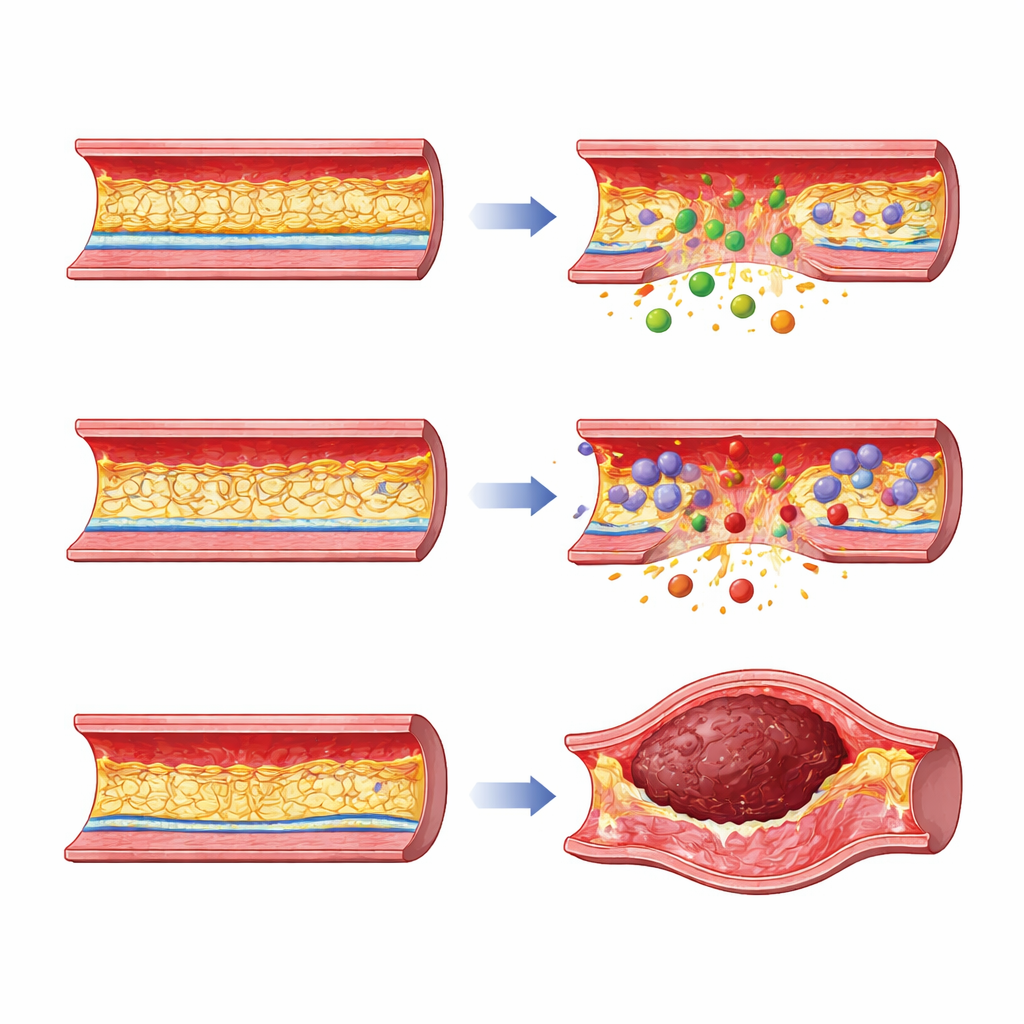
To study actual ruptures, the scientists combined all four factors: the two elastin‑digesting enzymes on the outside of the artery, collagen weakening in the drinking water, and chronic angiotensin II infusion. Under these conditions, the novel elastase–papain pairing produced an astonishing 93 percent rupture rate in the targeted lower abdominal segment, far exceeding the rupture rates of older models. Before the vessels burst, their walls were flooded with inflammatory cells and chemical messengers such as IL‑1β and IL‑6, alongside a surge in the same tissue‑eating enzymes that had already been linked to human aneurysm progression. Importantly, the damage remained focused on the intended stretch of the aorta, with no tears or dissections in the chest region, making the outcome much closer to what surgeons see in the clinic.
What This Means for Patients
For people living with an abdominal aortic aneurysm, the central question is whether and when the swollen artery will rupture. Direct studies in humans are limited, but this new mouse model reproduces many of the crucial features: location below the kidney arteries, gradual enlargement, internal clot formation, intense inflammation, and a high likelihood of rupture. By providing a more realistic stage on which to watch the disease unfold, the model should allow researchers to test new drugs, explore why certain immune signals and tissue‑breaking enzymes become so destructive, and evaluate ways to strengthen the vessel wall before it fails. While it does not yet translate into an immediate therapy, it brings science a step closer to predicting and preventing catastrophic aneurysm bursts.
Citation: Elizondo-Benedetto, S., Zaghloul, M.S., Arif, B. et al. Synergistic elastase and papain injury drives abdominal aortic aneurysm formation and rupture in mice. Commun Med 6, 217 (2026). https://doi.org/10.1038/s43856-026-01485-x
Keywords: abdominal aortic aneurysm, mouse model, artery rupture, vascular inflammation, aneurysm treatment research