Clear Sky Science · en
Spatial navigation as a digital marker for clinically differentiating cognitive impairment severity
Why losing your way can be an early warning sign
Many people think of memory lapses as the first hint of dementia, but trouble finding one’s way around can appear even earlier. This study explores whether a simple tablet game that measures our sense of direction could act as an early warning system for Alzheimer’s disease and related conditions, making brain health checks quicker, more engaging, and easier to deliver at scale.
A game-like test with serious goals
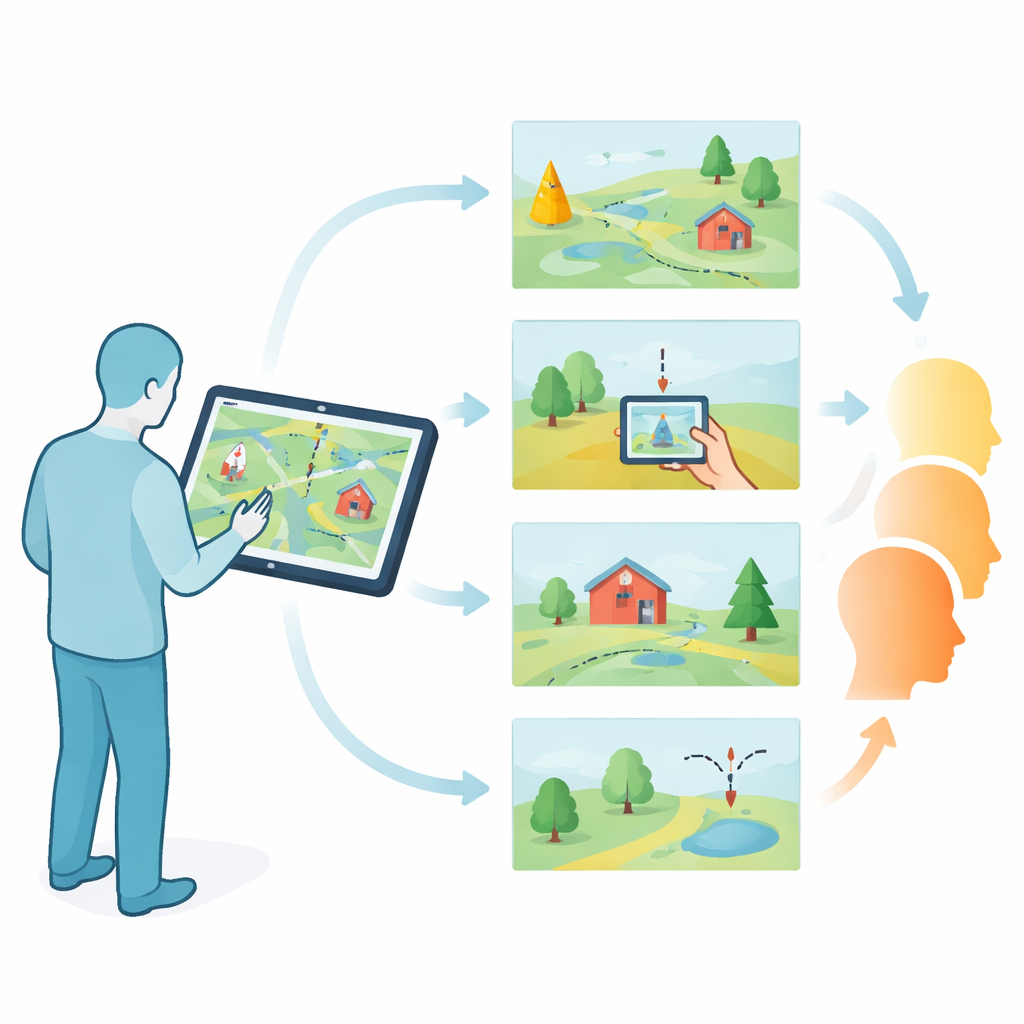
The researchers developed the Spatial Performance Assessment for Cognitive Evaluation, or SPACE, a tablet-based “serious game” in which players become astronauts exploring a small virtual planet. Using touch controls, participants learn the locations of a rocket and several landmarks, then complete five short navigation challenges. Some require walking an invisible triangle and finding the way back to the rocket, others ask players to point toward unseen landmarks, rebuild the map from memory, remember which objects appeared where, or judge directions from an imagined viewpoint. Although it looks playful, each task taps brain systems heavily involved in early Alzheimer’s disease, especially areas supporting spatial orientation and mapping of the environment.
Testing hundreds of older adults
To see how well SPACE reflects real clinical status, the team tested 300 people aged 50 and older from memory clinics and the wider community in Singapore. Each person had already been carefully rated with the Clinical Dementia Rating (CDR) scale, which classifies cognitive impairment from no dementia through questionable, mild, and moderate-to-severe dementia. Participants also completed standard paper-and-pencil and interview-based tests of memory, attention, and thinking, as well as answering questions about their health, mood, and daily habits. This allowed SPACE scores to be compared directly with widely used diagnostic tools and with a full professional work-up.
Navigation performance mirrors dementia severity
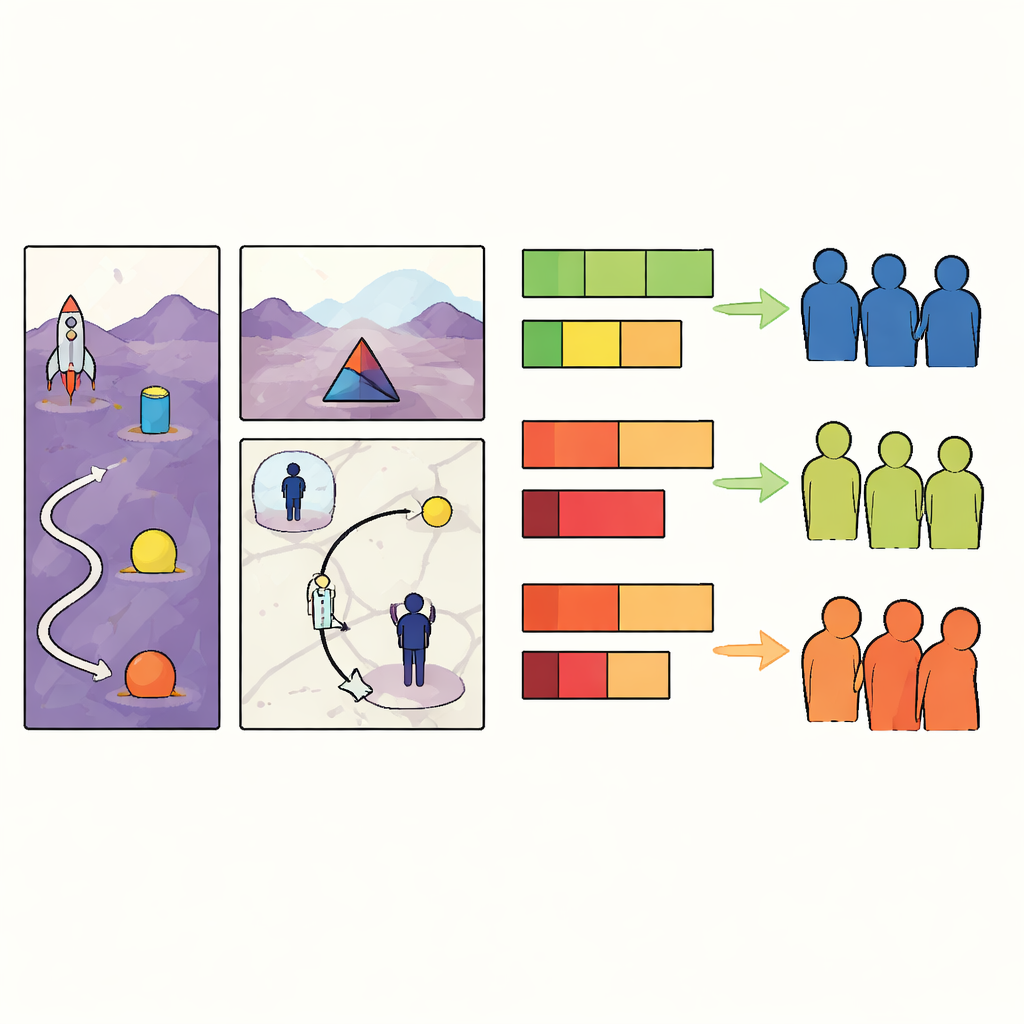
The study found clear patterns: people with more severe cognitive impairment took longer to master the basic training movements, made larger errors when trying to return to the rocket after following a path, and struggled more when judging directions from imagined viewpoints. These three measures—training time, path integration accuracy, and perspective taking—were especially powerful at separating groups. When combined with simple demographic information like age, they sharply improved the ability to tell apart no dementia from mild dementia, and questionable from mild dementia. In statistical terms, adding SPACE increased the overall accuracy measure known as the Area Under the Curve from around 0.70–0.80 to above 0.90 for most of these comparisons, with both sensitivity (catching true cases) and specificity (avoiding false alarms) staying high.
Shorter tests that still work well
Because long clinic visits can be tiring and expensive, the researchers also asked whether a trimmed-down version of SPACE could perform nearly as well. They focused on the quickest yet most informative parts: the training phase and the perspective-taking task. This “short SPACE” took under 11 minutes to complete—about 40% faster than the full battery—yet it still distinguished people without dementia from those with mild dementia almost as accurately, and did a good job separating questionable from mild cases. Repeating the analyses using cross-validation methods, which simulate how the test would perform on new patients, confirmed that both the full and short versions are robust rather than overfitted to this particular sample.
How this stacks up against traditional testing
SPACE was also compared directly with well-known clinic tools such as the Montreal Cognitive Assessment, trail-making and maze tests, and measures of attention and verbal fluency. Its performance was equal to or better than most of these, especially for the subtle but clinically important step from very mild to mild dementia. Only one broad screening test consistently matched or exceeded SPACE, and that tool is longer and less suited to remote use. Because SPACE is engaging, touch-based, and scenario-driven, it may be easier to administer repeatedly or outside specialist clinics, for example at home or in community centers.
What this means for everyday life
The work suggests that carefully designed digital navigation games can serve as sensitive markers of early cognitive change, capturing problems in “inner GPS” systems before they show up in traditional memory tests. While SPACE is not intended to replace full medical evaluations, it could become a fast, scalable first-line screen that flags people who should be seen by a specialist, easing pressure on healthcare services and reaching those who might otherwise go unchecked. In simple terms, how confidently someone can find their way in a virtual world may offer an accessible window into the health of their real-world brain.
Citation: Colombo, G., Minta, K., Taylor, W.R. et al. Spatial navigation as a digital marker for clinically differentiating cognitive impairment severity. Commun Med 6, 228 (2026). https://doi.org/10.1038/s43856-026-01484-y
Keywords: spatial navigation, digital dementia screening, Alzheimer’s disease, tablet-based cognitive tests, early cognitive impairment