Clear Sky Science · en
Best cochlear locations for delivering interaural timing cues in electric hearing
Finding Sound in Everyday Life
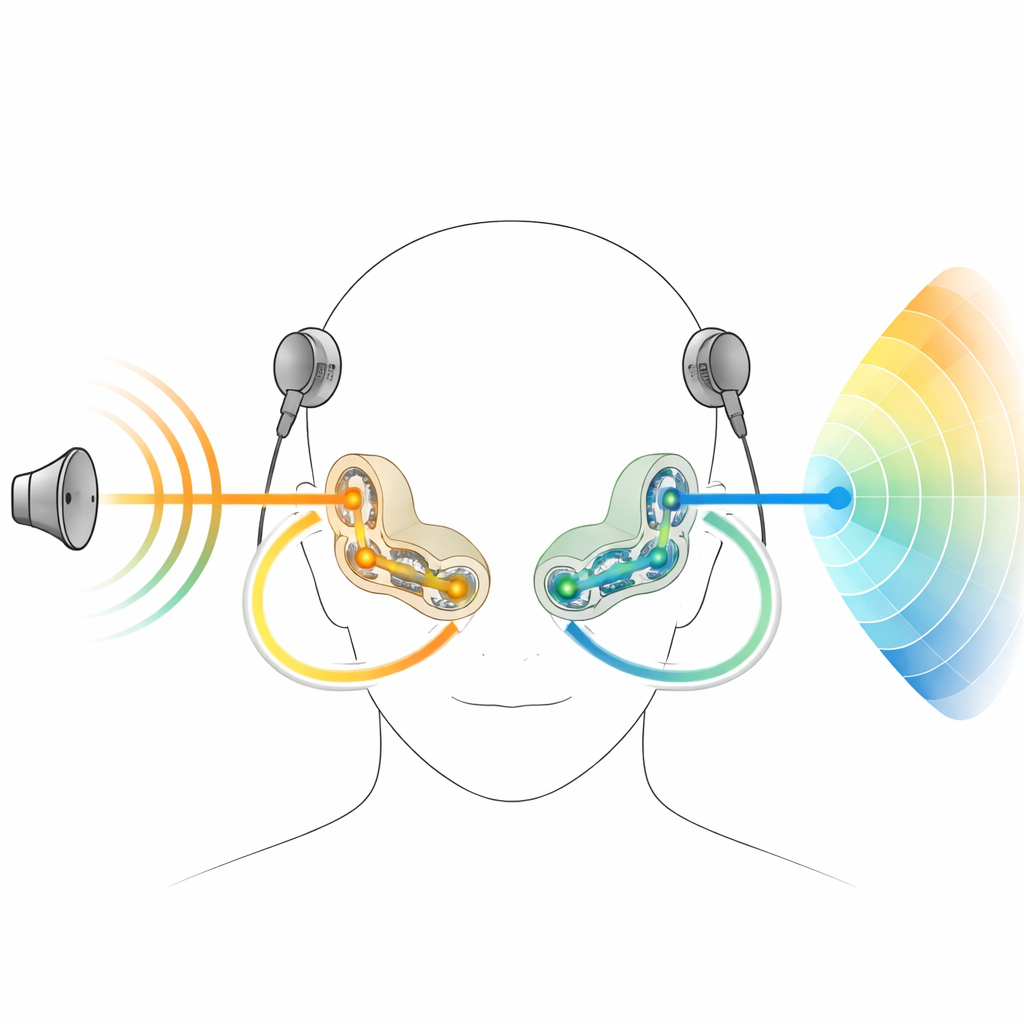
For people who use cochlear implants in both ears, following a friend’s voice in a noisy café or figuring out where a honking car is coming from can be surprisingly hard. Our brains normally compare tiny differences in the timing of sounds arriving at each ear to pinpoint where a sound comes from. Today’s cochlear implants, however, are not very good at restoring these delicate timing cues. This study asked a simple but important question: if we carefully choose where along the inner ear’s implant we send timing information, can we help users of two cochlear implants tell where sounds are coming from more accurately?
How Two Ears Usually Work Together
In natural hearing, the brain relies on two main clues to locate sounds: differences in loudness and differences in arrival time between the ears. Louder sounds on one side tell us the sound source is closer to that ear. For lower-pitched sounds, the brain pays special attention to microsecond-level timing differences, which are encoded in the inner ear’s snail-shaped structure, the cochlea. The tip of the cochlea is especially tuned for low pitches and provides very fine timing information. In people using cochlear implants, most clinical devices focus on loudness cues and speech clarity, using very fast electrical pulses that blur these subtle timing differences between the two ears.
Why Current Implants Fall Short
Modern bilateral cochlear implants send sound to each ear with separate processors that are not tightly synchronized. That means the electrical pulses arriving in the left and right ears can drift out of alignment by hundreds of microseconds—large enough to confuse the brain’s sense of direction. To make speech easier to understand, implants also tend to use high stimulation rates across all electrodes. These high rates are good for following rapid speech changes but poor for preserving precise timing differences between ears. Earlier experiments showed that using slower pulse rates on some electrodes can improve sensitivity to timing, but the benefits vary a lot from person to person. This inconsistency suggested the need for a more individualized approach.
A Personalized Target for Timing Cues
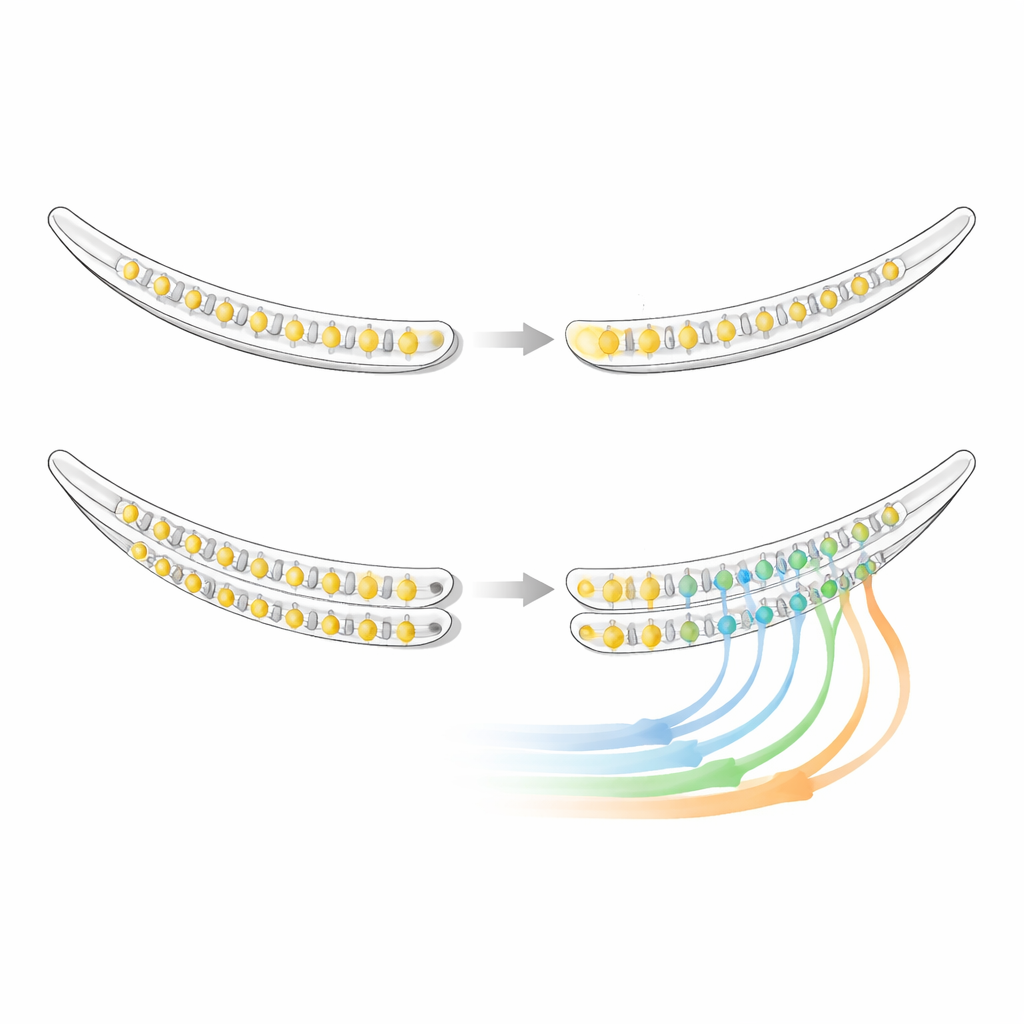
The researchers worked with 14 adults who had cochlear implants in both ears and already showed at least some sensitivity to timing differences. Using synchronized research hardware, they first measured how well each person could detect tiny timing shifts when only one pair of electrodes at a time was stimulated, sampling five locations along the implant array in each ear. From these tests, they identified for each listener a “best” electrode pair, where timing sensitivity was strongest, and a “worst” pair. They then created four listening strategies: one with only fast pulses on all electrodes; one “Interleaved” strategy with slow pulses on every other electrode; and two personalized “mixed-rate” strategies, where just a single electrode pair used slow pulses—either the best or the worst pair—while the others used fast pulses. Listeners then performed tasks that mimicked judging left–right sound position, using simple tone complexes and recorded speech-like words.
What Worked—and What Didn’t
When the sound was a steady, non-speech tone, people generally did better at judging left–right position with the Interleaved mixed-rate strategy, which used several slow-rate channels, than with any other strategy. Importantly, the personalized “Best” strategy—with just one slow-rate channel at each individual’s best electrode pair—also improved performance compared with the all-fast strategy and outperformed the “Worst” strategy. This showed that carefully choosing a single good cochlear location can indeed sharpen timing-based spatial hearing for simple sounds. However, when the signals were real recorded words, the advantage of the Best strategy mostly disappeared. Many participants’ best timing sites were toward the high-frequency end of the cochlea, where the specific speech tokens used did not always carry strong energy. As a result, the slow-rate channel at that location was not activated robustly enough over time to provide reliable timing information for speech.
Why More Than One Spot Matters
The study also looked at how factors like age at hearing loss and years living with hearing loss before receiving implants related to timing sensitivity. People who lost their hearing later in life, and who spent fewer years in a state of profound loss before implantation, tended to have better timing sensitivity across their electrode array. Regardless of history, timing performance varied along the array, and for most listeners the most timing-sensitive site was not at the low-pitch end, as in normal acoustic hearing, but instead at more basal (higher-pitch) locations. This suggests that electrical hearing does not simply copy the natural wiring of the inner ear and that optimal sites for timing cues may be found in unexpected places and differ across individuals.
What This Means for Everyday Listening
To a layperson, the main message is that one “sweet spot” in the inner ear is not enough to restore natural-like directional hearing for real-world sounds. The study shows that sending slow, precisely timed pulses to a listener’s personal best site can improve timing perception for simple tones. But speech is messy—its sound patterns jump around in pitch and time—so those timing cues need to be delivered across several effective implant sites to be consistently useful. Future cochlear implant designs and fitting strategies may therefore need to both personalize which electrodes carry timing information and spread that information across multiple regions. Done well, such mixed-rate, multi-site strategies could bring implant users closer to the effortless sense of where sounds are coming from that many hearing people take for granted.
Citation: Borjigin, A., Dennison, S.R., Thakkar, T. et al. Best cochlear locations for delivering interaural timing cues in electric hearing. Commun Med 6, 240 (2026). https://doi.org/10.1038/s43856-026-01470-4
Keywords: cochlear implants, binaural hearing, sound localization, interaural time differences, personalized stimulation