Clear Sky Science · en
Modelling of onchocerciasis-associated skin and ocular disease and the impact of ivermectin treatment
Why this matters for everyday life
River blindness is not just about losing sight; it also brings years of intense itching and disfiguring skin changes that affect work, sleep, and social life. This study asks a practical question with real-world consequences: how much do large-scale treatments with the drug ivermectin actually reduce these skin and eye problems over time, and what will that mean for millions of people still at risk across Africa?
What river blindness does to skin and eyes
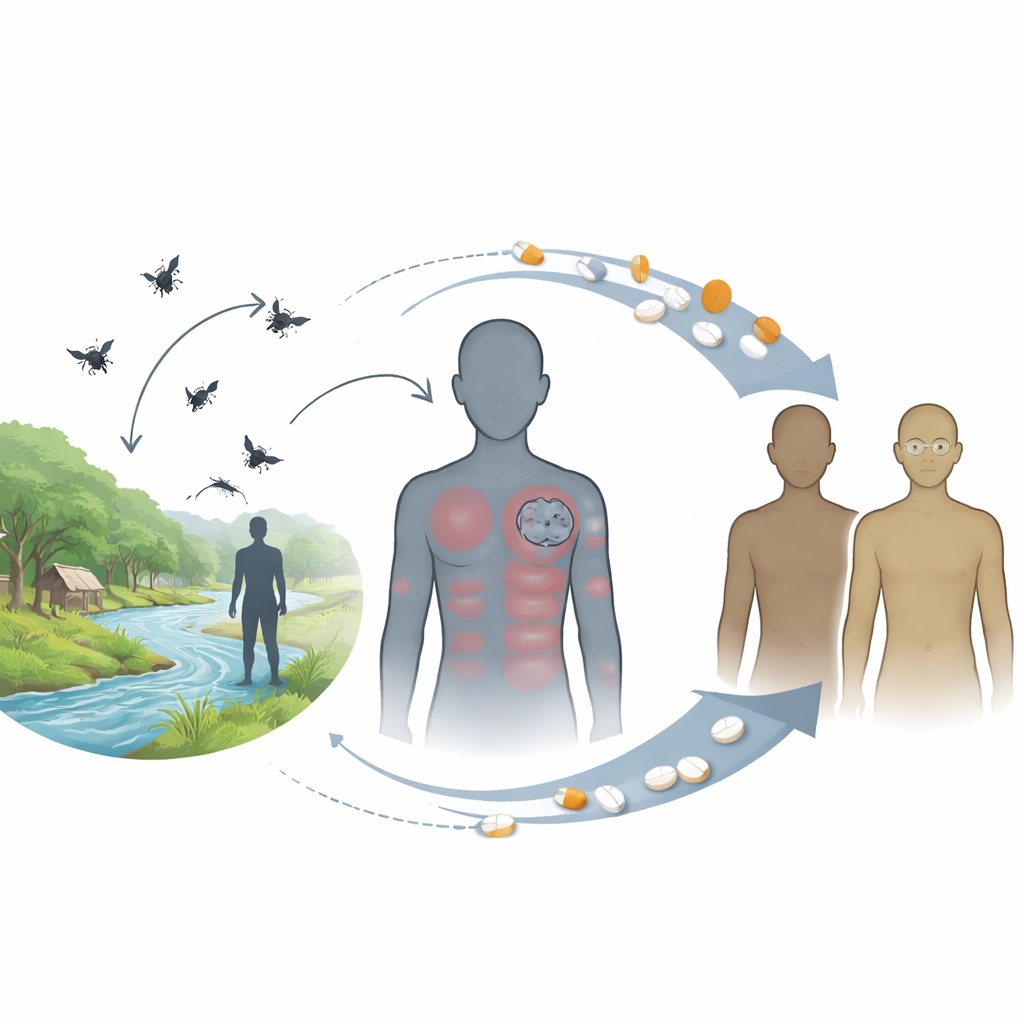
River blindness, or onchocerciasis, is caused by a parasitic worm spread by blackflies that breed along fast-flowing rivers. Once inside the body, the worms release tiny offspring that spread through the skin and sometimes into the eyes. People can develop unbearable itch, bumpy or thickened rashes, thinning and lightening of the skin, and a drooping fold of skin in the groin. When the tiny worms reach the eyes, repeated damage can slowly reduce vision and eventually lead to blindness. Even after decades of control programs, millions still live with these problems in parts of sub-Saharan Africa.
Turning patient data into a realistic virtual population
The researchers built on an existing computer model of how river blindness spreads between people and blackflies, called EPIONCHO-IBM. They added new components that translate infection into visible disease in the skin and eyes. To do this, they drew on large surveys carried out in the late 1980s and early 1990s in northern Nigeria and several West African countries, before mass drug treatment began. These surveys recorded, by age, who had the parasite in their skin, who had severe itch or different types of skin damage, and who had reduced vision or blindness. Using these data, the team estimated daily chances that an infected person would develop short-lived problems such as severe itch or reactive rashes, and long-lasting problems such as skin thinning, loss of skin color, hanging groin, or blindness.
Tracking disease across ages and communities
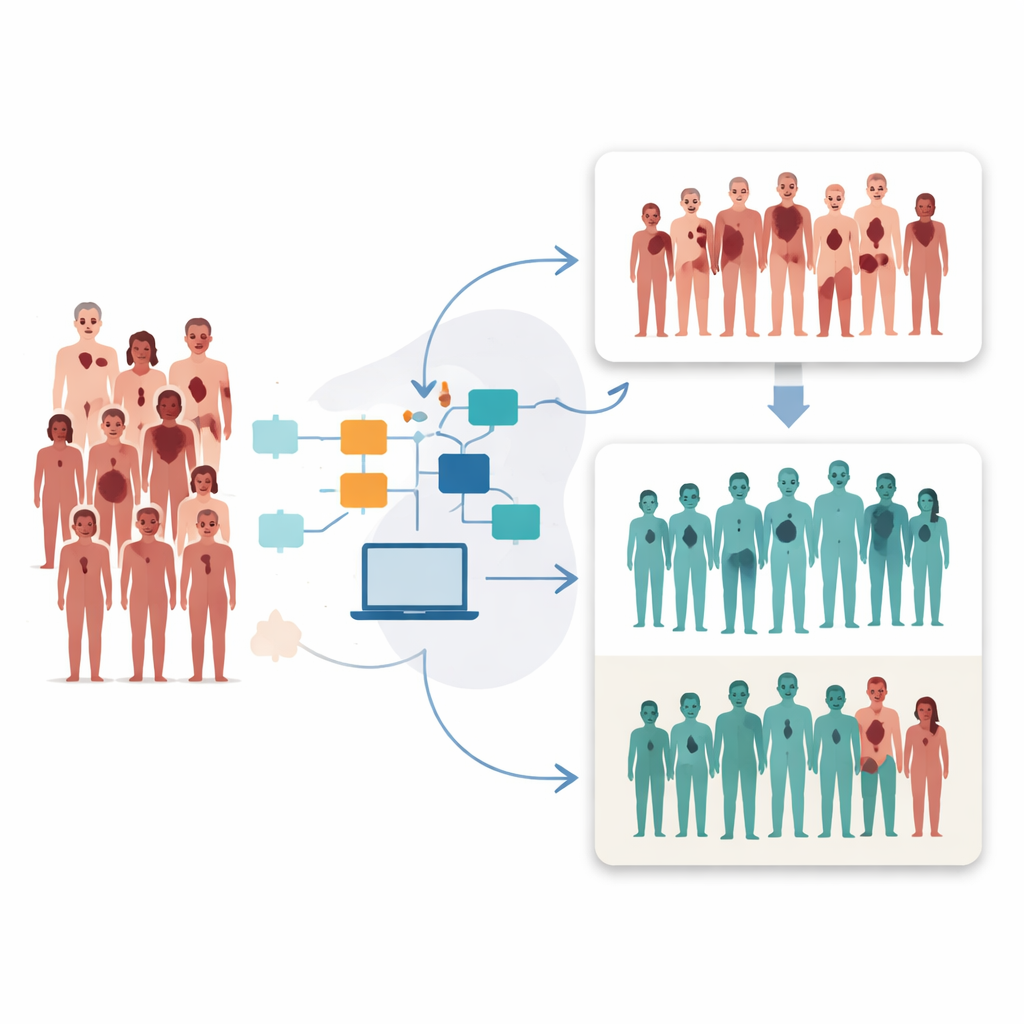
With these ingredients, the model creates a “virtual village” of about 2,000 people, each with their own level of exposure to blackfly bites and their own infection history. It then tracks, year by year, how many show each type of skin or eye problem at different ages. When the team compared these simulated age patterns with the original field data, they found that the model reproduced most of the observed trends. Reversible problems such as itch and reactive rashes rose quickly in childhood and early adulthood, echoing the rise in infection. Long-term changes, such as thinning skin, loss of skin color, hanging groin, and blindness, climbed steadily with age. The model did, however, underestimate some severe skin damage in the oldest adults.
What happens when mass treatment is added
The study then asked how years of ivermectin mass drug administration change these pictures. The researchers mimicked real treatment programs in Cameroon, Nigeria, Sudan, Uganda, and the Central African Republic, using reported coverage levels and patterns of people who never take the drug. In many settings, the model matched the observed drop in infection and captured broad declines in severe itching and some irreversible skin problems. But it tended to predict slower or smaller improvements in reactive rashes and blindness than actually reported in follow-up surveys. In some villages, the real-world data showed little or no fall in infection despite several treatment rounds, highlighting that local program performance can strongly shape outcomes.
How this helps plan the end of river blindness
By weaving realistic skin and eye outcomes into transmission modelling, this work brings river blindness projections closer to what patients actually feel and see. The authors conclude that such enriched models can improve estimates of the true burden of disease and help compare the value of different strategies, such as changing how often ivermectin is given or introducing newer drugs. Although the model still needs refinements—especially around long-term skin damage, blindness, and early death—it offers a more human-centered way to judge progress toward eliminating river blindness and reducing its lifelong impact.
Citation: Dixon, M.A., Ramani, A., Walker, M. et al. Modelling of onchocerciasis-associated skin and ocular disease and the impact of ivermectin treatment. Commun Med 6, 198 (2026). https://doi.org/10.1038/s43856-026-01464-2
Keywords: river blindness, ivermectin, mathematical modelling, skin disease, vision loss