Clear Sky Science · en
Predicting rates of cognitive and functional decline in Alzheimer’s disease and mild cognitive impairment
Why this matters for families facing dementia
Dementia does not follow a single script. Some people lose memory and independence quickly, while others change more slowly. For families trying to plan care, money, and living arrangements, this uncertainty can be frightening. This study explores whether information that clinics already collect during checkups can be used to give people with Alzheimer’s disease or mild cognitive impairment, and their clinicians, a clearer picture of how thinking and day-to-day abilities are likely to change over the next year.
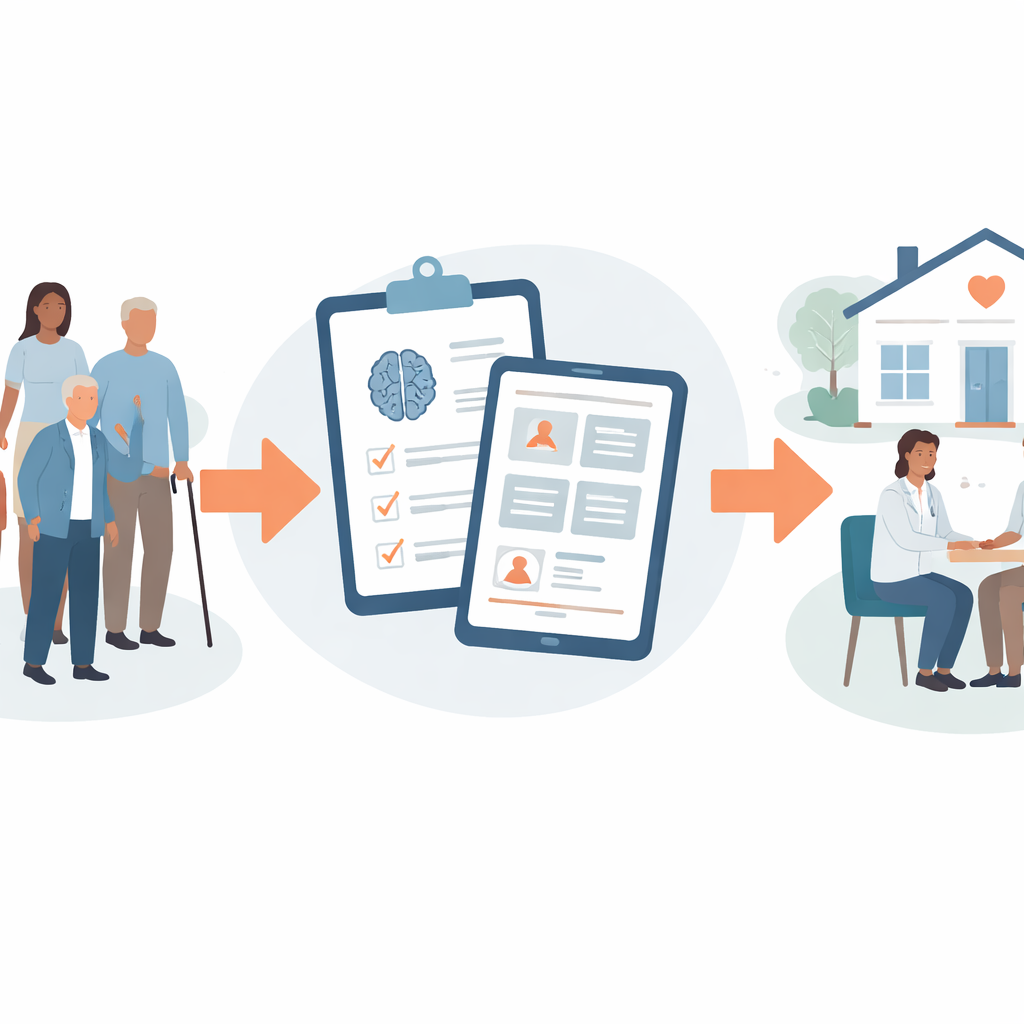
Turning everyday clinic visits into forecasts
The researchers followed a group of people in the United Kingdom who had either Alzheimer’s disease or mild cognitive impairment. Over several years, these participants regularly completed three kinds of simple tests: short questions that probe memory and orientation, more detailed tasks that probe language and problem-solving, and questionnaires about how independently they manage everyday activities like dressing, cooking, and handling money. Alongside these, basic details such as age, sex, and other medical conditions were recorded. Instead of relying on expensive brain scans or spinal fluid tests, the team deliberately focused on this kind of routine, low-cost information that is available in most memory clinics, including in settings with limited resources.
Teaching computers to follow individual paths
Using 153 one-year “trajectories” of test scores from the UK cohort, the team trained machine-learning models to predict where a person’s scores would be 12 months after a baseline visit. One model focused on thinking ability, using a widely known screening test; the other focused on independence in daily life. The models looked not only at the overall test scores, but also at the pattern of strengths and weaknesses across specific questions, such as recalling words, understanding spoken language, or preparing food. The researchers tried several types of algorithms and used rigorous cross-checking to avoid overfitting to this relatively small dataset.
How well the forecasts worked
The best-performing models were a type of advanced linear model that balances simplicity with flexibility. For thinking ability, predictions were usually within about two points of the actual score one year later, both in the UK group and in a much larger, independent set of 741 one-year trajectories from an international Alzheimer’s research project. For daily functioning, the model was typically within about four points on a scale that measures independence in tasks such as dressing, shopping, and managing finances. The models also highlighted which baseline abilities were most informative. Problems with planning and carrying out actions, staying oriented, and remembering words were especially telling for future thinking decline, while difficulty with food preparation, money management, and dressing signaled steeper loss of independence.
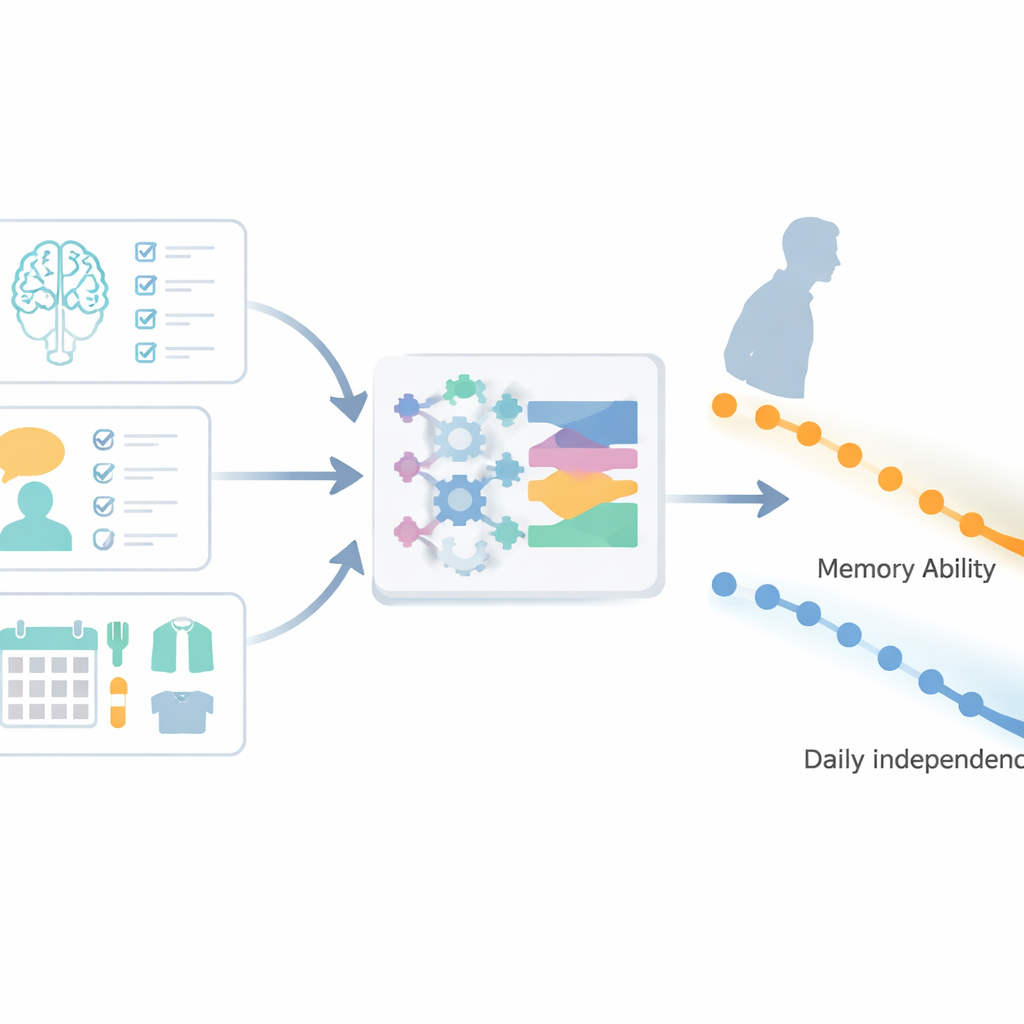
What drives decline in daily life
By examining the internal workings of the models, the researchers found that changes in thinking often foretold later changes in everyday function. Detailed cognitive tests, particularly those probing word recall and recognition, helped predict who would struggle more with daily tasks a year later. In contrast, information about other long-term health problems added little to the forecasts in this one-year window, at least when grouped in broad disease categories. Age also played a role in predicting future loss of independence. Importantly, the study showed that total scores alone were less informative than the finer-grained pattern within each test, reinforcing the idea that not all forms of cognitive difficulty carry the same risk for rapid decline.
A new kind of planning tool for clinics
To make their work useful at the bedside, the team built a prototype decision-support app, called Theia, that runs these prediction models in the background. Clinicians can enter a person’s routine test scores, age, sex, and medical history, and receive estimated thinking and daily functioning scores one year ahead. The app also produces simple visual explanations that show which aspects of a person’s current abilities are pushing the prediction toward faster or slower decline. This transparency is meant to help clinicians trust and interpret the tool rather than treat it as a “black box.”
What this could mean for people living with dementia
The study suggests that information already collected in many memory clinics can be harnessed to provide more personal, data-driven forecasts of cognitive and functional decline over the coming year. While these predictions are not perfect, they are accurate enough to help guide conversations about future care needs, safety, and financial and housing plans. Because the models rely on inexpensive, widely used assessments, they have the potential to support clinicians not only in specialist centers but also in ordinary clinics and resource-limited settings. If further validated and refined, tools like Theia could give people living with Alzheimer’s disease or mild cognitive impairment, and their families, a greater sense of preparedness and control in the face of an often unpredictable illness.
Citation: Fogel, A., Walsh, C., Fletcher-Lloyd, N. et al. Predicting rates of cognitive and functional decline in Alzheimer’s disease and mild cognitive impairment. Commun Med 6, 193 (2026). https://doi.org/10.1038/s43856-026-01432-w
Keywords: Alzheimer’s disease, dementia progression, machine learning, cognitive decline, activities of daily living